Introduction
Why Engineering Plastics Creep Under Sustained Loads
Creep Vs. Stress Relaxation: What Is the Difference?
How Applied Stress Controls Long-Term Deformation
Why Temperature Accelerates Creep in Engineering Plastics
Predicting Years of Creep from Short-Term Testing
Why Fiber Orientation and Interfaces Matter
Physical Aging and Long-Term Polymer Performance
When Creep Becomes Creep Rupture
Comparing the Creep Behavior of Common Engineering Plastics
Designing Engineering Plastic Components for Long-Term Loads
From Material Data Sheets to Service-Life Prediction
Conclusion
References
Engineering plastics can appear rigid and reliable in short tests yet continue to change for years under load, making stress, temperature, molecular structure, reinforcement, and predictive modeling central to whether a component retains its shape, strength, and function.
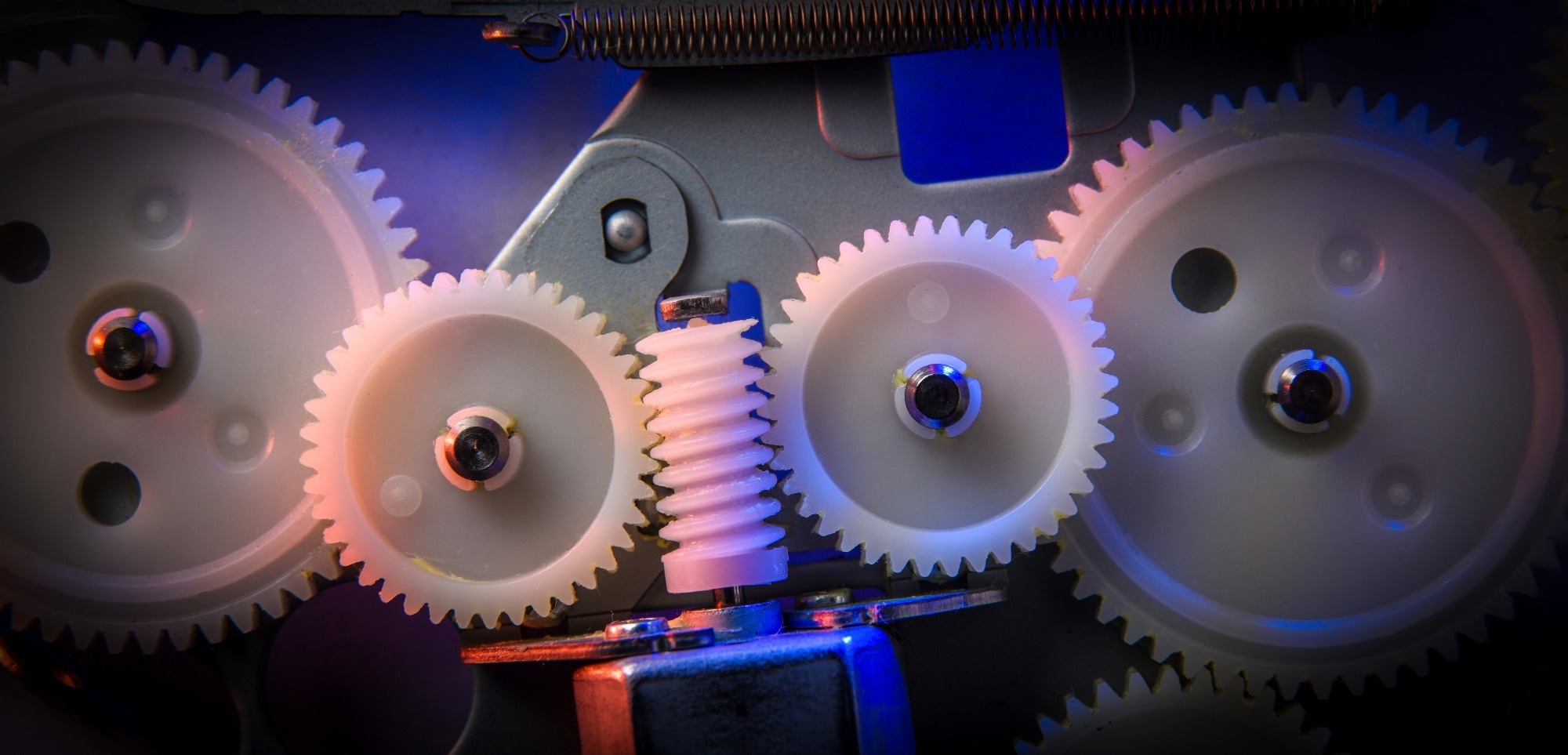
Interlocking plastic and metal gears inside a mechanical system. Image Credit: Davizro Photography / Shutterstock
Introduction
Engineering plastics now carry real structural duty. Designers specify them for gears, bearings, fasteners, snap-fit housings, brackets, and load-bearing assemblies where metal once dominated. The appeal comes from low density, corrosion resistance, quiet operation, and the freedom to mold complex geometries in a single operation. That expanding role raises a question about behavior after months of continuous service.1
The tensile strength and modulus values printed on data sheets are obtained from short tests lasting seconds or minutes. These values indicate how well a plastic can handle a quick load or pressure. But when a plastic is under sustained load, it behaves differently because it can continue to deform as long as the stress is applied.2
Two main behaviors govern the response, and both depend on elapsed time:
- Creep: The gradual deformation of a material under a constant load.2
- Stress Relaxation: It describes the decrease in stress in a component held at a constant deformation.2
Both of these behaviors arise from the time- and rate-dependent response of polymers, which may include viscoelastic and, depending on stress and temperature, viscoplastic deformation rather than simple steady “flow” of the chains.1,2 Temperature, stress magnitude, crystalline structure, fiber reinforcement, and the surrounding environment each shift the outcome.3
Why Engineering Plastics Creep Under Sustained Loads
Polymer chains are arranged in a tangled, partially ordered structure. When stress is applied, time-dependent molecular rearrangements allow deformation to continue after the initial elastic response; the rate and magnitude of this response depend strongly on molecular mobility, temperature, and material structure.1,6 As a result, deformation accumulates gradually rather than settling at a fixed value immediately.
Long-duration testing of polyamide 12 separates total strain into three contributions. Elastic strain appears immediately and reverses immediately. The viscoelastic strain develops over time and also recovers when the load is removed. In contrast, the viscous contribution in the four-element Burgers representation describes the non-recoverable component of deformation after unloading.3 Each portion responds differently to stress level and duration.
Amorphous and semicrystalline grades of polymers behave differently due to their distinct internal structures. In the polyamide systems studied experimentally, increasing crystallinity reduced molecular mobility, delayed creep, and lowered creep compliance; the crystalline domains therefore acted as restraints on deformation rather than allowing the amorphous matrix to respond freely.6 The classical primary, secondary, and tertiary creep stages describe polymers loosely, since the boundaries between them blur.
Creep Vs. Stress Relaxation: What Is the Difference?
A polymer bracket supporting a constant load demonstrates creep. Over time, as the load remains unchanged, the bracket gradually sags, resulting in a loss of dimensional accuracy over weeks. Similarly, bearings subjected to continuous radial loads exhibit this behavior, as their clearance gradually changes. While the stress remains at the level set by the designer, the strain continues to increase.3
On the other hand, a snap fit, a gasket, or a bolted plastic joint illustrates stress relaxation. During assembly, a fixed deflection is imposed, and over time the polymer gradually loses the force required to maintain that deflection. As a result, clamp loads decrease, seals may begin to leak, and retention features can become loose. Testing polyoxymethylene under constant strain for twenty hours clearly shows this decline in stress during the imposed-strain period.2 In the same study, relative stress relaxation in recycled polypropylene increased as the imposed strain increased.2
Polymer viscoelasticity and the relaxation modulus
Creep and stress relaxation are related manifestations of time-dependent polymer behavior, but their constitutive response need not be identical under all stress and strain regimes.1,2 Chain rearrangement either increases strain under fixed stress or reduces stress under fixed strain. Recovery after unloading follows a similar pattern; although the delayed elastic portion slowly returns, some permanent viscous strain remains. Experiments on POM and recycled polypropylene used four hours of zero-stress creep after unloading to characterize this recovery behavior.2
The dependence of creep on stress is not universally superlinear.7,8 Short-carbon-fiber PEEK was found to behave approximately as a linear viscoelastic material while stresses remained below its damage threshold, whereas the minimum steady-state creep rate of the tested ABS and HIPS grades showed a stress-dependent power-law response.7,8 Measurements taken at low stress therefore should not automatically be extrapolated to substantially higher stresses unless the same deformation regime has been demonstrated.7,8
Work on glass-fiber-reinforced polybutylene terephthalate quantifies that limit. The time span over which matrix creep successfully predicts composite creep shrinks exponentially as creep stress increases. Higher stress narrows the window of predictable behavior and moves the material toward conditions where the matrix-governed prediction is no longer accurate.4 For the studied PBT composites, matrix-based creep prediction was considered sufficiently accurate when initial stress did not exceed 12.5 MPa, approximately one-quarter of the neat PBT yield stress.4
Why Temperature Accelerates Creep in Engineering Plastics
Heat supplies the energy needed for polymer chain segments to move. Every rearrangement of a polymer chain requires enough thermal energy to clear a local barrier, and the population of segments able to clear that barrier grows steeply with temperature. The same applied stress therefore produces more strain in less time, and both creep and stress relaxation accelerate together.1
The glass transition temperature (Tg) is pivotal to this behavior. Below Tg, the cooperative motion of long-chain segments remains largely immobilized. However, being below Tg does not eliminate time dependence: sub-Tg polymers and polymer-matrix composites can still creep and undergo physical aging.5 As the temperature approaches Tg, increased segmental mobility can substantially accelerate creep and relaxation.1,8
Poly(ether ether ketone) (PEEK) exemplifies this trend. Creep and stress relaxation tests conducted from room temperature to 180°C reveal temperature-dependent rates associated with elastoplastic, viscoelastic, and viscoelastoplastic responses.1 Above Tg, the corresponding Arrhenius activation energies were similar, falling in the approximate range of 113-148 kJ/mol.1
Stress and temperature are interdependent. A load deemed safe at 23°C can produce unacceptable deflection at 90°C, and a temperature safe under light load can prove damaging under heavy load. For CF/PPS composites tested between 40 and 75°C, temperature-dependent shift factors shifted the creep response systematically along the time scale, demonstrating that even within a sub-Tg test range, temperature must be explicitly included in long-term predictions.5
Predicting Years of Creep from Short-Term Testing
Time-Temperature Superposition
Raising the temperature accelerates time-dependent processes that can be superposed, provided the material remains within the same viscoelastic regime.5,6,7 Time-temperature superposition (TTSP) uses that equivalence. Creep compliance curves measured at several elevated temperatures shift horizontally along the logarithmic time axis until they overlap. This forms one master curve that reaches far beyond the duration of any single experiment.6
#51 Time Temperature Superposition | Polymers Concepts, Properties, Uses & Sustainability
Work on polyamide and glass-fiber-reinforced polyamide built master curves this way, with temperature shift factors following an Arrhenius relationship above 40°C.6 The method carries boundaries. For PEEK, conventional horizontal-shift TTSP was shown to overestimate activation energies when changes in modulus and other temperature-dependent constitutive parameters were disregarded.1 More generally, superposition is most defensible where curve shapes remain compatible, and no new damage or deformation mechanism appears.5,7
Creep Models and Master Curves
Mechanical analog models turn measured curves into predictive tools. The four-element Burgers model combines a Maxwell element with a Kelvin-type parallel spring-dashpot element.3 Its spring gives instantaneous elastic strain, its free dashpot gives permanent viscous flow, and its parallel spring and dashpot pair gives delayed recoverable strain.3
PA12 creep experiments were performed for 10 and 1000 hours at stresses of 5, 10, 15, and 20 MPa, enabling evaluation of the elastic, viscoelastic/relaxant, viscous, and total strain contributions using the Burgers representation.3 Extending the fitted curves beyond the test window then rests on the assumption that no new deformation mechanism appears across the extrapolated period.
Generalized Maxwell arrangements extend this concept by incorporating multiple relaxation times.7 Constitutive viscoelastic and viscoplastic formulations tie the response to temperature and loading history. Such models feed finite element analysis, letting engineers simulate the deflection of a molded part after years of duty without testing every geometry.1,7
How Crystallinity Influences Creep Resistance
In the PA and glass-fiber-reinforced PA systems studied, crystalline domains delayed creep by reducing molecular mobility and increasing the polymer's effective resistance to time-dependent deformation.6 Raising crystallinity therefore reduced creep compliance in those materials, although the magnitude of the effect remains material- and morphology-dependent.6
Holding the polyamide materials at 250°C for different crystallization durations yielded crystallinities ranging from roughly 33% to 45%.6 This led to significant changes in creep behavior. In fact, crystallinity warranted the use of both horizontal and vertical shift factors in constructing the master curve.6 Factors such as cooling rate, mold temperature, and annealing can therefore matter insofar as they alter the crystalline state of the processed polymer.6
How Fiber Reinforcement Reduces Creep
Fiber reinforcement can reduce creep by increasing composite stiffness and transferring part of the applied load away from the time-dependent polymer matrix.4,6,7 The matrix nevertheless continues to control much of the time dependence, particularly in short-fiber composites.4,6
Fiber content sets the scale of that benefit. Polybutylene terephthalate reinforced with 20-30% glass by weight showed creep compliance governed by matrix creep and scaled down by the reinforcement. Additionally, fiber length and matrix stiffness are essential, as short fibers need sufficient embedded length to accept the transferred load.4
The cited studies demonstrate reduced or modified time-dependent response in glass-fiber-reinforced PA, short-glass-fiber PBT, CF/PPS, and short-carbon-fiber PEEK systems, while also showing that matrix creep remains active.4,5,6,7 A carbon-fiber PEEK grade holding a load at high temperature still creeps because the surrounding polymer keeps rearranging while the fibers restrain overall movement.7
Why Fiber Orientation and Interfaces Matter
Injection molding aligns short fibers in the direction of the melt flow. It creates a skin and core structure with different orientations through the wall thickness. The resulting properties are anisotropic. Testing carbon-fiber-reinforced PEEK samples at angles of 0, 45, and 90 degrees relative to the injection direction revealed different creep responses, with fibers aligned in the flow direction providing the greatest resistance.7
When a load is applied, it is transferred to the fibers through the interface. Predictions for glass-fiber polybutylene terephthalate underestimated the measured creep compliance by approximately 10-38% parallel to the flow direction and 2-17% perpendicular to it, depending on fiber content and processing route.4 The underprediction reflected model assumptions of perfect fiber-matrix adhesion and purely elastic behavior in the composite portion; fracture-surface observations indicated that actual adhesion was good but not perfect.4 Surface treatment of carbon fibers in polyphenylene sulfide lowered initial compliance by around 25% and slowed the creep response by about 1.1 decades in time at equivalent normalized compliance.5
Amorphous polymer regions cooled below Tg retain excess free volume. Over time, they drift toward a denser and lower-energy structural state. This physical aging stiffens the material slowly and reduces creep compliance, meaning that measured time-dependent properties can depend on the material's aging or storage time before testing.5
Testing carbon-fiber polyphenylene sulfide folded aging effects using a single shift factor that combines temperature and aging time.5 Thermal history therefore belongs in any long-term assessment. In particular, specimen aging time and test temperature should be controlled when comparing creep data or constructing accelerated master curves.5,6
When Creep Becomes Creep Rupture
Sustained load eventually carries a part beyond its dimensional tolerance, toward cracking and separation. Three specific limits require particular attention:
- Allowable Creep Strain: The maximum deformation a design can tolerate over time.8
- Creep Strength: This indicates the level of stress that causes a specified strain within a defined period.8
- Creep Rupture: This describes failure after a finite period under sustained stress, with rupture life depending on both stress and temperature.8
Long-term tensile testing of commercial acrylonitrile butadiene styrene (ABS) and high-impact polystyrene (HIPS) grades showed that rupture life decreased as stress and temperature increased. Notably, the fracture behavior of the ABS materials became more ductile at elevated temperatures. The HIPS systems remained more strongly associated with craze- and microcrack-controlled fracture behavior.8 Probabilistic Larson-Miller master curves captured the average lifespan along with the associated statistical variability.8
The Larson-Miller predictions should be treated as calibrated engineering models rather than as tools for unlimited extrapolation. In the ABS/HIPS study, the authors specifically cautioned that prediction at substantially lower stresses, much longer lives, or temperatures outside the tested 40-80°C range carries additional uncertainty if the governing deformation or failure mechanism changes.8
Comparing the Creep Behavior of Common Engineering Plastics
PEEK can tolerate higher temperatures than most thermoplastics but still exhibits stress- and temperature-dependent creep across its operating range. Polyoxymethylene is comparatively rigid and brittle, yet exhibits measurable stress relaxation and recovery, whereas polyamide creep is strongly influenced by temperature and crystallinity.1,2,6
Polyamide 12 deforms over time in selective-laser-sintered form, with build orientation affecting short-term viscoelastic strain more strongly than long-term creep at low stresses.3 Polybutylene terephthalate depends heavily on reinforcement for long-term dimensional stability. Polyphenylene sulfide gains further high-temperature capability from fiber reinforcement. ABS grades reach creep rupture under sustained load as stress and temperature climb.3,8
Ranking these materials in one fixed order can be misleading. Temperature, stress level, fiber content, fiber orientation, crystallinity, and interfacial quality can all affect the measured creep response, so comparisons should be made under matched service conditions.4,5,6,7 Consequently, material selection should be based on the specific service conditions and requirements.
Designing Engineering Plastic Components for Long-Term Loads
To ensure safety and reliability, designers should not substitute short-term strength or modulus directly for long-term allowable stress. Instead, sustained-load design should use creep deformation or rupture-life data at the relevant stress and temperature, with a target lifetime and, where available, an explicit reliability level.8
Where dimensional stability governs function, engineers specify reinforced grades and account for direction-dependent stiffness by controlling gate position and flow paths. The evidence from short-fiber PEEK and PBT also shows that fiber orientation, aspect ratio, volume fraction, and fiber-matrix adhesion need to be accounted for in composite creep calculations, rather than assuming isotropic material behavior.4,7
Components held at a fixed deflection require an explicit relaxation design. Clips, springs, seals, snap fits, and interference fits are sized using relaxation data at the service temperature, with retention geometry shaped to maintain position after the initial force decays. Because relaxation can depend on imposed strain and material state, constitutive parameters should be validated over the strain regime relevant to the application.1,2
From Material Data Sheets to Service-Life Prediction
A single modulus value cannot describe a material whose stiffness depends on elapsed time. Long-term design draws on creep modulus curves, creep compliance data, isochronous stress-strain curves, relaxation curves, master curves, and rupture data. Each describes a different facet of the same time-dependent response.1
Constitutive modeling and finite element simulation increasingly carry that information into part-level prediction, while statistical lifetime methods estimate how long a material is expected to last.7,8 Accelerated predictions should remain tied to the experimentally calibrated stress, temperature, aging, and damage regime.5,7,8 For the CF/PPS unified model specifically, extrapolation more than about three decades beyond the experimental time window was not recommended.5
Conclusion
Engineering plastics naturally deform over time due to various factors. Stress magnitude, temperature, crystallinity, reinforcement content, fiber orientation, thermal history, and load duration interact to set the deformation that a part accumulates. Short-term strength figures describe only the opening moments of that longer history.2
A solid understanding of creep and stress relaxation enables engineers to select appropriate material grades, set allowable stress levels, and design component shapes. This ensures that components maintain clamp load, dimensional accuracy, and functionality throughout their intended service life. Reliable prediction also requires recognition of the limits of each model: TTSP, constitutive creep models, and Larson-Miller life curves are strongest in regimes where the underlying material and failure mechanisms remain consistent with experimental observations.5,7,8
References
- Drozdov, A. D., & Christiansen, C. (2021). Thermo-Mechanical Behavior of Poly(ether ether ketone): Experiments and Modeling. Polymers, 13(11). DOI:10.3390/polym13111779. https://www.mdpi.com/2073-4360/13/11/1779
- Stoltz, B., Lindvall, M. & Kroon, M. (2024). A modified neo-Hookean model for semi-crystalline thermoplastics assessed by relaxation and zero-stress creep tests of recycled polypropylene and polyoxymethylene. Mech Time-Depend Mater 28, 43–63. DOI:10.1007/s11043-023-09631-x. https://link.springer.com/article/10.1007/s11043-023-09631-x
- Krönert, M. et al. (2022). Creep behavior of polyamide 12, produced by selective laser sintering with different build orientations. Int J Adv Manuf Technol 121, 3285–3294. DOI:10.1007/s00170-022-09446-z. https://link.springer.com/article/10.1007/s00170-022-09446-z
- Rech, J. et al. (2025). Prediction of creep behavior in short fiber reinforced polymer matrix composites using an elementary volume approach. Mech Time-Depend Mater 29, 72. DOI:10.1007/s11043-025-09801-z. https://link.springer.com/article/10.1007/s11043-025-09801-z
- Motta Dias, M.H. et al. (2016). Effect of fiber-matrix adhesion on the creep behavior of CF/PPS composites: temperature and physical aging characterization. Mech Time-Depend Mater 20, 245–262. DOI:10.1007/s11043-016-9294-z. https://link.springer.com/article/10.1007/s11043-016-9294-z
- Sakai, T. et al. (2018). Estimating the creep behavior of glass-fiber-reinforced polyamide considering the effects of crystallinity and fiber volume fraction. Mech Adv Mater Mod Process 4, 5. DOI:10.1186/s40759-018-0038-4. https://link.springer.com/article/10.1186/s40759-018-0038-4
- Corveleyn, S. et al. (2022). Long-term creep behavior of a short carbon fiber-reinforced PEEK at high temperature: Experimental and modeling approach. Composite Structures, 290, 115485. DOI:10.1016/j.compstruct.2022.115485. https://imt-mines-albi.hal.science/hal-03626631/document
- Lee, J. et al. (2026). Long-term tensile creep behavior and stochastic Larson–Miller life prediction of commercial ABS and HIPS grades for household appliance applications. Polymer Testing, 161, 109281. DOI:10.1016/j.polymertesting.2026.109281. https://www.sciencedirect.com/science/article/pii/S0142941826001984
Disclaimer: The views expressed here are those of the author expressed in their private capacity and do not necessarily represent the views of AZoM.com Limited T/A AZoNetwork the owner and operator of this website. This disclaimer forms part of the Terms and conditions of use of this website.