Inspired by natural glaze layers in cobalt superalloys, the new coating uses cobalt oxide migration to fill cracks, limit spallation, and protect extreme-environment engine components from heat-driven damage.
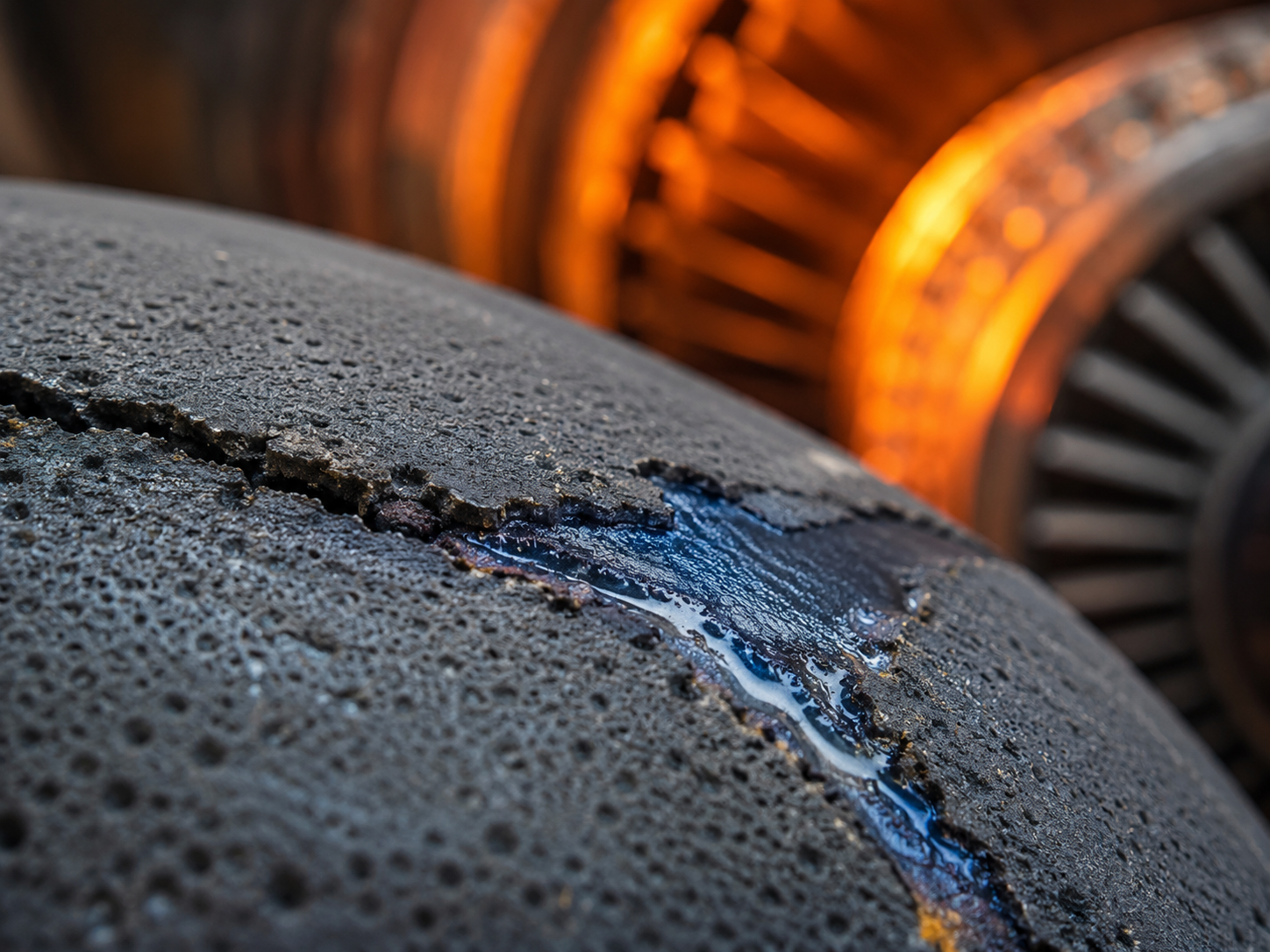
Paper: Glaze-enabled self-healing ceramic coatings for extreme environments. Illustration of a cracked, high-temperature ceramic coating surface, with a glossy cobalt oxide-rich glaze filling the fracture. A blurred, heat-lit gas turbine in the background represents the extreme engine environment targeted by the self-healing coating. Image credit: AI-generated image created using ChatGPT/OpenAI
In a recent research article available as an Article in Press in the journal Communications Materials, researchers developed a self-healing ceramic coating based on phase segregation in the CoO–Cr2O3 system that autonomously repairs thermally induced cracks at elevated temperatures, enhancing durability and lubricity for gas turbine engine applications.
Extreme Environment Material Challenges
Gas turbine engines experience extreme thermal and mechanical stresses, with surfaces exposed to temperature gradients that can reach 2000 °C, leading to material degradation through cracking and wear. Enhancing surface durability is essential for improving engine efficiency and meeting environmental targets.
Cobalt-based superalloys are commonly used because they naturally form protective glaze layers composed of cobalt and chromium oxides, which improve wear resistance and lubricity. However, cobalt alloys have limitations, including challenges with mechanical strengthening, high density, rising material costs, and supply risks.
This motivates the development of alternative coatings that mimic natural glaze layers. Synthetic CoO–Cr2O3 coatings have been created via suspension plasma spraying to replicate these glazes on substrates such as Inconel 718.
Tribological tests revealed cobalt segregation that forms lubricious CoO/Co3O4 oxide layers and fills cracks, suggesting self-healing behavior. This study investigates the phase behavior, segregation, and autonomous crack healing in these ceramic coatings under turbine-relevant conditions using advanced characterization and molecular simulations.
Coating Fabrication & Testing
Coatings with compositions corresponding to CoO-21Cr2O3 and CoO-42Cr2O3 were fabricated via suspension plasma spraying onto Inconel 718 substrates to replicate naturally occurring glaze layers in cobalt-based superalloys.
A pure Cr2O3 coating was also prepared for comparison. The microstructure consisted predominantly of CoO and Cr2O3 phases, with minor spinel phases, including CoCr2O4, as determined by XRD and Raman spectroscopy.
Tribological tests simulating turbine interface conditions were performed at 600 °C and 800 °C in air, using Inconel 718 balls against coated flat specimens. Testing conditions involved a 5 N load, 1 Hz angular oscillation, a 10 mm track diameter, and a 30° reciprocating angle to assess high-temperature sliding behavior under turbine-relevant conditions. Post-test analysis included Electron Microscopy">SEM, energy-dispersive X-ray spectroscopy (EDX), XPS, and focused ion beam (FIB) milling for cross-sectional examination.
Artificial defects were introduced by instrumented scratching to simulate cracks and evaluate self-healing behavior during subsequent thermal treatments at 800 °C in air. Confocal microscopy measured scratch profiles over time to monitor recovery.
Molecular dynamics simulations modeled cobalt and oxygen diffusion in defective CoO crystal structures at elevated temperatures (1600-2000 K), employing mean squared displacement analysis to calculate diffusion coefficients. These computational insights helped understand atomic transport mechanisms underlying the observed phase segregation and crack healing.
Self-Healing Mechanism Insights
The CoO-Cr2O3 glaze-based coatings exhibited dense microstructures with minor microporosity. XRD and Raman analyses identified CoO, Cr2O3, and spinel phases, with CoCr2O4 appearing at higher chromium levels.
Tribological tests at 800 °C showed similar friction across coatings, with spinel oxides likely contributing to lubricity. Notably, the CoO-21Cr2O3 coating developed a lubricious Co3O4-rich surface and exhibited reduced counterface material transfer, supporting improved tribological performance; coating wear itself could not be directly quantified because material removal was minimal.
Thermal expansion mismatch induced cracks in all coatings, but pure Cr2O3 coatings spalled during cooling, while CoO-containing coatings demonstrated crack filling and improved resistance to spallation via cobalt oxide phase segregation.
Microscopy and XPS revealed cobalt oxide migrating to surfaces and crack interiors, forming a glaze that fills cracks and prevents spallation. Raman spectroscopy showed Co3O4 on surfaces and CoO within filled cracks, with surface oxidation forming a diffusion-limiting Co3O4 shell that limits further diffusion.
Self-healing was demonstrated most clearly in CoO-21Cr2O3 scratched samples heat treated at 800 °C; scratches progressively healed over 8 hours, consistent with phase segregation, not mere oxidation. A pure CoO coating lacked this healing, underscoring the composite's importance.
Molecular dynamics simulations indicated faster Co transport than oxygen in defective CoO, whereas prior diffusion data suggest much lower Cr3+ mobility. Formation of Co3O4 spinel at surfaces constrains segregation, causing the segregated layer to stabilize at around 8-10 μm in the CoO-21Cr2O3 coating under the study conditions.
This dual-action segregation mechanism supports coating integrity and forms a lubricious glaze that may improve high-temperature tribological performance, offering a new pathway for self-healing high-temperature coatings in extreme environments.
Durable Glaze Coating Outlook
This study introduces a glaze-enabled ceramic coating system based on the CoO–Cr2O3 system that autonomously self-heals at high temperatures relevant to gas turbine engines. The coatings exploit phase segregation, with mobile CoO migrating to surfaces and cracks to fill defects and prevent spallation.
Surface oxidation to Co3O4 limits excess segregation, stabilizing a segregated surface layer while leaving surplus CoO within the coating available for future crack filling. Mimicking natural cobalt superalloy glazes, these coatings can be applied on more mechanically robust substrates such as nickel-based alloys, potentially enhancing durability by combining damage tolerance with improved lubricity, as shown by tribological and CoO-21Cr2O3 scratch-healing tests.
Molecular dynamics simulations provide atomic-level insight into cobalt and oxygen diffusion in defective CoO, revealing the interplay of phase chemistry, diffusion, and oxidation. This work highlights glaze-based coatings as a promising strategy to improve material longevity and reliability in extreme environments, offering new directions for aerospace surface engineering. Future efforts may focus on process efficiency and reducing the time required for effective healing to expand their applicability across various wear conditions.
Download your PDF copy by clicking here.