A global model suggests that unless renewable productivity gains substantially outpace fossil fuel gains, AI may reinforce carbon-intensive energy systems rather than accelerate decarbonization.
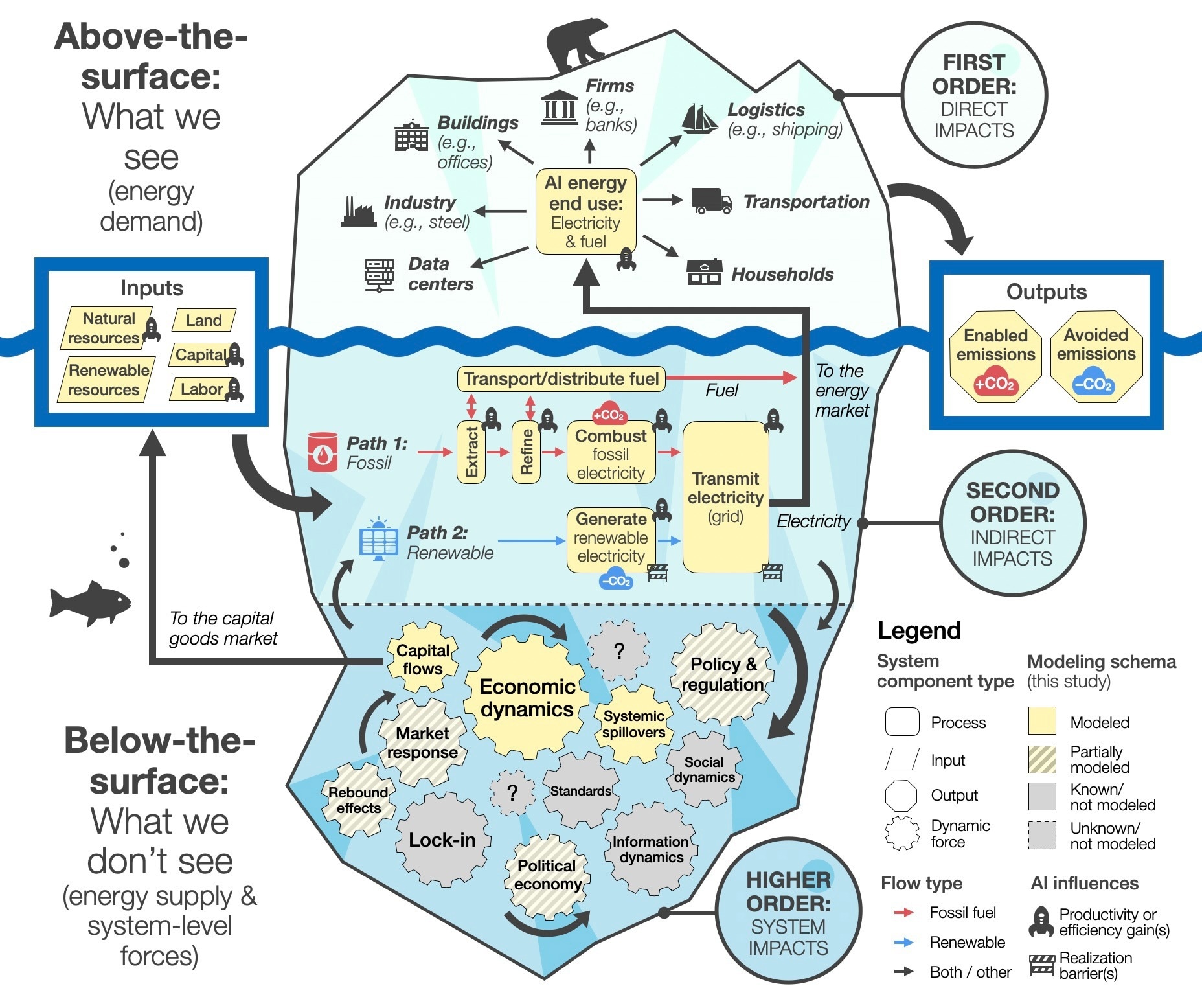
Conceptual systems diagram of AI–energy market dynamics across first-, second-, and higher-order effects. Modified Causal Loop Diagram70 representing energy market dynamics across first-order (operational), second-order (avoided/enabled), and higher-order (amplification) effects. Technology is modeled as productivity shocks applied to competing energy pathways: Path 1 (fossil productivity gains) and Path 2 (renewables optimization). The diagram includes both modeled and unmodeled mechanisms to illustrate whole-system structure. Notable deployment barriers are indicated for system comprehension but not explicitly modeled. Element sizes are representative, not quantitative. Designer credit: Rachel Woods-Robinson
A recent study published online as an 'Article in Press' in the journal npj Climate Action investigates how artificial intelligence (AI)-driven productivity gains could reshape global carbon dioxide (CO2) emissions from fossil fuel combustion across the energy sector. Using a global computable general equilibrium (CGE) model, the researchers evaluated how AI affects fossil fuel production, renewable energy systems, and other energy-related activities that support industrial manufacturing. The study highlights the importance of evaluating economy-wide interactions when assessing AI's implications for industrial decarbonization and the transition to lower-carbon energy systems.
Why AI-Driven Productivity Matters for Industrial Decarbonization
Artificial intelligence (AI) is transforming energy systems by improving how energy is produced, distributed, and consumed. AI-powered tools already support renewable energy forecasting, electricity grid management, predictive maintenance, industrial process optimization, and fossil fuel exploration. These advances could also influence energy-related CO2 emissions associated with energy-intensive manufacturing, as industries such as steel, aluminum, cement, and fertilizer production depend on reliable, affordable energy. Improving the energy systems that support these industries is therefore an important component of industrial decarbonization.
Recent studies have focused on AI's potential to improve energy efficiency, expand renewable energy deployment, and address the growing electricity demand of AI infrastructure. Less attention has been given to AI-driven productivity gains in fossil fuel supply chains and their broader impact on global emissions. Rebound effects, in which efficiency improvements stimulate additional energy use, further complicate this relationship.
The researchers modeled AI as a productivity-enhancing technology operating across both fossil-fuel and renewable-energy pathways. The analysis also incorporated electricity transmission, maritime shipping, and an aggregated energy-intensive industry sector to capture broader industrial interactions within the energy system. This economy-wide approach enabled the researchers to evaluate how AI-driven productivity gains propagate through interconnected energy and industrial systems and ultimately influence global CO2 emissions from fossil fuel combustion.
Modeling AI Across Global Energy and Industrial Systems
The researchers evaluated AI's climate impacts using the GTAP-E-Power computable general equilibrium (CGE) model, which simulates interactions across global energy markets and the broader economy. Rather than treating AI solely as an emissions-reduction technology, the model represents it as a productivity-enhancing tool operating simultaneously across competing energy pathways.
The model was calibrated using a 2017 global economic database and aggregated into 20 economic sectors across five world regions. Renewable electricity generation was adjusted to approximate its 2024 share of the electricity mix. These sectors included coal, oil, natural gas, renewable electricity generation, electricity transmission and distribution, maritime shipping, and an aggregated energy-intensive industry sector representing manufacturing activities with high energy demand. This framework enabled the researchers to evaluate economy-wide interactions between energy production, industrial activity, and carbon emissions.
The team introduced AI-driven productivity gains as productivity shocks rather than simple efficiency improvements. These shocks influence not only technical performance but also production costs, market prices, capital allocation, and resource use. The model therefore captures economy-wide rebound and induction mechanisms within its structure, although not their full extent.
The analysis then compared scenarios in which AI enhanced productivity in fossil fuel production, renewable energy systems, or both simultaneously. Additional analyses examined fuel-neutral pathways, in which improvements were applied without favoring a particular energy source, including grid infrastructure and selected demand-side applications, while sensitivity analyses evaluated the robustness of the results under different productivity assumptions, energy mixes, elasticities, and carbon pricing scenarios. The direct electricity use and operational emissions of AI data centers were excluded from the equilibrium calculations and were used only as an external point of comparison.
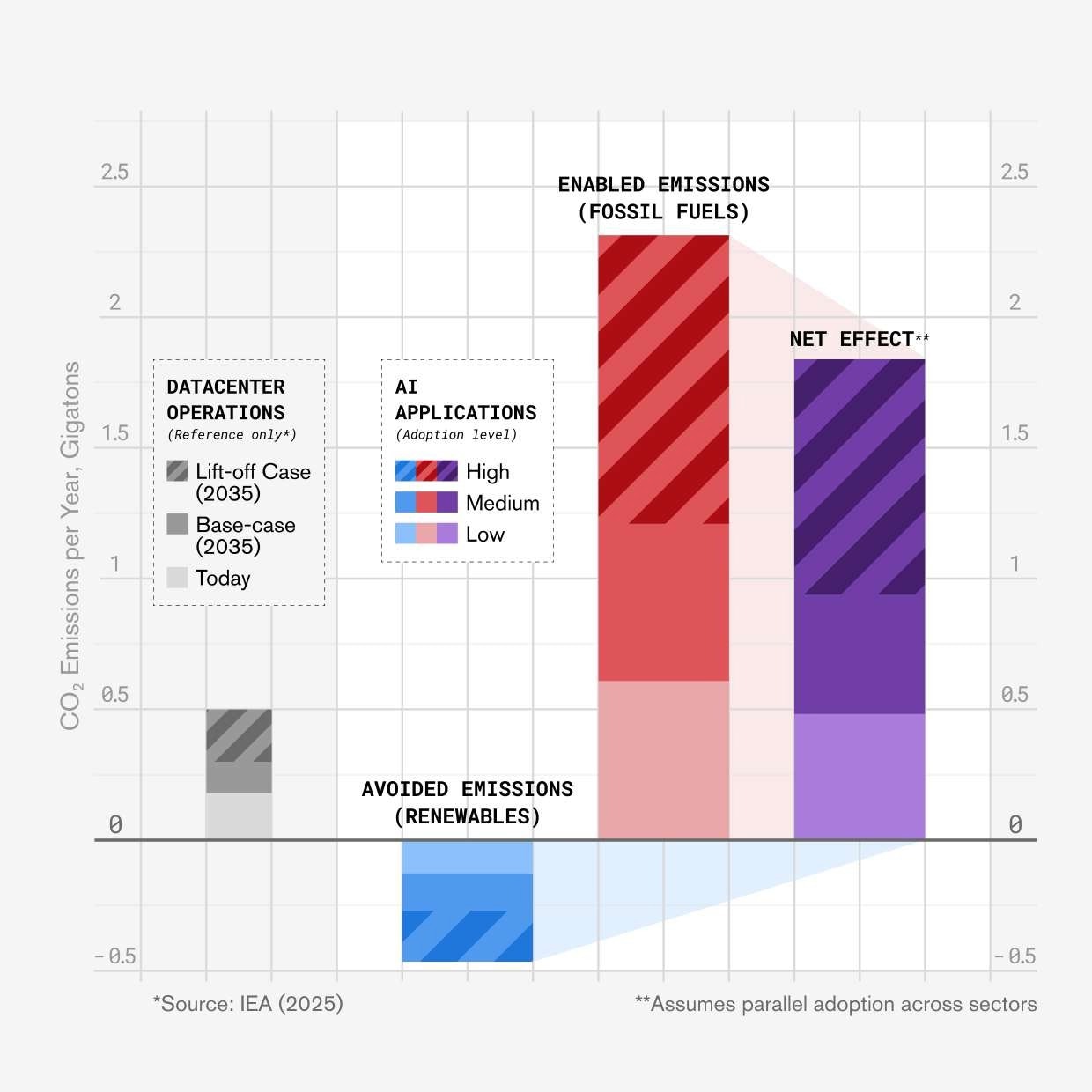
AI Emissions (Modeled). Annual CO2 emissions changes attributable to AI-mediated productivity gains across modeled pathways. Gray bars show unmodeled first-order datacenter estimates from the IEA14 for reference only; these are not directly additive to the modeled second-order effects. Blue bars show avoided emissions from renewables-only productivity shocks applied at low, medium, and high adoption levels, with no fossil shocks. Red bars show enabled emissions from fossil-only productivity shocks applied at low, medium, and high adoption levels, with no renewables shocks. Purple bars show the modeled net effect under parallel adoption, in which fossil and renewables supply pathways receive proportional productivity gains simultaneously, indicating an annual CO2 emissions increase of 0.5–1.8 Gt. Because the net effect is estimated under simultaneous shocks, it is not equal to the sum of the isolated pathway effects. Designer credit: Camille Hu
AI Productivity Gains Favored Fossil Fuel Expansion Over Renewable Benefits
The simulations showed that AI-driven productivity gains increased modeled net global CO2 emissions across all parallel adoption scenarios examined. Under parallel adoption, fossil fuel, renewable energy, and fuel-neutral pathways were assigned the same adoption tier, although productivity gains varied across sectors. Across these modeled pathways, adoption tiers that are undermatched increased annual emissions by 0.5–1.8 gigatonnes of CO2, equivalent to 1.2–4.8% of global energy-related CO2 emissions in 2024. Productivity gains in fossil fuel production consistently generated larger increases in emissions than the reductions associated with improvements in renewable energy systems.
The analysis revealed a clear imbalance between the two pathways. Renewable energy productivity gains would need to be approximately four to five times greater than those in fossil fuel production before the overall emissions balance reached breakeven. Across the 64 empirically parameterized scenario combinations, net emissions reductions occurred only when fossil-sector productivity gains were zero. These findings suggest that expanding AI across competing energy systems does not automatically support decarbonization. Instead, the model showed that productivity improvements in fossil fuel supply chains increased the carbon intensity of economic growth by propagating through the broader economy.
Implications for Industrial Decarbonization and Materials Manufacturing
The study challenges the common assumption that AI will inherently accelerate decarbonization. It highlights AI as a bidirectional productivity technology capable of improving both renewable energy systems and fossil fuel production. Without policies that both support low-carbon applications and constrain AI-enabled fossil fuel productivity, productivity gains in fossil fuel supply chains may outweigh the emissions reductions achieved through renewable energy optimization.
The findings also highlight the close relationship between industrial decarbonization and energy system transformation. Energy-intensive manufacturing relies on affordable, reliable energy, so AI-driven improvements in energy productivity can indirectly affect the energy-related emissions associated with industrial production. Although the model represents these activities as an aggregated energy-intensive sector rather than individual materials industries, it provides systems-level insight into how energy system changes may affect industrial decarbonization more broadly, but does not separately quantify emissions from steel, aluminum, cement, or fertilizer production.
The authors emphasize that these are comparative-static equilibrium scenarios rather than long-term forecasts. The model also excludes industrial process emissions, non-CO2 greenhouse gases, and direct operational emissions from AI data centers. Future work could incorporate updated economic datasets, dynamic technology adoption, industrial process emissions, and evolving energy markets to better capture long-term transitions. They also propose governance frameworks that distinguish enabled emissions from avoided emissions when evaluating climate policies.
Overall, the study provides a valuable systems-level framework for understanding AI's role in industrial decarbonization. By examining interactions across fossil fuel production, renewable energy systems, and energy-intensive manufacturing, it demonstrates that AI's climate impact depends not only on technological capability but also on how productivity improvements are distributed across the global energy economy.
Disclaimer: The views expressed here are those of the author expressed in their private capacity and do not necessarily represent the views of AZoM.com Limited T/A AZoNetwork the owner and operator of this website. This disclaimer forms part of the Terms and conditions of use of this website.
Source:
- Alpine, W., Geldner, N., Alpine, H., & Chepeliev, M. G. (2026). AI-driven productivity gains enable more CO2 emissions than they avoid in a global energy–economy model. Npj Climate Action. DOI: 10.1038/s44168-026-00411-0, https://www.nature.com/articles/s44168-026-00411-0