Researchers asked whether beneficial bacteria could claim a metal surface before destructive microbes take hold, opening a new way to think about how living coatings might control corrosion.
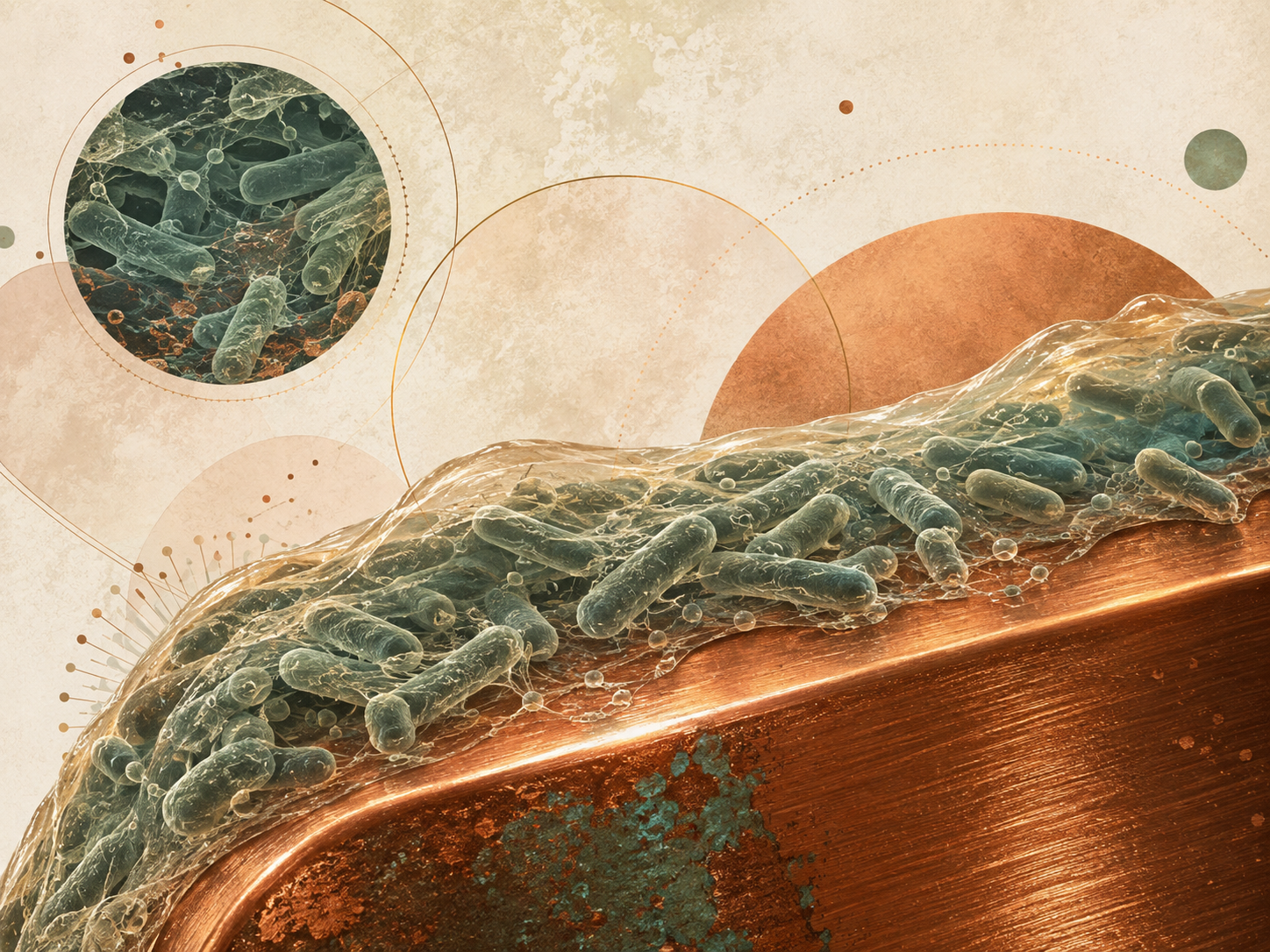
Paper: Living commensal biofilms for corrosion prevention. AI-generated abstract conceptual image created using ChatGPT/OpenAI
A recent study in the journal npj Biofilms and Microbiomes introduces a microbiome engineering strategy that uses protective commensal biofilms to limit copper corrosion. The researchers used a Citrobacter strain (MICI21) to form a living biofilm on copper and tested its ability to suppress corrosion caused by the sulfate-reducing bacterium Oleidesulfovibrio alaskensis. The study found that MICI21 rapidly colonized the copper surface, formed a dense and mechanically cohesive biofilm, and ultimately reduced corrosion under anoxic conditions.
Engineering Microbial Communities for Corrosion Control
Corrosion remains a major challenge for industrial materials, causing significant economic losses and shortening the service life of metals and infrastructure. Microbiologically influenced corrosion (MIC) further accelerates metal degradation. Sulfate-reducing bacteria (SRB) are major contributors because they produce sulfide and bisulfide species that react with copper, promoting corrosion.
Conventional corrosion-control methods often use biocides, inhibitors, and protective coatings. However, these approaches can be costly and ecologically disruptive, while static coatings may struggle to contend with dynamic microbial communities. Instead of eliminating microorganisms from metal surfaces, researchers explored whether beneficial microbes could occupy these surfaces and limit the activity of corrosive bacteria.
The study introduces the concept of a microbioclaim, in which a commensal biofilm establishes biological control over a surface and restricts harmful microbial activity. The researchers focused on Citrobacter sp. MICI21 was investigated for its ability to protect copper from SRB-driven corrosion. The findings provide a new framework for using microbial communities as active components of corrosion-control strategies.
Building and Characterizing a Living Protective Biofilm
The researchers used high-purity copper as the model metal and prepared its surface through polishing and thermal treatment. They studied copper under anoxic conditions using cultures of Citrobacter sp. MICI21, O. alaskensis G20, and their co-culture.
Electrochemical measurements provided the main assessment of corrosion behavior. The team monitored open-circuit potential (OCP), electrochemical impedance spectroscopy (EIS), and polarization responses over time. The researchers also examined the biofilm structure using scanning electron microscopy (SEM), energy-dispersive X-ray spectroscopy (EDS), and confocal laser scanning microscopy (CLSM). Nanoindentation measurements were used to determine the mechanical properties of the biofilm.
X-ray diffraction (XRD) identified chemical phases within the surface layer. The team also conducted cell-free experiments comparing EPS from the reference strain Citrobacter freundii ATCC 8090 with that from G20, as EPS could not be extracted directly from MICI21. To investigate microbial competition, the researchers measured bacterial growth, hydrogen sulfide production, and surface colonization. They used 16S rRNA gene analysis to determine the composition of mature biofilms.
Commensal Biofilms Strengthen Copper Protection
The electrochemical measurements showed a clear improvement in the corrosion resistance of copper in the presence of MICI21. Protection was not immediate: in the co-culture, OCP initially declined through day 12 before recovering by day 60, consistent with a transition from early electrochemical vulnerability to longer-term passivation. In the co-culture system, the low-frequency impedance increased by about 2.5-fold. Total corrosion resistance increased from 2.10 kΩ cm² at the start of the experiment to 7.24 kΩ cm² after 60 days.
The biofilm developed into a dense and compact layer on the copper surface. SEM imaging showed abundant rod-shaped MICI21 cells and fewer vibrio-shaped G20 cells. Nanoindentation measurements showed a hardness of about 12.7 MPa and an elastic modulus of approximately 0.8 GPa. These properties indicate a cohesive biofilm that can resist mechanical detachment.
EDS detected carbon, sulfur, and oxygen within the biofilm-associated layer. XRD identified copper sulfide (Cu2S) and copper oxide (CuO). Together, the biofilm and inorganic phases formed a protective composite layer on the copper surface.
Microbial growth experiments showed that MICI21 had a faster doubling time than G20. Copper exposed to MICI21 showed a fourfold increase in corrosion resistance over 15 days, whereas resistance under G20 decreased by approximately sixfold. Weight-loss tests supported this pattern, with similarly low corrosion rates for MICI21 and the co-culture, compared with substantially greater corrosion under G20. The researchers also observed lower hydrogen sulfide production in the MICI21 system. G20 produced about 725 ppm H2S, while MICI21 produced 310 ppm. The co-culture produced 464 ppm. Lower sulfide availability may therefore contribute to the reduced corrosion observed in the protective biofilm.
The mature biofilm was strongly dominated by MICI21. After 60 days, MICI21 reached about 8.2 log10 copies μL-¹ in the analyzed biofilm fraction, while G20 was not detected. The findings are consistent with early surface colonization giving MICI21 a competitive advantage, ultimately allowing it to dominate the copper surface.
The researchers propose several mechanisms for this protection. The MICI21 biofilm may act as a physical barrier, limiting bisulfide transport to the copper surface. Experiments with surrogate Citrobacter-derived EPS suggest that extracellular polymers can bind copper and modify surface chemistry. Faster growth may also help MICI21 occupy surface sites before G20 can establish a corrosive biofilm.
Comparative analysis of publicly available Citrobacter genomes also identified genes associated with a Type VI secretion system (T6SS), a bacterial system that can mediate contact-dependent competition. The researchers propose T6SS-mediated antagonism as a possible contributor to MICI21's dominance over G20, but MICI21 was not whole-genome sequenced, and T6SS activity was not directly demonstrated.
Living Biofilms for Sustainable Corrosion Control
The study suggests that engineered microbial communities could offer a new approach to corrosion control. The approach combines four linked concepts: microbiome engineering as the overall strategy, microbioclaim as the ecological mechanism, biological passivation as the protective function, and sustainable corrosion control as the intended outcome.
MICI21's relatively rapid growth may help it establish early surface dominance. The dense biofilm can also restrict the movement of corrosive species toward the metal. Competition between the microbial populations may further suppress SRB. The protective effect was also observed under both oxic and anoxic conditions and across annealed, cold-worked, and graphene-coated copper surfaces. This suggests that the strategy may be robust across different copper environments and surface states, although whether it can protect other metals remains to be established.
Future studies should investigate the molecular mechanisms using transcriptomics, proteomics, and metabolomics, and by directly validating T6SS activity. Overall, the work shows how microbial ecology can become a materials-engineering tool for developing more adaptive and potentially sustainable corrosion-control strategies.
Disclaimer: The views expressed here are those of the author expressed in their private capacity and do not necessarily represent the views of AZoM.com Limited T/A AZoNetwork the owner and operator of this website. This disclaimer forms part of the Terms and conditions of use of this website.