Researchers at the University of Bath have discovered a renewable, bio-based polymer membrane capable of efficiently capturing toxic ‘forever chemicals’ from water, offering a potential new route to more sustainable water treatment.
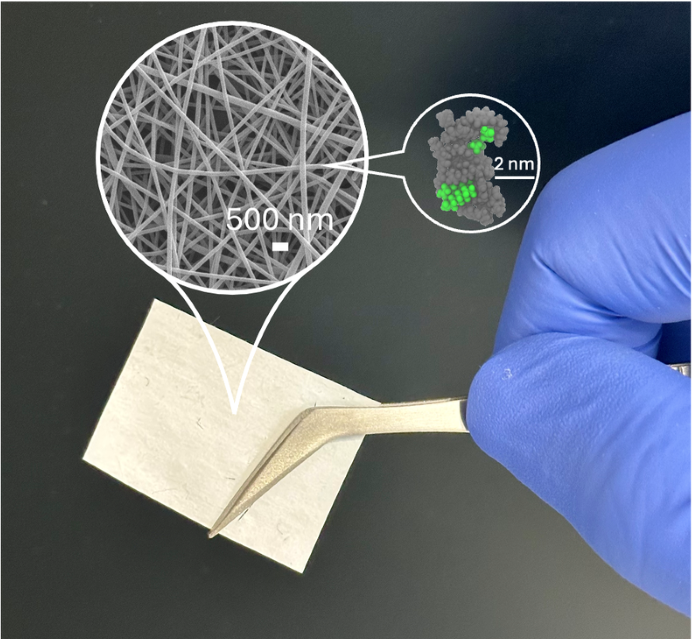 The bio-based membrane is made up of a network of billions of nanofibers, each one hundreds of times thinner than a human hair. Image Credit: University of Bath
Perfluorooctanoic acid (PFOA), a member of the per- and polyfluoroalkyl substances (PFAS) family and once commonly used in non-stick coatings, has now been widely detected in water sources worldwide. High levels of exposure have been linked to cancers, hormone disruption and immune system suppression, with governments around the world taking action to protect people and the environment.
Unlike many conventional water treatment materials that require frequent replacement or generate secondary waste, the new bio-based membrane can trap and hold over 94 % of PFOA from water. It can later be treated with heat to remove the trapped pollutants, allowing the polymer to be reused and reprocessed into a new membrane.
A Water-Activated Tightening Net
The novel membrane is made from a network of nanofibers that are hundreds of times thinner than the width of a human hair. When placed in water, these nanofibers absorb moisture and swell, acting like a tightening net to trap and hold the pollutants.
Dr Xiang Ding, from the Innovation Centre for Applied Sustainable Technologies (iCAST) at the University of Bath and the study’s post-doctoral researcher and lead author, said: “What really surprised us was how this material responds when it meets water.
“Traditional nylon materials, like Nylon 6 or Nylon 66, barely change, but our bio-based nanofibers structurally reorganize themselves and tighten. This feature gives them a remarkable ability to trap stubborn PFAS pollutants right inside the polymer network, and quickly!”
Rapid, Reliable and Reusable
‘Forever chemical’ pollution is notoriously hard to treat. Current clean-up methods that use electricity, sunlight or microbes to break down PFOA can be expensive and difficult to use at scale. More conventional treatment methods, such as activated carbon or ion-exchange resins, can remove PFAS but often require frequent replacement or complex regeneration processes.
This water-activated trapping mechanism works rapidly, capturing up to half of the PFOA present in an hour and retaining it even after washing. The researchers also discovered that the membrane can be regenerated through a heating and re-spinning process, unlocking a reprocess-recycling ability that recovers up to 93 % of its original adsorption capacity.
Dr Ding added: “By using renewable, furan-based building blocks instead of fossil-derived materials, we’ve shown that high-performance PFAS removal can be combined with more sustainable polymer design.”
This study provides a new example of bio-based membranes capable of removing PFOA from water. The team, which includes Dr Hannah Leese, Professor Matthew Davidson and Dr Carmelo Herdes, now aims to explore scaling up the technology for real-world testing, broadening its application to capture other PFAS chemicals and further optimizing the regeneration process.
Their findings pave the way for a new class of polymer membranes to serve as a practical, circular, and sustainable solution for tackling PFAS contamination and advancing sustainable water treatment worldwide.
This work was supported by the Research England Development Fund through the Innovation Centre for Applied Sustainable Technologies (iCAST), the EPSRC Catalysis Hub grant, and the University of Bath.