Researchers at Johannes Gutenberg University Mainz (JGU) have developed a new way to employ molecules as tiny data storage devices using a new manganese-based material. Until now, this was only possible with iron-containing molecular materials, which require very low temperatures – ranging from 100 to a maximum of 130 Kelvin (approximately minus 173 to minus 143 degrees Celsius) – making their application significantly more difficult.
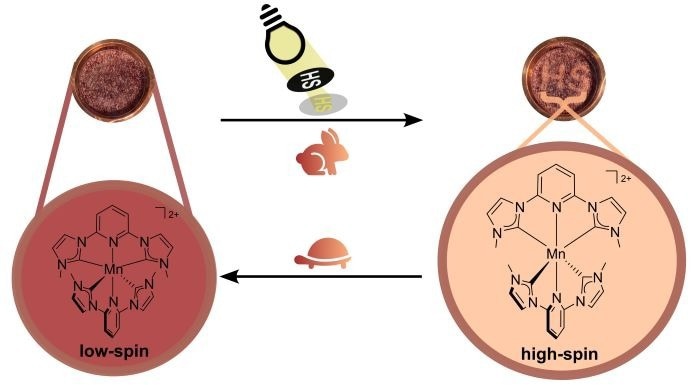 A coin-sized area of the new material is illuminated through a mask: The spins change their state, and the material changes color. Image Credit: Katja Heinze / Johannes Gutenberg University Mainz (JGU)
“With our novel manganese-based material, we succeeded in raising the operating temperature for the potential storage devices to around minus 132 degrees Celsius on our very first attempt,” said Prof. Dr. Katja Heinze from the Department of Chemistry at JGU. “This means the material outperforms all previously known iron-containing molecular materials for these applications and marks a breakthrough in spintronics.” The results were published by the research group led by Heinze today in the renowned journal Nature Chemistry.
A Temperature Jump of Eleven Kelvin
In the quest for increasingly efficient data storage, atoms – or, more precisely, ions – offer an intriguing option: Until now, the electron spins – that is, the magnetic moment of electrons, which behaves like a bar magnet – of individual iron ions have been aligned either in parallel or antiparallel fashion, corresponding to a “1” or a “0”. These are referred to as high-spin or low-spin states. The drawback: such iron-based storage devices require very low temperatures, typically a maximum of 100 Kelvin (about minus 173 degrees Celsius). A team of researchers previously reported achieving temperatures of 130 Kelvin (about minus 143 degrees Celsius). This suggests that a limit of the maximum achievable operating temperature of “iron-based memory devices” has been achieved. The required low temperature complicates operation: the memory devices would need to be cooled, which comes with high energy requirements.
The new approach developed by researchers at JGU now allows for a significant temperature jump. “Our study shows that manganese can perform just as well as iron. And our new molecular material does it even better,” said Sandra Kronenberger, who synthesized the new material as a doctoral student in Heinze’s research group, supported by the Max Planck Graduate Center in collaboration with JGU. “Of course, the system still operates well below room temperature, but this new development marks a significant step forward,” said Dr. Luca Carrella from the Department of Chemistry at JGU, who measured the magnetic behavior of the new material. In his assessment, even higher temperatures in spintronics are on the horizon.
Manganese Combined with Carbene Ligands
The recent breakthrough in temperature performance was achieved by using manganese in combination with ligands derived from N-heterocyclic carbenes that bind strongly to the manganese. This strong bond stabilizes the low-spin state while simultaneously creating a high energy barrier between the two spin states. In less physicochemical terms: The two spin states, which can serve as information storage, become more stable and can withstand higher temperatures. The “writing” of the memory works in a similar way to what was previously described for iron ions: When the manganese ions are irradiated with light, certain electrons change their spin state, and the color of the material shifts from dark red in the low-spin state to light yellow in the high-spin state. “Both the color and the magnetic properties of the switched material persist for a useful period of time – even after the light is turned off. Therefore, this concept could pave the way for future digital storage technologies,” said Heinze.