Differential scanning calorimetry is a well-established technique for determining thermal characteristics of materials, such as phase transitions, onset temperature, and the heat of a reaction.
Complete Safety Testing of Fully Assembled Coin Cells
The Coin Cell DSC assesses coin cells' thermal properties, showing energy release reactions that can be used to evaluate safety and performance.
- Direct coin-cell testing of completely manufactured 2032 coin cells without teardown
- Quick and dependable thermal insights, including onset temperature, reaction process, heat of reaction, and off-gas analysis
- Integrate thermal and electrochemical signals for battery safety and performance testing
- Complete safety characterization using thermal and electrical signals from -80 to 600 °C
Advanced Features Engineered for Precise Thermal Diagnostics
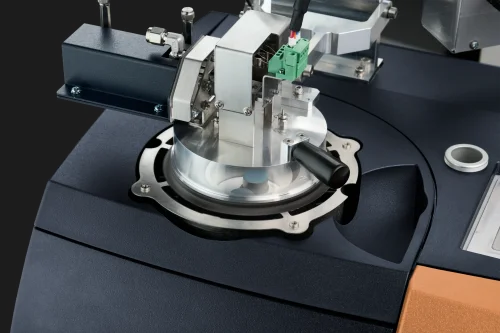
Image Credit: TA Instruments
Features
- Highly sensitive sensor allows for more accurate onset temperature and heat flow measurements
- A wide temperature range displays battery behavior from -80 to 600 °C
- Coin-cell capsules retain great contact with the sensor until cell failure
- Voltage monitoring facilitates state-of-charge and short-circuit analysis
- Modern gas analysis that can be used with GC-MS, FTIR, or MS to assess reaction processes
Fit-for-Purpose Battery Safety Testing
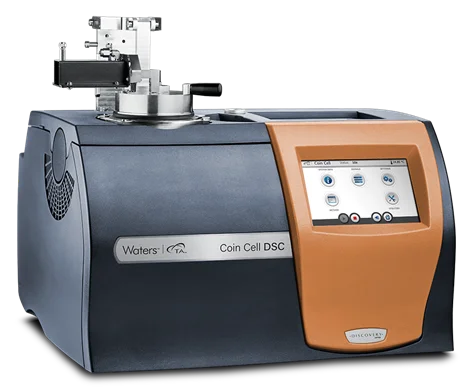
Image Credit: TA Instruments
Compared to late-stage safety testing, battery makers can now confirm the safety of novel formulations in early-stage testing with less material and quicker turnaround times.
Dual Testing Modes
- The scanning operating mode evaluates material cross-reaction, heat of reaction, onset temperature, thermal abuse, and thermal deterioration.
- Heat flow during the development of the solid electrolyte interface (SEI), charge/discharge, overcharge, and overdischarge are assessed using the isothermal operating mode.
Coin-Cell Capsule
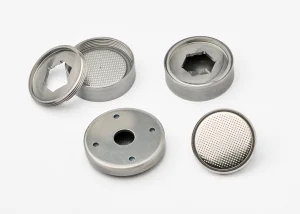
Image Credit: TA Instruments
New coin-cell capsules work with 2032 and any 20 mm diameter coin cell. With its fit-for-purpose design, it is ideal for coin-cell testing without the need for dismantling, delivering accurate whole-cell safety testing that was previously difficult on DSCs.
- Coin-cell standard capsules preserve thermal signal over the whole sample range
- Coin-cell cycling capsules improve heat flow during isothermal cycling
- Twenty mm classic aluminum pans for material samples
Large Format DSC Cell Technology
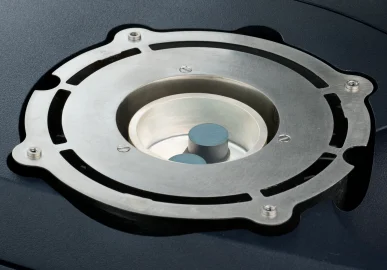
Image Credit: TA Instruments
The large format DSC cell’s high reliability, precision, and reproducibility in heat flow measurements allow for the identification of even minor thermal transitions, indicating early symptoms of battery degradation or failure. This dependability allows battery scientists to:
- Evaluate battery material phase transitions
- Identify the reaction mechanisms
- Improve battery safety through design
Complete Versatility in Battery Safety Testings
Interchangeable Cooling Systems
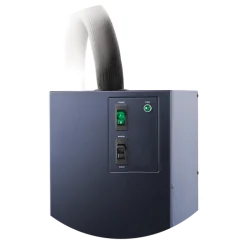
Image Credit: TA Instruments
- Finned air cooling system (FACS) for high-temperature heating from ambient to 600 °C
- Refrigerated cooling system (RCS) is capable of reaching -80 °C up to 400 °C
Evolved-Gas Analysis (EGA)
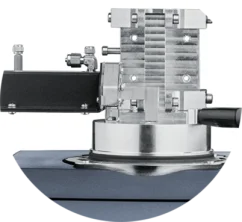
Image Credit: TA Instruments
EGA assists battery scientists in understanding reaction processes and evaluating off-gases for safety. It is compatible with:
- Mass spectrometry (MS)
- Fourier transform infrared spectroscopy (FTIR)
- Gas chromatography-mass spectrometry (GC-MS)
Electrochemical Connection
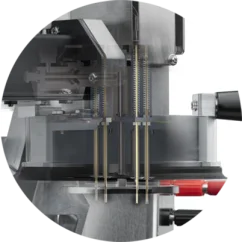
Image Credit: TA Instruments
Combining thermal analysis, voltage monitoring, and cycling capabilities gives new electrochemical insights, such as state of charge, internal short circuit, and heat created during cycling, for safety and performance evaluation. Users can link the Coin Cell DSC to a:
- Potentiostat
- Voltage monitoring device
- Battery cycler
Ultimate Data Control and Confidence
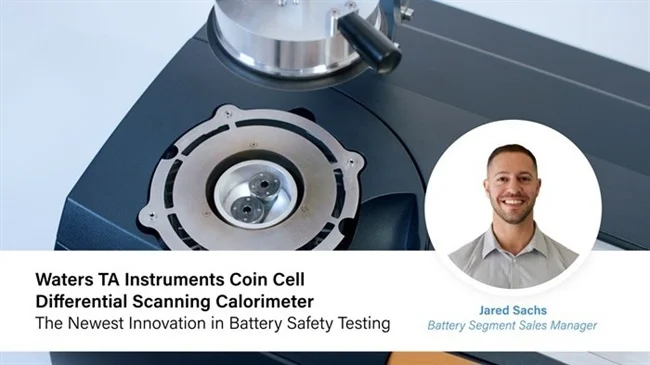
Image Credit: TA Instruments
TRIOS™ Software is a cutting-edge platform that uses state-of-the-art technology for data collection, data processing, and instrument control for both thermal analysis and rheology.
Specifications
Source: TA Instruments
| Specification |
Coin-cell DSC |
| Baseline flatness |
≤500 μW |
| Baseline repeatability |
≤100 µW |
| Temperature range1 |
-80 °C to 600 °C |
| Temp accuracy2 |
±0.1 °C |
| Temp precision2 |
±0.05 °C |
| Enthalpy precision2 |
±1% |
| Heating rate |
0.01 °C to 20 °C/minute |
| Instrument Features |
| Color app-style touch screen |
● |
| Evolved gas analysis (EGA) capable |
● |
| Electrochemical analysis (ECA) capable |
o |
| Pan Options |
| 20 mm aluminum pan |
Up to 600 °C |
| Coin Cell DSC standard capsule |
Up to 600 °C |
| Coin Cell DSC cycling capsule |
Up to 60 °C with ECA |
1 Depends on cooling systems
2 Indium with 20 mm aluminum pan
● Included
o Optional