A project-by-project analysis reveals how Western Australia rapidly scaled up hard-rock lithium production, even as volatile prices, rising costs, and downstream processing challenges tested the economics of its expansion.
Paper: Rapid Growth of the Western Australian Lithium Industry: Insights for Future Development Projects. AI-generated conceptual image created using ChatGPT/OpenAI
In recent years, Western Australia has emerged as a global hub for battery raw materials, with hard-rock lithium production increasing tenfold between 2010 and 2024. State royalty revenues from this growth have exceeded one billion Australian dollars.
A study from the University of Western Australia, published in the journal Mining, evaluated the techno-economic performance, project execution timelines, and resource dynamics behind this growth. Using project-level data from major spodumene operations, researchers examined how geological quality, engineering practices, and rapid capital deployment helped enable the state to supply 37% of global lithium production.
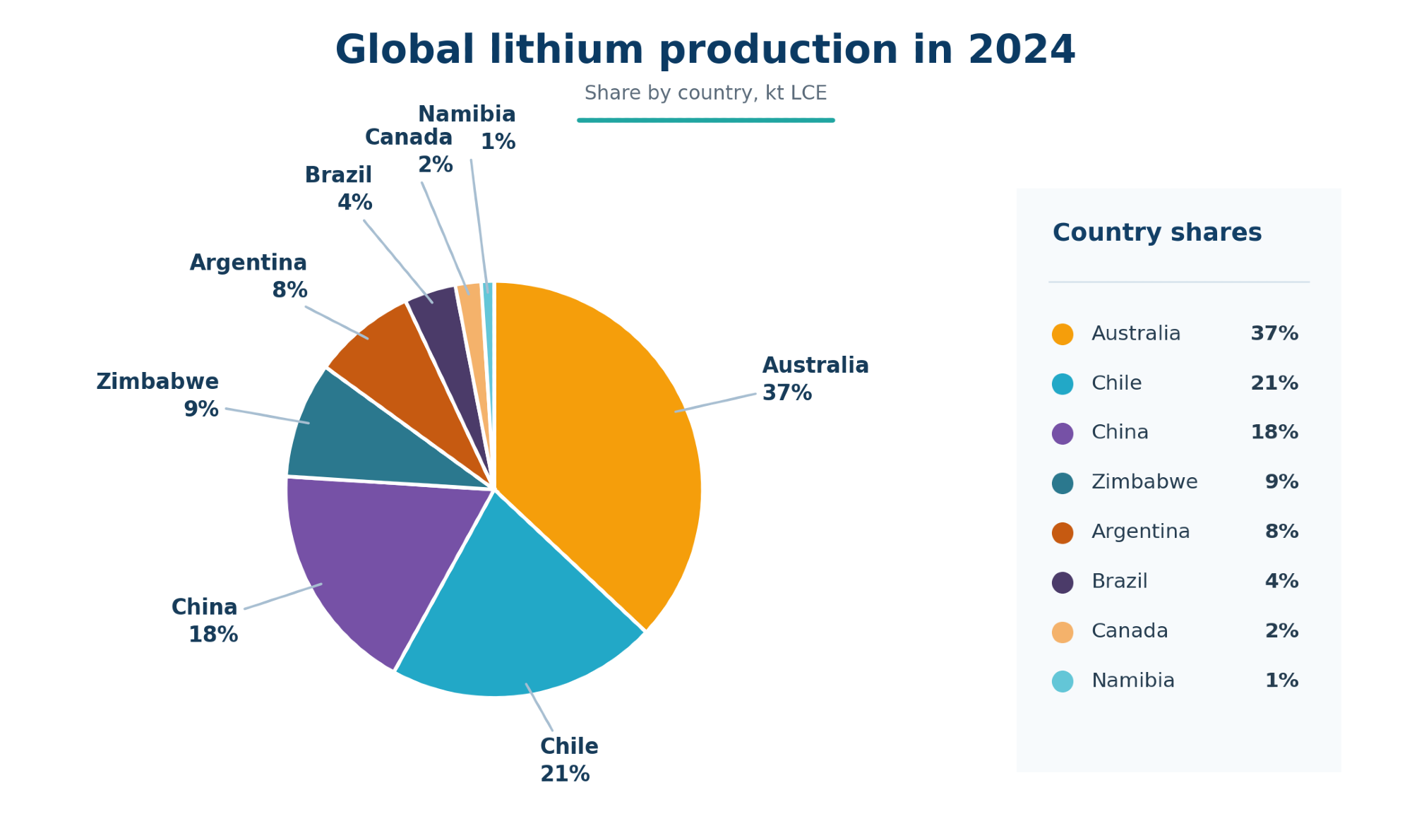
Geographical concentration of lithium production in 2024 (kt), data adapted from the United States Geological Survey using 1 t Li = 5.323 t LCE. Excludes US production
The Rise of Hard-Rock Lithium
Lithium is a core component of lithium-ion batteries used in electric vehicles (EVs) and energy storage. Historically, lithium was sourced mainly from continental brine deposits. However, hard-rock production now dominates, accounting for 65% of global lithium production in 2024. Australia holds approximately 8.9 million tonnes of contained lithium metal, representing 7.7% of global resources, primarily found in Western Australia.
Price Dynamics in Lithium Production
The international lithium market has evolved from a relatively concentrated industry into a more active but highly volatile commodity market. Spodumene concentrate prices increased more than sixteen times, from US$375 per tonne in mid-2020 to US$6,401 per tonne by late 2022, then fell 88% to US$740 per tonne by late 2024 as substantial new supply came online, supply outpaced demand, and inventories accumulated. Similarly, lithium hydroxide prices fluctuated significantly, rising from US$10,000 per tonne in April 2020 to US$72,000 per tonne in January 2023 before falling to US$9,075 per tonne by December 2024. These price swings highlight the need for robust economic and metallurgical benchmarks when evaluating lithium projects.
Comprehensive Analysis of WA Lithium Operations
Researchers analyzed hard-rock lithium operations in Western Australia that reached a final investment decision or production since 2010. This included notable projects such as Pilgangoora, Wodgina, Mt Marion, Mt Holland, Kathleen Valley, Bald Hill, and Mt Cattlin, along with exploration- and feasibility-stage projects like Tabba Tabba and Manna. Finniss in the Northern Territory was also included for benchmarking. The Greenbushes deposit served as a benchmark for comparing ore grade and operating costs.
Technical and commercial data were compiled from definitive feasibility studies, resource reports, and technical disclosures. Capital expenditures were converted to real 2025 values using the Australian Bureau of Statistics price indices and normalized against annual spodumene capacity and life-of-mine production. Project schedules were evaluated across development milestones, including first resource, preliminary and definitive feasibility studies, final investment decision, construction, production, and first shipment.
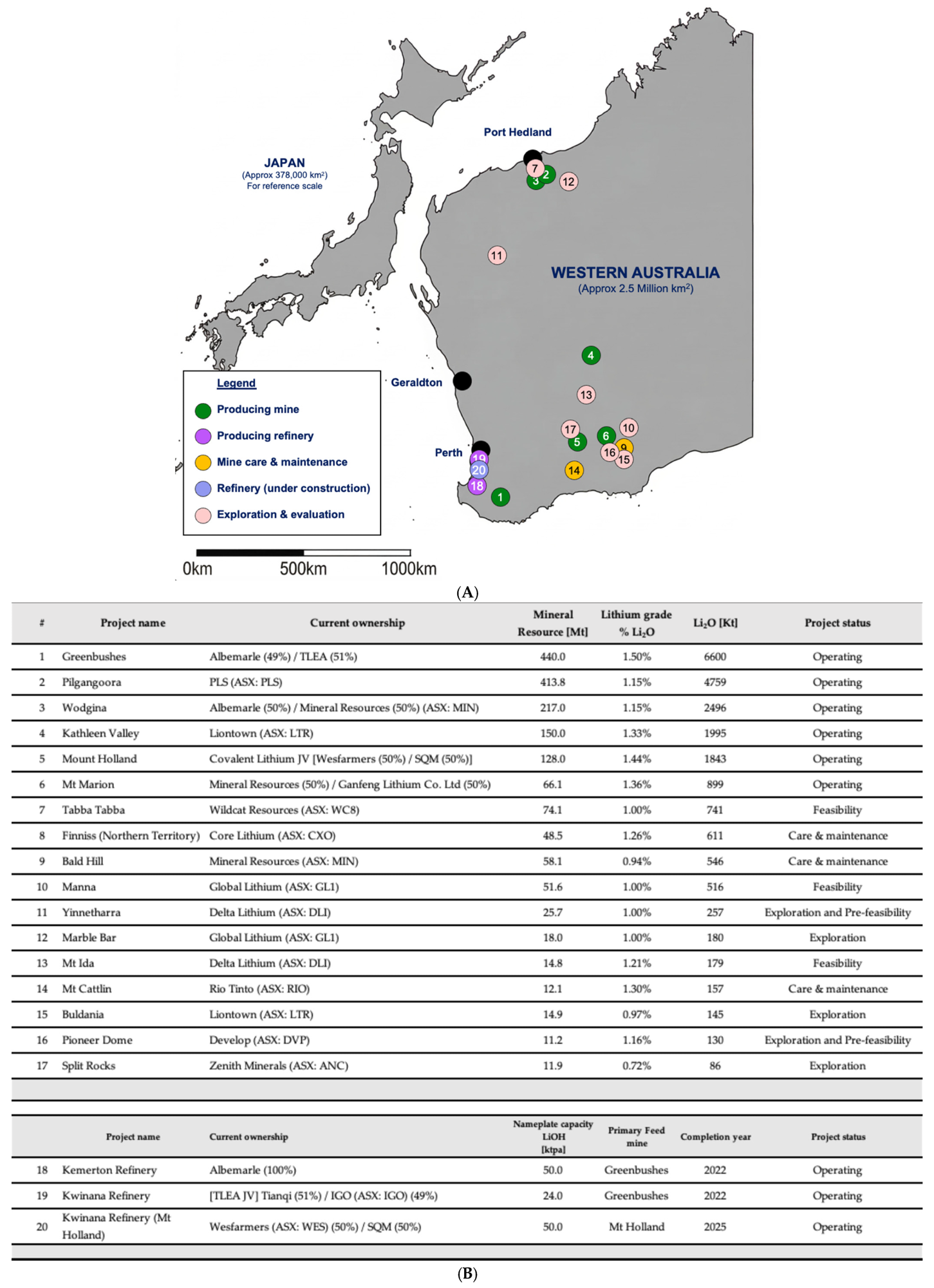
WA lithium mines and refining projects in December 2025 (data from company announcements). (B) WA lithium mines and refining projects in December 2025 (data from company announcements). Note: Kemerton refinery was subsequently put into care and maintenance in February 2026 (post Dec’25 data cut-off)
Resource Expansion and Economic Viability
The data showed that combined reported mineral resource estimates, excluding Greenbushes, increased from 25 million tonnes in 2010 to 1,295 million tonnes in 2025, equivalent to a 30% compound annual growth rate. Tier-one assets reached world-class scale, led by Greenbushes at 440 million tonnes and Pilgangoora at 414 million tonnes. This analysis challenged the view that regulatory approvals were the dominant cause of development delays; all developed WA projects examined reached first production within 7.5 years of their first resource estimates, with Bald Hill doing so in about nine months, although project scale, financing, and market conditions also influenced timing.
Announced capital expenditure across nine analyzed projects totaled around US$3.9 billion, although not all were sanctioned, with annualized capital intensity averaging US$799 per tonne of annual capacity. Over the life of the mines, large-scale operations reduced this figure to US$21-US$25 per tonne. Operating costs were closely linked to ore grade, deposit scale, plant utilization, processing efficiency, and market conditions. Greenbushes recorded the lowest life-of-mine cash operating cost at US$316 per tonne, while major primary producers reported FY2025 operating costs of roughly US$508-US$627 per tonne. Smaller or lower-grade operations reported costs above US$800 per tonne, and several were in care and maintenance during the weaker-price environment.
Domestic downstream conversion presented additional challenges. The two WA refineries with sufficient reported utilization data operated at 13% and 28% of nameplate capacity, reflecting multifactorial ramp-up challenges including tight impurity requirements, feedstock chemistry, higher domestic operating costs, complex joint-venture arrangements, and weak lithium prices.
Integrating Sustainable Practices in Lithium Production
These extraction and beneficiation operations produce feedstocks for the global battery industry, with spodumene concentrates containing approximately 5.5-6% lithium oxide. The concentrates are further processed into lithium hydroxide monohydrate and lithium carbonate, primary battery-material feedstocks used in EVs and energy storage.
Mining operations are adopting lower-carbon power and processing strategies. Kathleen Valley uses a hybrid power system combining wind, solar, battery storage, gas, and diesel backup, while Pilgangoora currently combines thermal generation with solar and plans further battery storage and wind integration. Emerging midstream approaches, including a demonstration project at Pilgangoora, aim to upgrade products closer to mine sites, reducing carbon emissions and improving transport efficiency.
Strategic Insights for Future Mineral Development
In summary, the rapid development of Western Australia’s lithium sector demonstrates that mineral security and commercial viability depend heavily on project quality, deposit scale and grade, access to financing, market conditions, and regional mining capability rather than strategic mineral classification alone. Fast project development remains possible when sound engineering is supported by established regional mining capabilities and favorable market conditions.
As upcoming projects such as Tabba Tabba, Manna, and Mt Ida progress toward investment milestones, expanding resource bases through targeted exploration could be particularly important for Tabba Tabba and Manna, helping to reduce capital intensity and improve prospects for positive investment decisions. The benchmarks established in Western Australia also provide a useful framework for developing other mineral sectors, including rare earth elements and vanadium.
Disclaimer: The views expressed here are those of the author expressed in their private capacity and do not necessarily represent the views of AZoM.com Limited T/A AZoNetwork the owner and operator of this website. This disclaimer forms part of the Terms and conditions of use of this website.
Source:
- Bradbury, H.; Trench, A.; Baur, D.G. (2026). Rapid Growth of the Western Australian Lithium Industry: Insights for Future Development Projects. Mining, 6, 65. DOI: 10.3390/mining6030065, https://www.mdpi.com/2673-6489/6/3/65