Theoretical valuations place billions of dollars of resources inside some asteroids, but turning those distant materials into usable supplies will require solving engineering challenges that begin much closer to Earth.
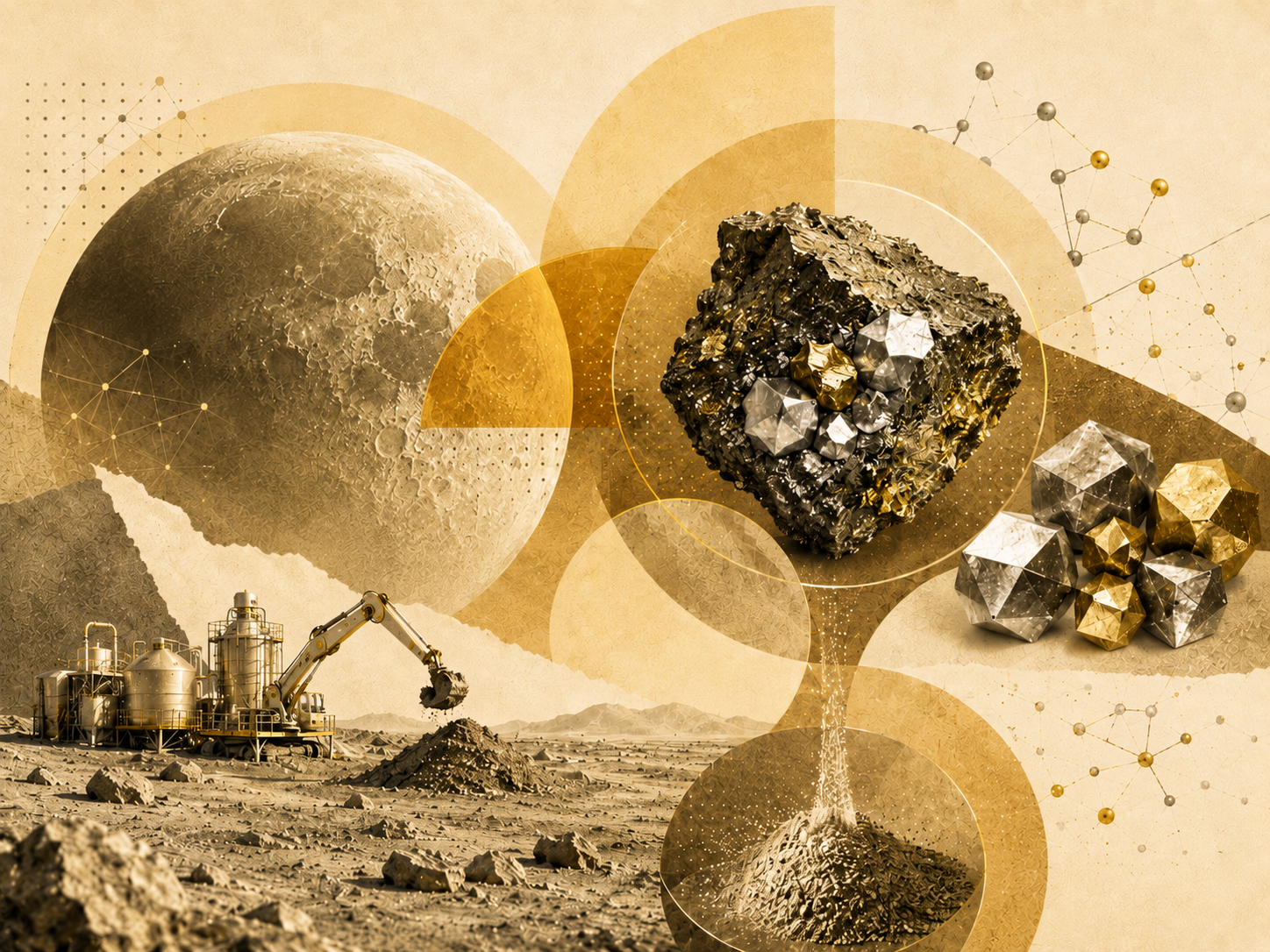
Paper: Asteroid and Lunar Space Resources for Future Space Industry: Critical Materials, In-Situ Resource Utilization and Governance Challenges. AI-generated abstract conceptual image created using ChatGPT/OpenAI
A recent perspective review published in the journal Chemical Engineering Research and Design explored the feasibility of recovering rare earth elements (REEs) and platinum group metals (PGMs) from asteroids while examining the Moon as a nearer-term platform for developing and validating in-situ resource utilization (ISRU) strategies before extending resource-recovery efforts to asteroids.
The paper cites a theoretical estimate that the Ryugu asteroid could contain about $82.76 billion worth of resources, although the authors stress that such valuations are highly speculative and depend on assumptions about composition, extraction, transport, and future commodity prices. This highlights the potential of extraterrestrial bodies as future sources of strategic materials.
Researchers also introduced an integrated framework connecting critical raw material demand with astrochemical engineering and examined potential methods for recovering valuable elements from extraterrestrial bodies. This approach provides a conceptual basis for future assessments of the technical and economic feasibility of off-world resource utilization.
Supply Constraints
The global transition to renewable energy, electric mobility, and advanced electronics heavily depends on reliable supplies of REEs and PGMs. REEs such as neodymium and dysprosium are widely used in high-performance permanent magnets, while platinum is important in catalytic applications and emerging hydrogen technologies.
However, terrestrial supplies are concentrated in a limited number of regions, and extraction can cause significant environmental impacts. These supply constraints have increased interest in extraterrestrial resources. Asteroids, remnants of the early solar system, may contain metals and volatile compounds that could serve as future sources.
Extraterrestrial Material Extraction
Researchers developed a conceptual framework to assess the engineering and logistical requirements for extraterrestrial material extraction from a chemical engineering and process design perspective. They considered how terrestrial mining and mineral-processing technologies would need to be adapted for space, focusing on the mechanical and thermal processes required to recover valuable materials under microgravity, vacuum, and extreme thermal cycling conditions.
A major focus was the technological readiness of extraction methods for different celestial targets. For lunar regolith, which contains silica, iron, and titanium oxides, the study examined laboratory-demonstrated approaches such as hydrogen reduction and molten-salt electrolysis. It considered their products, engineering constraints, and current levels of technological maturity.
For asteroids, the analysis considered proposed approaches including volatile extraction from carbonaceous bodies and mechanical beneficiation and refining of metallic asteroids. Key processing stages included mineral beneficiation, phase separation, and metal refining, with attention to the autonomous robotic systems and closed-loop chemical plants needed to convert raw extraterrestrial material into purified resources. Most asteroid-processing concepts remain at the conceptual or early development stage and require substantial validation. Space-traffic management frameworks and international treaties were also considered relevant to the future regulation of commercial extraterrestrial resource use.
The Economic Potential of Celestial Bodies
The literature and resource estimates reviewed in the paper suggest that certain celestial bodies may contain high concentrations of materials with potential economic value. Metallic asteroids, although less common, are rich in nickel and iron and can contain PGMs at concentrations exceeding 50 parts per million, significantly higher than those found in typical terrestrial platinum ores. Some near-Earth asteroids have been assigned theoretical resource values of tens of billions of dollars. Carbonaceous asteroids are particularly rich in hydrated minerals and organic compounds, while their water-bearing materials could support propellant production for in-space operations.
Lunar regolith processing emerged as a substantially more technologically mature pathway than asteroid processing for near-term extraterrestrial resource utilization. The analysis identified the Moon as a suitable environment for testing extraction technologies, with laboratory studies demonstrating oxygen extraction from lunar regolith and several processing routes that could yield metallic products. Lunar water ice represents a separate, potentially valuable resource. Validating these processes on the Moon could provide a technological foundation for more complex autonomous resource-extraction missions to asteroids.
Applications of Recovered Extraterrestrial Resources
Resources recovered from extraterrestrial environments could support both terrestrial manufacturing and in-space infrastructure. REEs obtained from asteroids could help produce high-performance permanent magnets used in electric vehicle motors, wind turbines, and other advanced technologies. Additionally, water, oxygen, and structural metals extracted from lunar regolith and carbonaceous asteroids could support in-space refueling stations and manufacturing facilities. Producing structural components locally could reduce the need to launch materials from Earth, potentially lowering energy and logistical costs for space construction and supporting deep-space exploration missions.
Conclusion and Future Directions
In summary, resource extraction from the Moon and asteroids could become an important extension of global resource management. Recovering critical metals and other materials beyond Earth may eventually reduce some environmental pressures associated with terrestrial mining, although this would depend on extraction and return operations proving safe and sustainable.
Future work should focus on developing astrochemical engineering expertise, scaling autonomous robotic processing systems, and establishing international regulatory frameworks for safe and equitable resource utilization. The authors also call for life-cycle sustainability assessments and more rigorous techno-economic analyses incorporating mission costs, resource-recovery efficiencies, transportation, market dynamics, and regulatory constraints.
Together, these advances could support the development of reliable extraterrestrial resource systems for industrial and space-based applications, although it remains entirely unclear how asteroids could be captured, mined, and processed, and how their extracted resources could be transported back to Earth at a commercial scale.
Disclaimer: The views expressed here are those of the author expressed in their private capacity and do not necessarily represent the views of AZoM.com Limited T/A AZoNetwork the owner and operator of this website. This disclaimer forms part of the Terms and conditions of use of this website.