By linking atomic-scale features to dielectric performance, researchers found a way to tune tungsten bronze ceramics for the competing demands of miniaturization, low loss, and thermal stability.
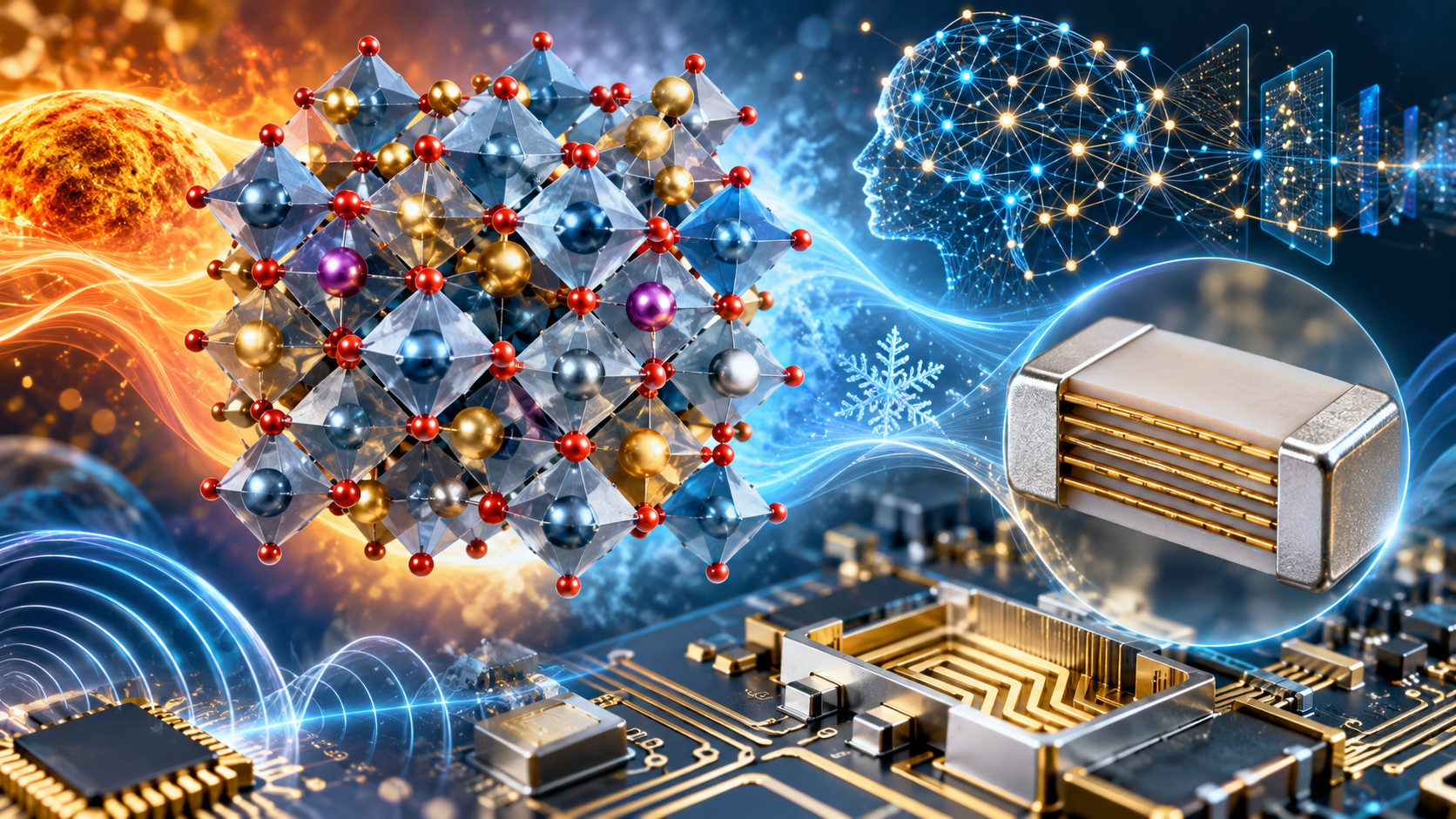
Paper: Temperature-stable high-κ oxides for miniaturized capacitors. AI-generated abstract conceptual image created using ChatGPT/OpenAI
A recent Nature Electronics study introduced a machine learning (ML)-guided strategy for designing temperature-stable, high-permittivity oxides for miniaturized electronic components.
Using this strategy to refine chemical co-substitution in tungsten bronze ceramics, researchers developed a material with a dielectric constant of 185, a loss tangent of 0.0005, and a temperature coefficient of capacitance within ±30 ppm K-1. These properties address key trade-offs in capacitor design, enabling compact, high-performance components for RF modules, integrated circuits, and telecommunications systems.
The Limitations of Traditional Dielectrics
Miniaturization in electronics requires dielectric materials that combine high relative permittivity (κ), low dielectric loss (tan δ), and a near-zero temperature coefficient of capacitance (TCκ). But improving one property often compromises another.
For example, ferroelectric ceramics like barium titanate exhibit high permittivity but significant dielectric loss because of domain-wall motion. Compared with these materials, paraelectric materials such as strontium titanate have lower loss but moderate permittivity and negative temperature coefficients.
Linear dielectrics, like silicon dioxide, offer low loss and good thermal stability but have low permittivity, limiting their use in miniaturized components. The ML-guided materials discovery approach offers a systematic way to examine these relationships and identify dielectric materials that balance permittivity, loss, and temperature stability.
ML Approach for Material Design
Researchers developed a hierarchical ML approach to identify dielectric materials with high permittivity and temperature stability. The initial datasets included 250 material samples with 24 permittivity-related features and 162 samples with 24 temperature-coefficient features, corresponding to 6,000 and 3,888 data entries, respectively.
After cleaning the data and analyzing correlations, the researchers retained six key global features for modeling.
The researchers evaluated several algorithms using ten-fold cross-validation for hyperparameter selection, then trained the final models on 70% of the data and tested them on 30% across 1,000 random splits.
Random forest regression achieved an R2 (coefficient of determination) above 0.80 for predicting room-temperature permittivity. For TCκ, support vector regression (SVR) with a radial basis function kernel achieved an R2 above 0.65 for predicting the temperature coefficient of capacitance.
These models screened a virtual library of 132,651 entries and identified tungsten bronze oxides as promising materials because of their flexible crystal structures.
Local feature analysis and density functional theory (DFT) calculations examined factors governing dielectric performance. The analysis linked permittivity to atomic mass and electronegativity at four-membered ring sites in the tungsten bronze lattice, while metal-oxygen octahedral bond strength and covalency were associated with temperature stability.
The study assessed dielectric loss later during experimental validation rather than predicting it as a primary ML target.
Synthesis and Characterization of Dielectric Material
For experimental validation, the study synthesized Ba4Nd9.33Ti18O54 (BNT) and its Bi- and Ge-substituted derivatives by solid-state reaction. The researchers wet-milled BaCO3, Bi2O3, TiO2, GeO2, and Nd2O3 in ethanol for 20 hours, adding excess bismuth to Bi-containing batches to compensate for evaporation. The powders were calcined at 800-1,000 °C, pressed with a binder, and sintered at 1,100-1,400 °C for 1.5-6 hours.
Bismuth was introduced at the A″ site to increase permittivity, and germanium at the titanium site to improve thermal stability. Prototype single-layer chip capacitors were fabricated using roll-to-roll tape casting to produce 20 μm-thick ceramic tapes, which were warm-isostatically laminated and fitted with titanium-tungsten, nickel, and gold electrode layers.
Improved Dielectric Performance and Mechanistic Insights
Experimental validation showed that dual-site substitution improved the dielectric properties of the tungsten bronze ceramic.
Replacing neodymium with bismuth at the A″ sites increased ionic polarizability, raising the permittivity to approximately 205 at a 50 mol% substitution level. This gain came with a less favorable temperature coefficient of about -140 ppm K-1, which motivated the germanium substitution step.
Germanium substitution at the titanium sites introduced stronger Ge-O (Germanium-Oxygen) bonds that influenced local atomic displacements and improved thermal stability.
The final composition, Ba4(Nd0.5Bi0.5)9.33(Ti0.99Ge0.01)18O54 (BNBGT), had a dielectric constant of 185, a loss tangent of 0.0005, and a temperature coefficient of capacitance of -22 ppm K-1.
In situ high-angle annular dark-field scanning transmission electron microscopy revealed that the average atomic displacement at the A-sites increased by approximately 23% as the temperature rose from room temperature to 500 °C. Quasi-harmonic density functional theory calculations suggested that strong Ge-O bonding promoted cooperative tilting of neighboring octahedra through bridging oxygen atoms.
The resulting local symmetry breaking sustained non-centrosymmetric polar displacements during thermal expansion, counteracting the reduction in dielectric susceptibility associated with lattice expansion.
Capacitor Fabrication and Reliability Testing
The BNBGT ceramic showed a frequency-stable dielectric response in separate measurements from 1 Hz to 1 GHz.
To evaluate its suitability for electronic components, researchers fabricated single-layer chip capacitors with titanium-tungsten, nickel, and gold electrodes. They fabricated prototypes with design capacitances of about 1, 4.5, 8, and 35 pF, using the 35 pF device for frequency-dependent measurements.
The prototypes exhibited linear, hysteresis-free polarization responses during high-electric-field testing from -70 °C to 150 °C. A 1 pF prototype measuring 0.35 × 0.35 × 0.20 mm3 was about 85% smaller by volume than the Murata CLB095C1R0K1000TC1 comparator used in the paper, which measures 0.90 × 0.90 × 0.20 mm3.
Reliability testing demonstrated that the capacitors retained more than 99.8% of their initial capacitance after 1,000 thermal shock cycles between -55 °C and 150 °C. During accelerated lifetime testing at 1,000 V and 150 °C for 100 hours, capacitance changed by no more than 0.1%, resistivity decreased by no more than 15%, and no device failures were observed.
Future Directions in Dielectric Material Development
The study combined ML-guided materials discovery with atomic-scale characterization to develop temperature-stable, high-permittivity tungsten bronze ceramics. The BNBGT composition was used to fabricate miniaturized single-layer chip capacitors that were about 85% smaller by volume than the specific commercial Murata comparator used in the study while maintaining low dielectric loss and temperature stability.
The open-access dielectric databases and hierarchical ML workflow could be used to screen other functional oxides. The paper also reports parallel experiments in several tungsten bronze systems that supported the wider co-doping strategy.
Disclaimer: The views expressed here are those of the author expressed in their private capacity and do not necessarily represent the views of AZoM.com Limited T/A AZoNetwork the owner and operator of this website. This disclaimer forms part of the Terms and conditions of use of this website.