A spiropyran-coated carbon nanotube catalyst uses light to attack a persistent water contaminant and raises questions about how well the approach could perform beyond controlled laboratory tests.
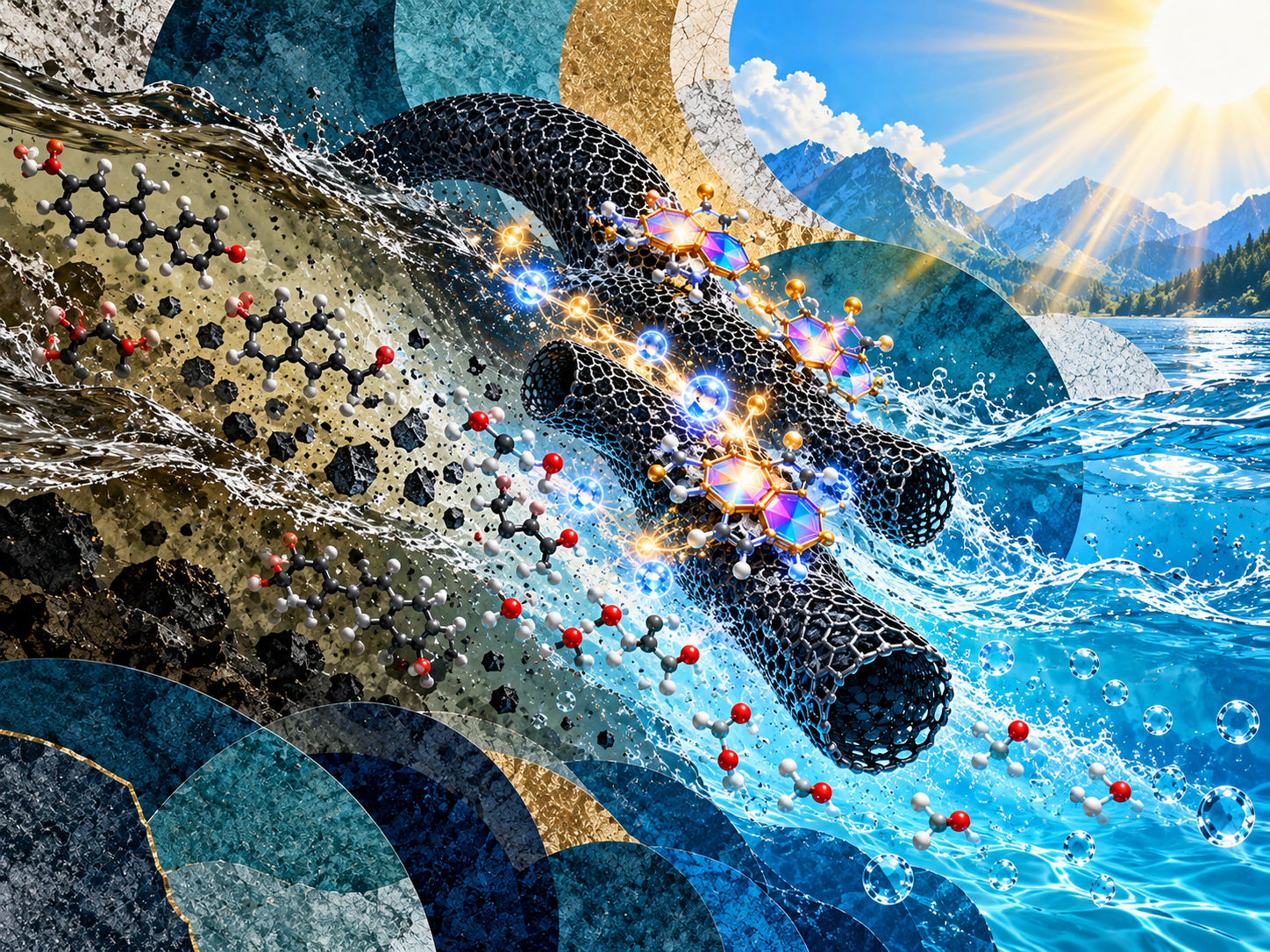
Paper: Design and development of a photochromic material based on spiropyran for Bisphenol A removal. AI-generated abstract conceptual image created using ChatGPT/OpenAI
*Important notice: This news reports on an unedited version of an accepted paper and is awaiting final editing. Therefore, the paper should not be regarded as conclusive or treated as established information.
In a recent study published in the journal Scientific Reports, researchers introduced a light-activated nanohybrid that increased the apparent pseudo-first-order degradation rate constant for Bisphenol A (BPA) by about 19-fold compared with uncatalyzed photolysis under simulated solar irradiation in laboratory tests.
This material combines light-responsive spiropyran molecules with conductive multi-walled carbon nanotubes (MWCNTs). Upon light exposure, the hybrid generates reactive oxygen species that degrade BPA.
The treatment also produced a modest reduction in cytotoxicity in MCF-7 cell assays, suggesting that the material merits further study for wastewater treatment.
The Challenge of BPA in Aquatic Environments
BPA is a prevalent industrial pollutant that enters water through plastic production, consumer products, and industrial wastewater. Its stable chemical structure makes it difficult to remove completely through conventional wastewater treatment processes, contributing to its persistence in aquatic environments. BPA exposure has also been linked to effects on wildlife physiology, and widespread human exposure has been reported.
Advanced oxidation processes (AOPs) and photocatalysis offer additional methods for degrading pollutants. These techniques use reactive oxygen species to break down organic compounds. Attaching light-responsive molecules to nanomaterials lets researchers control catalytic activity with light and can make the catalyst easier to recover after treatment.
Synthesis and Characterization of the MWCNT Hybrid
Researchers prepared the nanohybrid by loading spiropyran molecules onto commercial MWCNTs, which the supplier specified as 40 to 60 nm in diameter and 1 to 2 µm long; High-resolution transmission electron microscopy (HRTEM) later showed apparent diameters of about 17 to 30 nm.
They dispersed 1 g of pristine MWCNTs in 20 mL of a 5 mM spiropyran solution and stirred the mixture at 70°C for about 24 hours.
The nanohybrid was then rinsed with ultrapure water to remove unbound dye. Ultraviolet-visible (UV-Vis) measurements using a Multiskan GO microplate reader monitored the supernatant during washing until spiropyran was no longer detected, followed by an absolute ethanol wash and drying at 70°C.
The study characterized the nanohybrid using several analytical techniques. HRTEM and energy-dispersive X-ray spectroscopy (EDX) examined its structure and composition. Raman and infrared spectroscopy identified structural and functional-group features, while X-ray photoelectron spectroscopy analyzed surface elements and chemical bonding. X-ray diffraction (XRD) assessed crystallinity and average crystallite size. Nitrogen adsorption measurements determined the Brunauer-Emmett-Teller (BET) surface area and pore properties.
Together, these measurements confirmed spiropyran loading and showed that the nanotubes largely retained their structure.
Kinetics and Mechanisms of Photocatalytic Activity
Spiropyran was successfully loaded onto the carbon nanotubes, with XPS nitrogen measurements suggesting an apparent spiropyran surface loading of about 14 wt%, assuming the detected nitrogen came entirely from spiropyran.
The specific surface area decreased from 140.45 m²/g for the raw MWCNTs to 50.22 m²/g for the hybrid, suggesting partial pore filling while retaining photoactivity. HRTEM confirmed that the nanotubes maintained their tubular structure, and XRD showed graphitic crystallites with an average size of 3 nm.
Photocatalytic tests followed pseudo-first-order reaction kinetics. Dark adsorption tests accounted for only about 5% to 10% BPA removal, depending on catalyst loading.
Under simulated sunlight, the degradation rate constant increased from about 0.0013 min-¹ without a catalyst to 0.0251 min-¹ with 1.00 g/L nanohybrid, achieving about 63% BPA removal within 30 minutes. Using secondary municipal wastewater effluent spiked to 5 µM BPA, the system degraded nearly 50% of BPA in just 15 minutes.
Dissolved organic matter, nitrate, and iron species in the effluent may have increased the reaction through photochemical processes, but the study did not isolate or quantify the contribution of individual wastewater constituents.
Electron spin resonance measurements detected singlet oxygen concentrations of about 84 µM after two hours of UVA irradiation. Scavenger tests indicated that singlet oxygen and hydroxyl radicals were the primary contributors to BPA degradation.
The researchers identified intermediate compounds, including 1,4-benzoquinone, p-hydroquinone, and phenol, and placed them within a proposed pathway in which further oxidation and ring opening can produce shorter-chain aliphatic molecules.
The study did not fully identify all degradation products or establish complete mineralization under the tested conditions.
Human cell assays using MCF-7 cells indicated a modest reduction in cytotoxicity after treatment, while the authors noted that some intermediate products may retain residual cytotoxic activity.
Practical Applications for Wastewater Treatment
The spiropyran-nanotube composite has potential for light-driven wastewater treatment, though the experiments were conducted at laboratory scale with artificial irradiation. Its activity under near-neutral to slightly alkaline conditions may make it compatible with conventional wastewater treatment without major pH adjustment, though the authors did not test municipal-scale integration, costs, or energy use.
For catalyst recovery, the authors propose combining sedimentation with microfiltration or ultrafiltration. Carbon nanotubes tend to aggregate when stirring stops, which could help them settle before membrane filtration and reduce the solids load on the membrane.
Future Directions for Environmental Remediation
The spiropyran-nanotube composite removed BPA in these experiments without added chemical oxidants during photocatalysis.
Recycling tests showed that the material retained its crystalline structure over four cycles, while BPA degradation efficiency declined gradually. UV-Vis analysis found no characteristic signals of free spiropyran derivatives or detached carbon nanostructures in the filtered treated water under the tested conditions.
Future work should test the composite against mixtures of industrial pollutants, assess its long-term stability in continuous-flow systems, and examine the fate and toxicity of degradation by-products, catalyst recovery, and solar reactor performance at larger scale. These studies are needed to determine whether these results can translate to larger treatment systems and whether catalyst recovery and energy use are practical.
Disclaimer: The views expressed here are those of the author expressed in their private capacity and do not necessarily represent the views of AZoM.com Limited T/A AZoNetwork the owner and operator of this website. This disclaimer forms part of the Terms and conditions of use of this website.