A new partnership between Lucideon and Excelitas® is utilizing the power of Xenon Flash lamp technology to deliver the next generation of high-performance ceramic materials, in sectors including aerospace, nuclear, and energy.
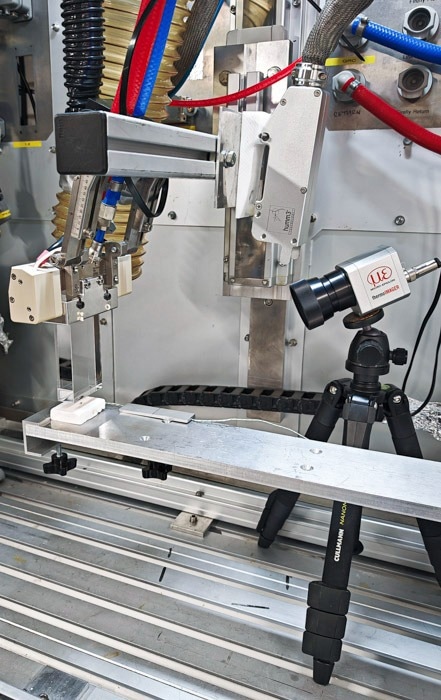 Image Credit: Lucideon
In collaboration, both companies are developing a Xenon Flash sintering technique using high-intensity lamps to rapidly sinter ceramic materials fully contact-free.
Sintering is a critical process that involves heating materials below their melting point to increase their strength and density by bonding particles at the atomic level, giving advanced ceramics the capability to perform robustly in the most challenging conditions.
Sintering is typically both energy-intensive and time-consuming. When densifying thin ceramic layers or coatings, having a process that can rapidly sinter the ceramic layer without damaging substrate is essential. The introduction of the new Xenon Flash lamp technology offers a new level of capability to transform processing times, reduce energy consumption, and offer greater flexibility.
David Pearmain, Business Manager – Technology Engagement & Partnerships at Lucideon said: “The ability to rapidly sinter ceramic layers without damaging the substrate of a component, while maintaining microstructural control and remaining cost-effective and scalable, is a high priority for critical sectors including the aerospace, nuclear, and energy industries.
“Xenon Flash offers a solution, as it can provide targeted direct high temperature heating, without requiring contact with the sample.
“Suitable applications include sintering fragile structures such as films, parts which are prohibitively large to heat, or layered structures with thermally sensitive layers that cannot withstand typical sintering temperatures, in critical devices such as solid oxide fuel cells (SOFCs), solid-state batteries, ceramic matrix composites (CMCs), and environmental barrier coatings (EBCs).
“For many of these applications, new sintering methods not only deliver in terms of cost reduction and enhancing productivity, but are key to enable manufacturing in the first place.”
Under the partnership, Excelitas’ commercialized Xenon Flash technology, is working with Lucideon's proprietary real-time linear control software, materials science expertise, and testing and characterization.
Ross Kitson, Sales Manager at Excelitas®,said: “Sintering is a critical step in ceramic processing, but it is typically both energy intensive and time consuming.
“When densifying thin ceramic layers or coatings, the maximum safe sintering temperature is often constrained by the operating temperature of the substrate.
“Processing at these lower temperatures can negatively affect the performance of the ceramic layer and, in some cases, may require alternative deposition technologies, where extremely thin layers of material are added to the substrate, or even prevent the manufacture of certain components entirely.
“Xenon Flash sintering is an exciting development, due to its ability to deliver a high temperature, rapid heating technique, which requires no physical contact with the part or sample.
“It offers a broad emissions spectrum too, spanning ultraviolet to infrared wavelengths capable of heating large surface areas.
“The end result is a scalable technology with significant potential for rapid ceramic processing.”