From rare earth recycling to AI-managed cooling, engineers are racing to make data centers less wasteful and more resilient.
 Image Credit: kwarkot/Shutterstock.com
At the end of 2024, data centers accounted for approximately 1-1.2 % of global electricity use and around 0.4 % of greenhouse gas emissions, with figures projected to rise as artificial intelligence (AI), blockchain, and cloud computing scale globally.1
The International Energy Agency warns that without major innovation in materials and energy efficiency, this trajectory threatens to undermine net-zero ambitions.2
Sustainability in data centers is not simply an engineering challenge but a scientific and ethical imperative.
The Limits of Sustainability in Data Centers
Although digital systems may seem intangible, a world built in the ether, their foundations are firmly tethered to the physical world. Servers, storage units, and network devices depend on metals such as cobalt, lithium, tantalum, and indium, which are all limited in supply, concentrated in specific regions, and often extracted through processes that harm the environment.2
The production of each high-density server also generates substantial embodied carbon emissions during manufacturing and transportation. As Meinhold et al. (2025) argue, the depletion of such materials highlights the catch-22 in digital sustainability: technological efficiency gains are often offset by rebound effects in resource consumption.2
The physical limits of computation also impose a baseline energy cost. Most of a data center’s electricity is consumed not by computation but by the cooling systems that maintain stable operating temperatures.
The Power Usage Effectiveness (PUE) ratio, which compares total facility energy with IT energy, illustrates this inefficiency: the global average remains close to 1.5, meaning that every watt of computational power requires roughly half a watt more for supplementary operations.2
To address these constraints, researchers and industry leaders are redesigning materials, rethinking energy flows, and integrating renewable and circular systems.
Advanced Cooling Technologies for Energy-Efficient Data Centers
As the largest non-computational energy burden, cooling equipment accounts for over a third of total electricity consumption in many facilities. The transition from air-based to liquid-based cooling is a significant advancement in making this process more efficient.3
According to Chidolue et al., liquid immersion cooling, hot aisle containment, and free-air cooling can dramatically improve efficiency by optimizing heat transfer and reducing dependence on compressors and refrigerants.3
Google’s Hamina data center in Finland demonstrates this innovation at scale. Using seawater for indirect cooling, it has reduced cooling energy by up to 80 % while eliminating refrigerants entirely.4
In a similar move towards sustainability, Microsoft’s “Project Natick” tested underwater data centers cooled by ocean currents, achieving up to 40 percent energy savings compared to traditional onshore facilities. These examples show how integrating natural environments into design can redefine thermal management.5
An emerging field in developing sustainable data centers is waste heat recovery, where expelled heat is captured and reused for district heating.
For example, Meta’s Odense data center in Denmark recycles around 100,000 MWh of heat each year, enough to warm about 11,000 homes.
This closed-loop approach demonstrates how the byproducts of computation can be transformed into valuable community resources.
Rare Earth Recycling and Circular Design
The sustainability of data centers also depends on the materials that compose them. Servers and IT equipment typically have life cycles of only three to five years, leading to large volumes of electronic waste and loss of valuable rare earth materials.6
To address this, data center design is increasingly emphasizing modular construction and recyclability. Companies such as Dell and HP now produce servers with standardized, easily disassembled components, simplifying material recovery and reuse.7
Efforts to reduce embodied carbon extend to the buildings themselves. Murino et al. highlight green building strategies such as low-carbon concrete, cross-laminated timber, and passive ventilation, which significantly reduce lifetime emissions.6
Circularity extends beyond materials to energy flows. The integration of renewable energy, storage systems, and intelligent grid balancing forms the basis of sustainable energy management.8
On-site solar arrays, wind turbines, and batteries enable facilities to operate independently of fossil fuel grids, while AI-based control systems optimize load distribution and minimize waste in real-time.7
How are data centers powered sustainably?
Video Credit: Google Cloud Tech/Shutterstock.com
How AI is Optimizing Energy Use in Data Centers
Although artificial intelligence is energy-intensive in itself, it has become a key tool in enhancing sustainability. AI-driven data center infrastructure management systems continuously monitor conditions and adjust cooling loads, server use, and power allocation.2 Google DeepMind’s collaboration with Google Data Center Operations achieved a 40 % reduction in cooling energy use through machine learning optimization.
Similarly, OpenAI uses artificial intelligence–driven resource scheduling to balance computation across GPUs and CPUs, reducing idle energy use.2 These feedback systems represent digital sustainability in action, applying intelligent control to lessen the environmental impact of digital infrastructure.
Get all the details: Grab your PDF here!
Liquid Cooling and Sustainable Water Use
While liquid cooling greatly improves energy performance, it raises new sustainability challenges regarding water use. The U.S. National Renewable Energy Laboratory estimates that data centers consumed over 600 billion liters of water in 2014, primarily for evaporative cooling.
To address this, many facilities have begun a transition to closed-loop cooling systems that rely on non-potable or recycled water.
Microsoft’s Arizona data center, for example, operates with zero freshwater consumption, reusing treated wastewater for heat exchange. Meanwhile, Google has committed to being water positive by 2030, returning more water to ecosystems than it withdraws.
These measures highlight the need to strike a balance between energy efficiency and responsible water management, a dual priority for the next generation of data centers.
Sustainable Data Center Construction
Sustainability principles now extend to the architecture and location of data centers. The idea of building with place, which means adapting design to local environmental conditions, has become central to green construction.3
Iceland’s Verne Global center exemplifies locational efficiency. Powered entirely by geothermal and hydroelectric sources and benefiting from the island’s cool climate, it operates without mechanical chillers.
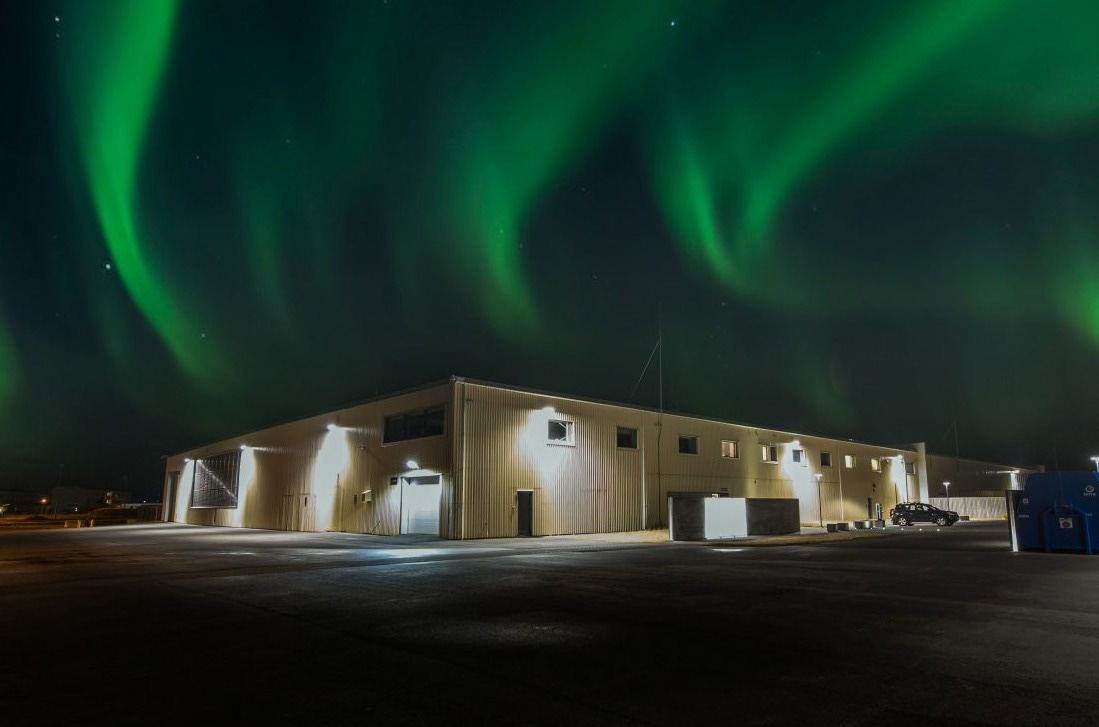 Image Credit: Verne Global
Circular Energy Models and Policy Integration
The broader vision of sustainable data centers aligns with the principles of the circular economy, which emphasize minimizing waste, maximizing reuse, and closing resource loops.
Energy reuse, renewable sourcing, and recyclable materials converge within transparent regulatory frameworks. Metrics such as PUE, Water Usage Effectiveness (WUE), and Carbon Usage Effectiveness (CUE) have become industry standards for measuring environmental performance.9
Murino et al. emphasize the importance of embedding these metrics into corporate compliance systems to ensure accountability and accelerate progress.
On a policy level, the European Union’s “Climate Neutral Data Centre Pact” requires all EU data centers to reach carbon neutrality by 2030, establishing clear targets for renewable integration, heat reuse, and lifecycle transparency. Such frameworks translate voluntary innovation into enforceable standards, driving sector-wide consistency.6,10
The Future of Data Center Sustainability
The journey toward sustainable data centers is not a simple tech upgrade, it's a systems-level redesign of how digital infrastructure interacts with the planet. Innovations in materials, cooling systems, renewable integration, and AI-driven management represent vital progress toward reducing environmental impacts.
The data center of the future must embody not only efficiency but also ecological reciprocity, creating facilities that recycle heat, reuse materials, and regenerate water. In this vision, digital progress becomes a process of coexistence rather than consumption, where the growth of computation aligns with the restoration of the planet.
References and Further Readings
- Banerjee, S., Sustainable Data Engineering: Building Business Success with Eco-Friendly Innovations. In Driving Business Success through Eco-Friendly Strategies, IGI Global Scientific Publishing: 2025; pp 375-396.
- Meinhold, R., Wagner, C., Dhar, B. K., Digital Sustainability and Eco-Environmental Sustainability: A Review of Emerging Technologies, Resource Challenges, and Policy Implications. Sustainable Development 2025, 33, 2323-2338.
- Onyinyechukwu, C., Peter, E. O., Aniekan, A. U., Bright, N., Adetomilola, V. F., Kenneth, I. I., Green Data Centers: Sustainable Practices for Energy-Efficient IT Infrastructure. 2024.
- Kseibati, R. Cooling Innovation and Circularity: Addressing Water Stress in the Age of AI-Driven Data Centers. Massachusetts Institute of Technology, 2025.
- Ewim, D. R. E.; Ninduwezuor-Ehiobu, N.; Orikpete, O. F.; Egbokhaebho, B. A.; Fawole, A. A.; Onunka, C., Impact of Data Centers on Climate Change: A Review of Energy Efficient Strategies. The Journal of Engineering and Exact Sciences 2023, 9, 16397-01e.
- Murino, T.; Monaco, R., Nielsen, P. S., Liu, X., Esposito, G., Scognamiglio, C., Sustainable Energy Data Centres: A Holistic Conceptual Framework for Design and Operations. Energies 2023, 16, 5764.
- Vishwakarma, S., Kumar, V., Arya, S., Tembhare, M., Dutta, D., Kumar, S., E-Waste in Information and Communication Technology Sector: Existing Scenario, Management Schemes and Initiatives. Environmental Technology & Innovation 2022, 27, 102797.
- Liu, W.; Li, X., Wang, J., Zhong, J., Wang, M., Yang, J., Knowledge Mapping of Research on Securing the Supply Chain for Critical Minerals: A Scientometrics and Text Mining Approach. Journal of Cleaner Production 2024, 434, 140312.
- Wesselkämper, J., Dahrendorf, L., Mauler, L., Lux, S., Von Delft, S., Towards Circular Battery Supply Chains: Strategies to Reduce Material Demand and the Impact on Mining and Recycling. Resources Policy 2024, 95, 105160.
- Chountalas, P. T., Chrysikopoulos, S. K., Agoraki, K. K., Chatzifoti, N., Modeling Critical Success Factors for Green Energy Integration in Data Centers. Sustainability 2025, 17, 3543.
Disclaimer: The views expressed here are those of the author expressed in their private capacity and do not necessarily represent the views of AZoM.com Limited T/A AZoNetwork the owner and operator of this website. This disclaimer forms part of the Terms and conditions of use of this website.