Sponsored by InterpowerReviewed by Olivia FrostApr 9 2026
Polymer pioneers from the 1960s and 1970s worked with various thermoplastics to develop a low-smoke, zero-halogen (LSZH) cable for the wire and cable industry.
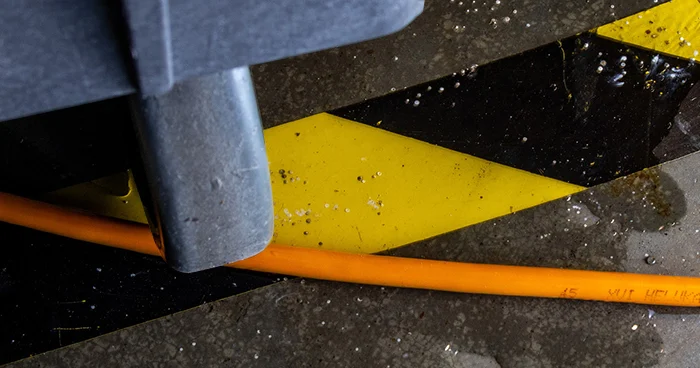
Image Credit: Interpower
Despite the achievement of low-smoke, low-halogen (LSLH) cable, the efforts of these scientists and engineers were not in vain; in 1979, Richard Skipper of the Raychem Corporation in Menlo Park, California, created the first LSZH thermoplastic by infusing it with aluminum trihydrate.
Aluminum trihydrate [Al(OH)3] is a white, odorless powder made from bauxite and widely used as a flame retardant. The new invention significantly reduced flames and smoke when exposed to high temperatures.
According to the Universal Harmonized Wire Coding System, the alpha-numeric code H05BQ-F indicates that the cable is LSZH due to its unique jacket and insulation compositions, as well as its fine-wire flexibility. This cable is further discussed in paragraph four.
Raychem's primary markets at the time were aerospace, automotive, and telecommunications. It is also worth noting that Raychem was developing touchscreens decades before mobile phones and other touchscreen gadgets became popular.
Raychem and other cutting-edge technology companies, whether conventional IBM or upstart Apple, would need miles of flexible wire inside their ever-shrinking control panels, where millions of computations were performed on a daily basis. They saw not only the hazards of wires and elements overheating to the point of combustion, but also the poisonous and toxic gases that accompany fire and smoke.
That is why LSZH cable has become extremely popular worldwide over the last four decades.
Such gases and other forms of toxic chemicals are thought to have spurred the EU agencies RoHS and REACH, which codified prohibitions on hazardous compounds, with RoHS limited to substances present in electronics, such as electrical fires that emit corrosive gases like hydrogen chloride.
It is important to note that RoHS and REACH are only applicable in Europe. Thus, a cord set sold in North America, South America, Asia, and the Middle East is not required to be RoHS and REACH compliant. If you are importing into Europe, you must follow the guidelines set forth by those two EU authorities.
Breaking the Cord Codes
The HO5BQ-F alpha-numeric code denotes: (H) Harmonized; (05) 300-500V; (B) Ethylene-propylene rubber; (Q) Polyurethane; and (F) Fine wire flexible cable/cord. The cable's outer sheath is polyurethane (PUR), while the insulation is made of ethylene-propylene rubber (EPR).
This makes the cable exceedingly flexible, particularly when the conductor wires within the outer sheath are finely stranded copper wire. A remark on "Harmonized" and the "<HAR>" mark. International cables must be produced in accordance with European Norm (EN) 50525.
Member nations of the European Committee for Electrotechnical Standardization (CENELEC) have ratified the standard, which calls for the uniform manufacturing and testing of common items. In Europe, LSZH cable has both the <HAR> and "CE" markings.
Countries outside CENELEC's jurisdiction can obtain licenses to manufacture international cables; however, they must have their cables tested by a European testing organization in compliance with EN 50525, which can be a costly and time-consuming endeavor.
This is the price paid for selling cables in 27 European countries, again, where your testing certification comes from a legitimate European safety body like VDE. Aside from its flexibility, the H05BQ-F is resistant to oil, UV light, saltwater, wastewater, acids, hydrolysis, and microorganisms.
It is tear-resistant, cut-resistant, and abrasion-resistant, which is why, according to IEC 60601-1, 201.8.11.3.2, it is the only standardized cable that can be linked to hospital beds in Europe. If the two come into contact, the bed's wheels will not cut or tear the cable.
It is also worth noting that most European nations utilize standard home cables in hospitals rather than hospital-grade cords.
H05BQ-F cable is suitable for both indoor and outdoor applications, as well as dry and wet conditions. The cable is commonly extruded in orange for visibility in a number of applications, although it may be extruded in other colors.
Is H05BQ-F the Only International Cable?
Hardly. Interpower makes or provides HO3VV-F, HO5VV-F, H05RN-F, and a variety of additional international cables. The symbol "VV" indicates that the cable's outer sheath is made of PVC. "RN" stands for rubber (natural or synthetic), polychloroprene, and many more variations.
A brief time-saving chart can be downloaded from Interpower's website at the Harmonized Wire Coding System page. While Interpower makes international cable, it also produces cable for individual nations, including Australia, Korea, Japan, and China.
Interpower recently gained clearance to produce a particular cord set using Pecso Cavi 1.0mm2 H05BQ-F orange cable at a length of 8.2 ft., meeting all EN 50525 and IEC 60227 cable specifications.
The cable set has a Continental European CEE 7/7 black plug at one end and an IEC 60320 C13 black connection at the other end. The cable set is rated at 10A/250VAC, and the Interpower component number is 86232790. The cable meets European standards and has the <HAR> and CE certifications.
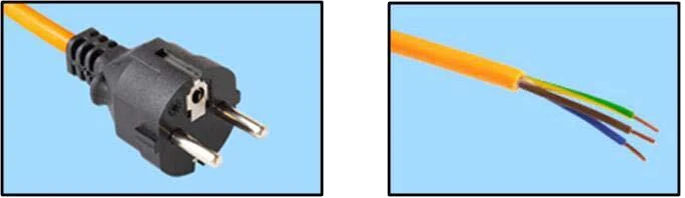
86232780 Continental European Power Cord. Image Credit: Interpower
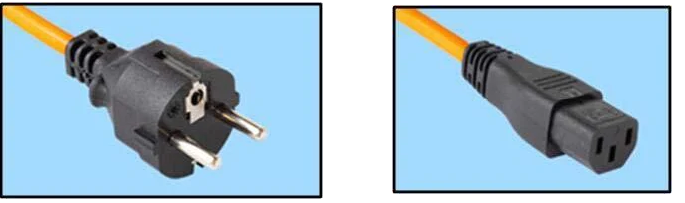
86232790 Continental European Cord. Image Credit: Interpower

This information has been sourced, reviewed, and adapted from materials provided by Interpower.
For more information on this source, please visit Interpower.