A new study suggests one of the biggest problems in room-temperature sodium-sulfur batteries may be avoidable by redesigning how sulfur reacts inside the cathode.
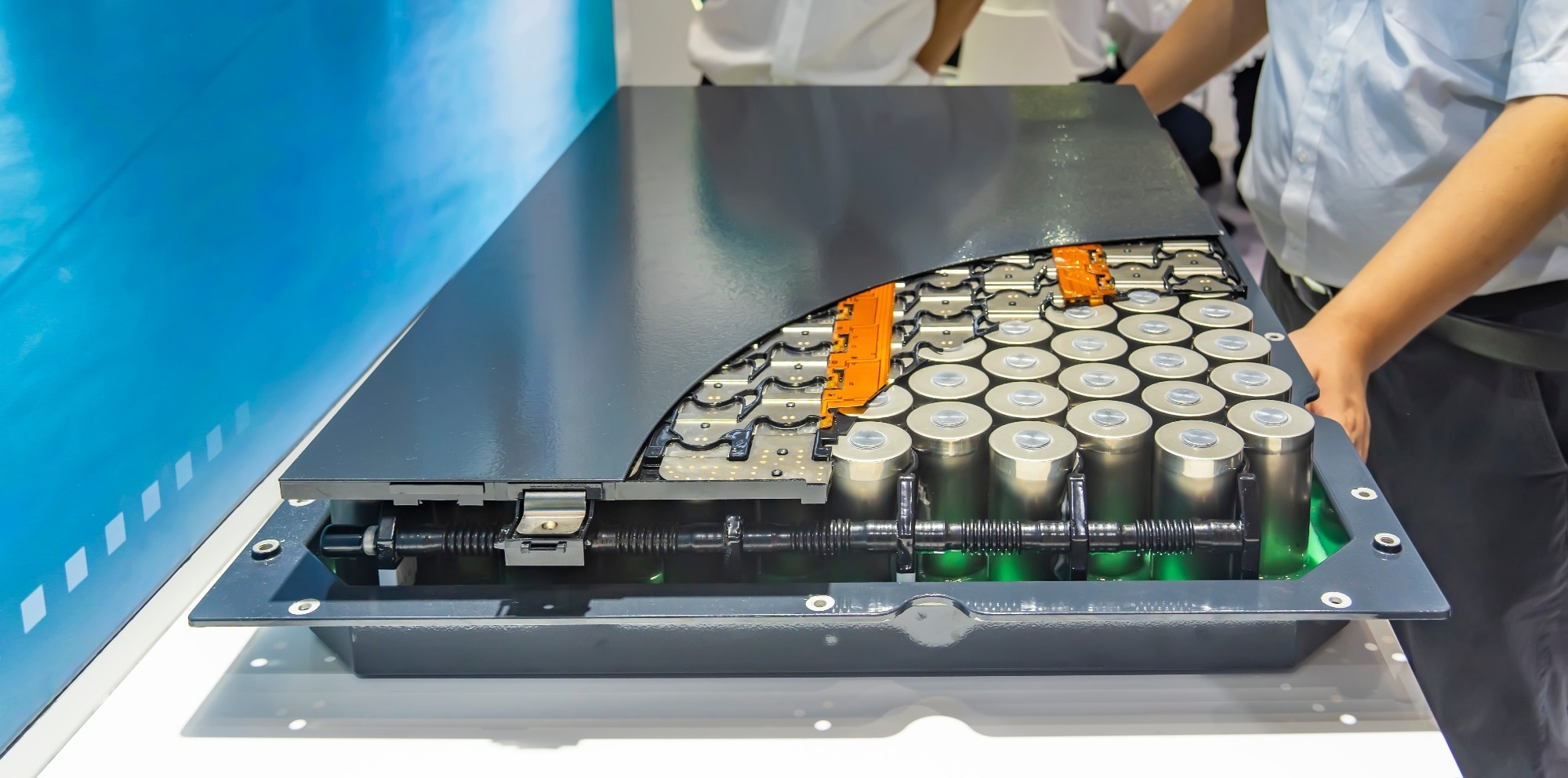 Study: Undercoordinated Molybdenum Catalysts Enable Ultrafast Quasi-Solid Sulfur Chemistry in Sodium-Sulfur Batteries. Image Credit: asharkyu/Shutterstock.com
Saving this for later? Download a PDF here.
Reporting in Advanced Materials, researchers in Australia and China say undercoordinated MoS2 nanosheets anchored to cross-linked carbon microspheres can guide sulfur through a quasi-solid-state reaction pathway, reducing polysulfide shuttling while sharply improving reaction speed and cycle life.
Sodium-sulfur (Na-S) batteries are promising candidates for large-scale energy storage. Sodium and sulfur are both abundant and inexpensive, and the chemistry offers high theoretical energy density. But practical performance has lagged for years.
Sulfur redox is slow; soluble sodium polysulfides migrate through the cell, side reactions build up, and the sodium metal anode degrades. This results in rapid capacity loss and poor long-term stability.
The Limits of Existing Solutions
Many efforts to improve Na-S batteries have focused on trapping sulfur in porous carbon or using polar materials to hold polysulfides more tightly. Those strategies help, but most still rely on a dissolution-based sulfur reaction pathway involving long-chain polysulfides. That means the shuttle effect is reduced, not removed, and the underlying kinetics remain sluggish.
A quasi-solid-state route offers a different approach. Instead of allowing sulfur to cycle through highly soluble long-chain intermediates, it pushes the reaction toward short-chain species in a more spatially confined environment. In principle, that should improve reversibility and reduce side reactions. In practice, though, these systems have often struggled with limited catalytic activity and weak ion transport under high current.
A Cathode to Control Sulfur Chemistry
The researchers set out to address that problem using what they describe as an unsaturated coordination chemistry strategy. The idea is to create undercoordinated molybdenum sites that serve as catalytic centers for sulfur conversion.
Their cathode host combines unsaturated MoS2 nanosheets with cross-linked carbon microspheres. The carbon framework provides a porous, conductive scaffold that can confine sulfur and buffer structural strain.
The MoS2 component was introduced by calcining ammonium tetrathiomolybdate with the carbon spheres at 500 °C under a 5 % H2/Ar atmosphere. Sulfur was then infused via melt diffusion to produce a uniform distribution of active material across the host.
Why is it Important that Mo is Undercoordinated?
The central claim is that the undercoordinated Mo sites do more than simply hold sulfur in place. They also change how sulfur reacts.
High-resolution electron microscopy identified sulfur vacancies, while synchrotron-based spectroscopy and EXAFS fitting were used to establish the undercoordinated Mo environment. X-ray absorption spectroscopy probed the electronic structure, and density functional theory calculations were used to evaluate bonding, adsorption energies, and catalytic behavior.
Together, those analyses suggest the unsaturated Mo sites act as Lewis acid centers, strengthening interactions with sodium polysulfides and accelerating their conversion. Computational results showed stronger Mo–S bonding and more favorable adsorption energies than in the control material, supporting the idea that the altered coordination environment is central to the catalytic effect.
Shifting the Reaction Pathway
That catalytic effect appears to change the sulfur redox chemistry itself. In situ X-ray diffraction indicated that sulfur conversion proceeds through short-chain intermediates, including Na2S4, followed by Na2S2 and Na2S. The absence of diffraction from long-chain polysulfides supports a quasi-solid-state pathway in the U-MoS2/C cathode under the reported conditions.
That matters because long-chain soluble polysulfides are closely tied to the shuttle effect, one of the main reasons Na–S batteries lose efficiency and degrade over time. By pushing the chemistry toward a more confined short-chain route, the cathode appears to suppress shuttling while improving reversibility.
The Results Revolve Around Performance
The most striking results are electrochemical. The cathode retained 933 mAh g-1 after 150 cycles and remained stable over 30,000 cycles at 10 A g-1. For room-temperature Na-S batteries, that combination of capacity retention, rate capability, and ultralong cycling is unusually strong.
The study also reports low self-discharge, stable operation at a sulfur loading of 3.3 mg cm-2, and pouch-cell performance of 445.5 mAh g-1 after 350 cycles. The pouch cell was able to power a red LED, providing a simple demonstration that the chemistry can be carried beyond coin-cell testing.
One of the most interesting parts of the paper is its attempt to directly visualize sodium-ion transport, rather than infer it only from electrochemical data.
Using in situ transmission electron microscopy in a specialized nanobattery setup, the team observed sodium ions penetrating the carbon microspheres and spreading through the structure.
They introduced two descriptors: sodium migration distance and local sodium concentration, to quantify transport. The authors present these as a methodological advance for studying Na-ion diffusion at the nanoscale.
They also add an important caution. The high bias used in the in situ TEM experiments is specific to the nanobattery configuration and does not directly represent the thermodynamic behavior of the electrode in a standard battery.
The Benefits Extend to the Sodium Anode
The improved cathode chemistry also appears to affect what happens at the sodium metal anode. By limiting soluble long-chain polysulfides and reducing parasitic reactions, the system promotes a more stable interphase.
The paper reports that the Na anode paired with the U-MoS2/C cathode forms an NaF-rich solid electrolyte interphase, whereas the control system produces a more organic-rich interphase.
That difference is consistent with lower interfacial degradation and helps explain why the cells cycle for so long without rapid failure.
The paper’s broader contribution is mechanistic. It links undercoordinated Mo active sites to faster sulfur conversion, quasi-solid-state redox, improved Na-ion transport, and more stable electrode interfaces.
In that sense, the findings provide a clear design logic for sodium-sulfur cathodes: combine catalytic regulation with structural confinement, and the chemistry becomes both faster and more controllable.
Journal Reference
Wang, M., et al. (2026). Undercoordinated Molybdenum Catalysts Enable Ultrafast Quasi-Solid Sulfur Chemistry in Sodium-Sulfur Batteries. Advanced Materials, e72912. DOI: 10.1002/adma.72912
Disclaimer: The views expressed here are those of the author expressed in their private capacity and do not necessarily represent the views of AZoM.com Limited T/A AZoNetwork the owner and operator of this website. This disclaimer forms part of the Terms and conditions of use of this website.