The Waters TA Instruments ARES-G3 Rheometer improves rheology by delivering sharper results across a greater number of conditions.
The ARES-G3 Rheometer uses cutting-edge technology and precise hardware to record genuine fluid behavior with fewer modifications and more accurate results. Its performance is built on 55 years of expertise.
Rheology is the study of how materials flow and deform. It is based on two fundamental measurements: the strain applied to a material and its response. These observations demonstrate the complex behavior of a wide range of materials, from low-viscosity fluids to stiff composites, under varying conditions.
Precision Powered by Innovation
The ARES-G3 Rheometer, which features sophisticated motor technology and a force rebalanced transducer (FRT), provides improved precision and consistent performance in crucial rheological measurements.
- Measurement accuracy: Measurements closer to genuine fluid dynamics with no geometry or inertia calibrations required, enabled by separate motor transducer (SMT) technology and perfect temperature control for reliable high-temperature testing
- Data and insights: collect higher quality data across a wider variety of rheological conditions with dual data acquisition, quicker rates, and increased functionality, plus decreased QC testing time by up to 80 % with the integrated optimally windowed chirps (Fast Frequency Chirps) process
- Usability and efficiency: Benefit from modern, intuitive software with fewer calibrations, walk-up usability, and quicker throughput for a smooth and efficient testing experience
Engineered for Next-Generation Rheology
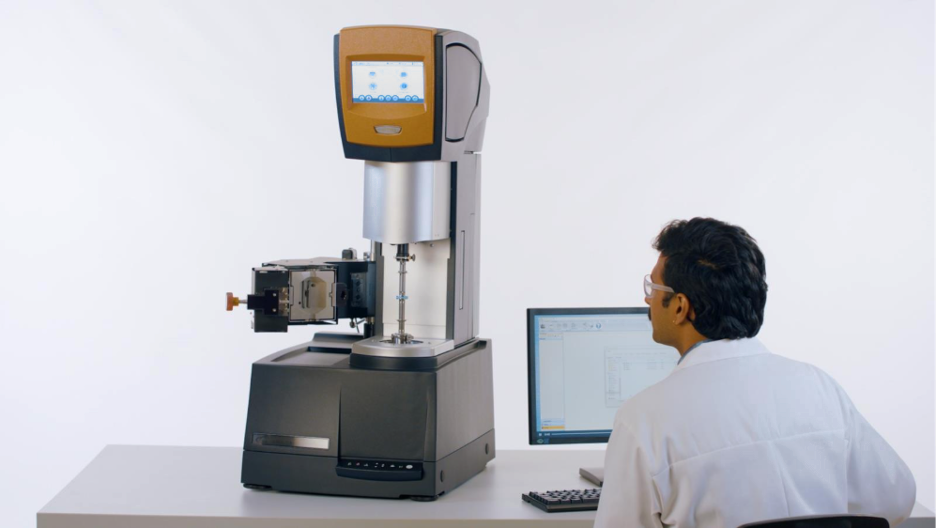
Image Credit: TA Instruments
- Easy controls: A new touchscreen and keypad make it easier to set up and run experiments
- Reliable data: Get unprocessed waveforms and phase angles for a more in-depth understanding
- Software: Walk-up usability, rapid setup, and fewer calibrations are made possible with TRIOS Express Software
- Improved data capture: High-speed acquisition and Fast Frequency Chirps reduce test times by up to 80 %
- Dependable testing environment: Dual gun heaters guarantee quicker, precise oxygen exclusion for polymer and composite testing
- Exceptional accuracy: Separate motor transducer (SMT) technology and force-rebalanced transducer (FRT) provide cutting-edge data with minimum adjustments
Separate Motor and Transducer (SMT) Technology
The ARES-G3 Rheometer's SMT design raises the bar for precision by separating the motor from the measurement, eliminating the need for typical calibration methods and revealing complex material characteristics that standard systems sometimes overlook.
This independence is especially useful for high-fidelity deformation testing, such as large-amplitude oscillatory strain (LAOS), as well as for assessing soft or complex materials, such as emulsions and polymers, under difficult conditions.
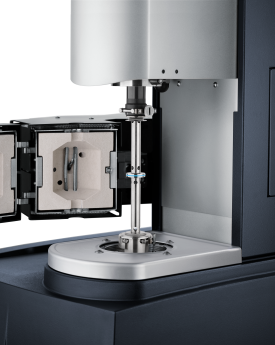
Image Credit: TA Instruments
At the heart of SMT is the force rebalanced transducer (FRT), which remains static and captures the sample's true response with minimal disturbance from motor dynamics. When combined with the strong drive motor, it produces cleaner data, free of mechanical noise, providing researchers with greater confidence in their rheological findings.
One Rheometer, Many Applications
Thermosets
Thermoset testing necessitates rapid, precise insight into curing, gelation, and viscoelastic changes when materials respond to heat. Advanced technologies such as Fast Frequency Chirps enable a new level of curing analysis, while precise thermal management and SMT design deliver consistent results across a wide temperature range.
Complex Fluids
Complex fluids, such as emulsions, suspensions, and slurries, display dual-phase behavior and intricate mechanical reactions. Advanced rheological tools provide the control and clarity needed to identify their underlying interactions and connect them to bulk properties.
Polymer Melts
Polymers transform from viscous melts to rigid solids, necessitating complete rheological characterisation, extensional viscosity, melt rheology, and DMA to optimize processing and performance. Advanced tools with purpose-built hardware and Fast Frequency Chirps methods speed up testing while reducing corrections.
Revolutionizing Rheology with Fast Frequency Chirp Technology
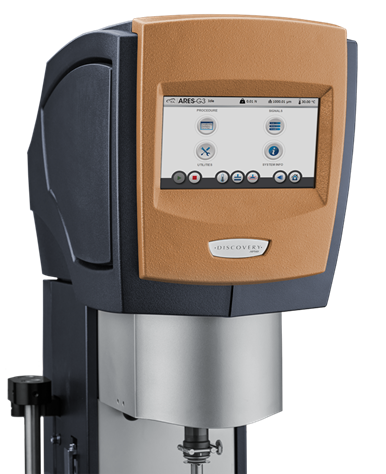
Image Credit: TA Instruments
The new optimally windowed chirps (Fast Frequency Chirps) technology1 implemented into TRIOS Software changes rheology frequency sweeps by significantly increasing speed and data density, particularly at low frequencies. Fast Frequency Chirps generates ramped time temperature superposition (TTS) master curves in about an hour, replacing multi-hour testing without sacrificing accuracy.
Unlike traditional single-frequency approaches, Fast Frequency Chirps uses quick sweeps to detect rapidly changing systems, such as curing or chemical processes, making it suitable for polymers, thermosets, and composites. Fast Frequency Chirps is fully integrated into TRIOS Software, simplifying operations with automated analysis and delivering faster, high-quality results.
Enhanced Measurement Capabilities
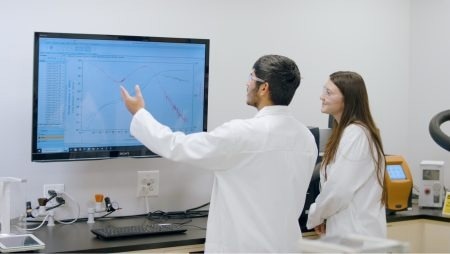
Image Credit: TA Instruments
The ARES-G3 Rheometer, with its cutting-edge technology and efficient SMT design, is an excellent solution for advanced testing applications. Its rapid-response motor enables the accurate execution of complex or user-defined deformation patterns, providing versatility beyond traditional testing standards.
Meanwhile, the force rebalanced transducer (FRT) technology maintains data integrity with minimal adjustment, producing findings that closely resemble actual material behavior and instill complete trust in the analysis.
Real Rheology for Real-World Applications
Rheology is most useful when it accurately represents real-world performance. The ARES-G3 Rheometer replicates a wide range of conditions, including temperature changes, force, and pressure, allowing materials to be developed and tested with confidence and accuracy.
Environmental
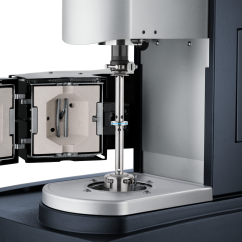
Image Credit: TA Instruments
The forced convection oven (FCO) and advanced peltier system (APS) provide fast temperature control and flexible testing options. Both attachments use SmartSwap technology for simple, plug-and-play installation.
Simultaneous Measurement
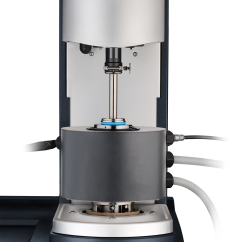
Image Credit: TA Instruments
Expand on fundamental rheology by using many analytical approaches (dielectric, electric fields, UV) to understand how a material flows when exposed to an external stimulus.
Beyond Rheology
The ARES-G3 Rheometer's precise stress and strain controls enable measurements beyond conventional rheology, including tribology, interfacial phenomena, linear dynamic mechanical analysis (DMA), extensional rheology, cone-and-plate rheometry, and orthogonal superposition (OSP).
Ultimate Upgrade Flexibility
The ARES-G3 Rheometer features a modular design and a high-performance core, providing a scalable platform that adapts to research and quality-control requirements.
- Faster workflows can expedite regular testing and data processing, hence improving lab productivity
- Expanded testing capabilities include support for solid material testing and sophisticated viscoelastic measures
- Enhanced data acquisition helps capture more comprehensive, concurrent data for better material insights
- Advanced control features allow sophisticated deformation profiles and waveform customization for cutting-edge research
Legacy and Support
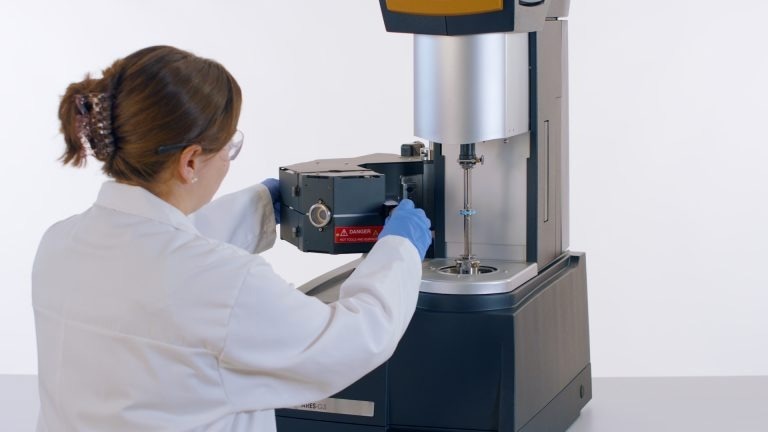
Image Credit: TA Instruments
TA Instruments has been at the forefront of rheology innovation since the 1970s, delivering performance and knowledge to the laboratories it supports. Their team of experienced application scientists and seasoned service specialists combines technical expertise with practical experience for maximized investment.
Specifications
Source: TA Instruments
| Force/Torque Rebalance Transducer (Sample Stress) |
| Minimum Transducer Torque in Oscillation |
0.02 µN.m |
| Minimum Transducer Torque in Steady Shear |
0.1 µN.m |
| Transducer Torque Resolution |
1 nN.m |
| Transducer Normal/Axial Force Range |
0.001 to 20 N |
| Drive Motor (Sample Deformation) |
| Maximum Motor Torque |
800 mN.m |
| Strain Resolution |
0.04 µrad |
| Min. Angular Displacement in Oscillation |
1 µrad |
| Angular Velocity Range |
1 x 10⁻⁶ rad/s to 300 rad/s |
| Angular Frequency Range |
1 x 10⁻⁷ rad/s to 628 rad/s |
| Step Change in Velocity |
5 ms |
| Step Change in Strain |
10 ms |
| Temperature Systems |
| Forced Convection Oven, FCO |
-150 °C to 600 °C |
| Advanced Peltier System, APS |
-10 °C to 150 °C |
| Dynamic Mechanical Analyzers |
0.0005 N |