Composition and Design Philosophy
The Role of Microalloying Elements in HSLA Steel
Strengthening Mechanisms in HSLA Steel
Thermomechanical Processing
Performance Advantages
HSLA Applications Across Industries
Conclusion
References and Further Reading
High-strength low-alloy (HSLA) steel is one of the most important material developments in modern metallurgy. HSLA steels achieve yield strengths ranging from 275 to more than 700 MPa through a carefully balanced combination of lean chemical composition and controlled processing.
These properties make HSLA steel more efficient than regular carbon steel while maintaining comparable or lower weight. As a result, HSLA steel is well-suited to applications where both strength and weight matter.
 Image Credit: Virrage Images/Shutterstock.com
Saving this article for later? Download a PDF here.
Composition and Design Philosophy
HSLA steels are defined by low carbon content, typically between 0.05 and 0.09 %, along with the intentional addition of microalloying elements at levels below 0.1 % by weight.
This low-carbon base is a deliberate design choice. It helps preserve weldability and ductility, while microalloying elements such as niobium (Nb), vanadium (V), and titanium (Ti) increase strength and toughness. Manganese (Mn) is also commonly added as a cost-effective solid-solution strengthener, improving the ferritic matrix and helping maintain a practical balance of strength and formability.
The result is a lean alloy system with lower carbon content, improved weldability, and less brittleness than conventional high-carbon steels.1,2
| Property |
HSLA steel |
Conventional carbon steel |
| Carbon content |
Low (about 0.05–0.09%) |
Usually higher, depending on grade |
| Main strengthening approach |
Microalloying + grain refinement + controlled rolling |
Carbon content + conventional processing |
| Yield strength |
About 275 to >700 MPa |
Generally lower for comparable structural grades |
| Weldability |
Good due to low carbon equivalent |
Often reduced as carbon content rises |
| Toughness |
Strong balance of strength and toughness |
Can decline in higher-strength grades |
| Weight efficiency |
High strength allows thinner sections |
Often requires thicker sections for the same load |
| Typical uses |
Automotive parts, bridges, pipelines, structural frames |
General-purpose structural and fabricated components |
The Role of Microalloying Elements in HSLA Steel
Each microalloying element contributes to the properties of high-strength low-alloy steel through distinct mechanisms.
Niobium is highly effective at preventing austenite recrystallization during hot rolling, even in small amounts, resulting in finer grains and improved toughness.
Titanium plays two roles: it stabilizes austenite grain size during reheating by forming stable TiN precipitates at high temperatures, and it interacts with Nitrogen (N) to make Niobium more effective by promoting NbC rather than Nb(CN) formation.
In contrast, Vanadium mainly strengthens the ferrite phase after transformation by forming fine VC and V(C, N) carbides that pin dislocations and raise yield strength.1,3
The precipitation behavior of niobium has been studied in detail. One study published in Materials Science and Engineering: A examined 450 MPa-grade Nb-bearing HSLA steel and identified NbC and Nb(C, N) particles with a mean size of just 8.2 nm. These particles were distributed across grain interiors and boundaries and contributed roughly 84 MPa of strengthening through precipitation alone.
These nanoscale carbides may appear as disc-shaped or spherical particles depending on precipitation temperature, and they align with the ferrite matrix through specific crystallographic relationships. Their small size is important because only nanometer-scale carbides create the particle-dislocation interactions needed for substantial strength increases.4
Strengthening Mechanisms in HSLA Steel
HSLA steels achieve their mechanical performance through the combined action of several strengthening mechanisms. Grain boundary strengthening, described by the Hall-Petch relationship, is often the most desirable because it improves strength and toughness at the same time. 5
Precipitation strengthening from finely dispersed carbonitrides further elevates yield strength but may reduce toughness when used alone. For this reason, grain refinement and precipitation strengthening are routinely combined, with grain refinement counterbalancing any toughness loss from precipitate hardening.
What's more, solid-solution strengthening from Manganese and Silicon contributes to overall strength, and dislocation strengthening from deformation during rolling adds a further increment.5
Thermomechanical Processing
The final properties of HSLA steel depend on both composition and processing route. The main production method is controlled thermomechanical rolling. This process takes advantage of microalloying elements that suppress recrystallization over a defined temperature range.
During the initial rough rolling, the steel is reheated. This process dissolves microalloying carbides and nitrides into the austenite. Small titanium-containing particles that survive solutionizing serve as grain-boundary pinning agents, keeping the austenite grain size fine.6,7
In the finishing passes, rolling occurs below the recrystallization stop temperature (RST). At this temperature, the austenite can deform but cannot recrystallize. This deformation creates bands and subboundaries that serve as sites for ferrite transformation as the steel cools. The final product has a ferritic microstructure with a much finer grain size than that produced by conventional hot rolling.
A variant called recrystallization-controlled rolling (RCR) performs both rough and finish rolling above the austenite recrystallization temperature. It produces equiaxed fine austenite grains through repeated recrystallization cycles before cooling. Accelerated cooling after rolling, by directing water-cooling onto the strip, suppresses pearlite formation and can further raise strength through transformation-based mechanisms.6,7
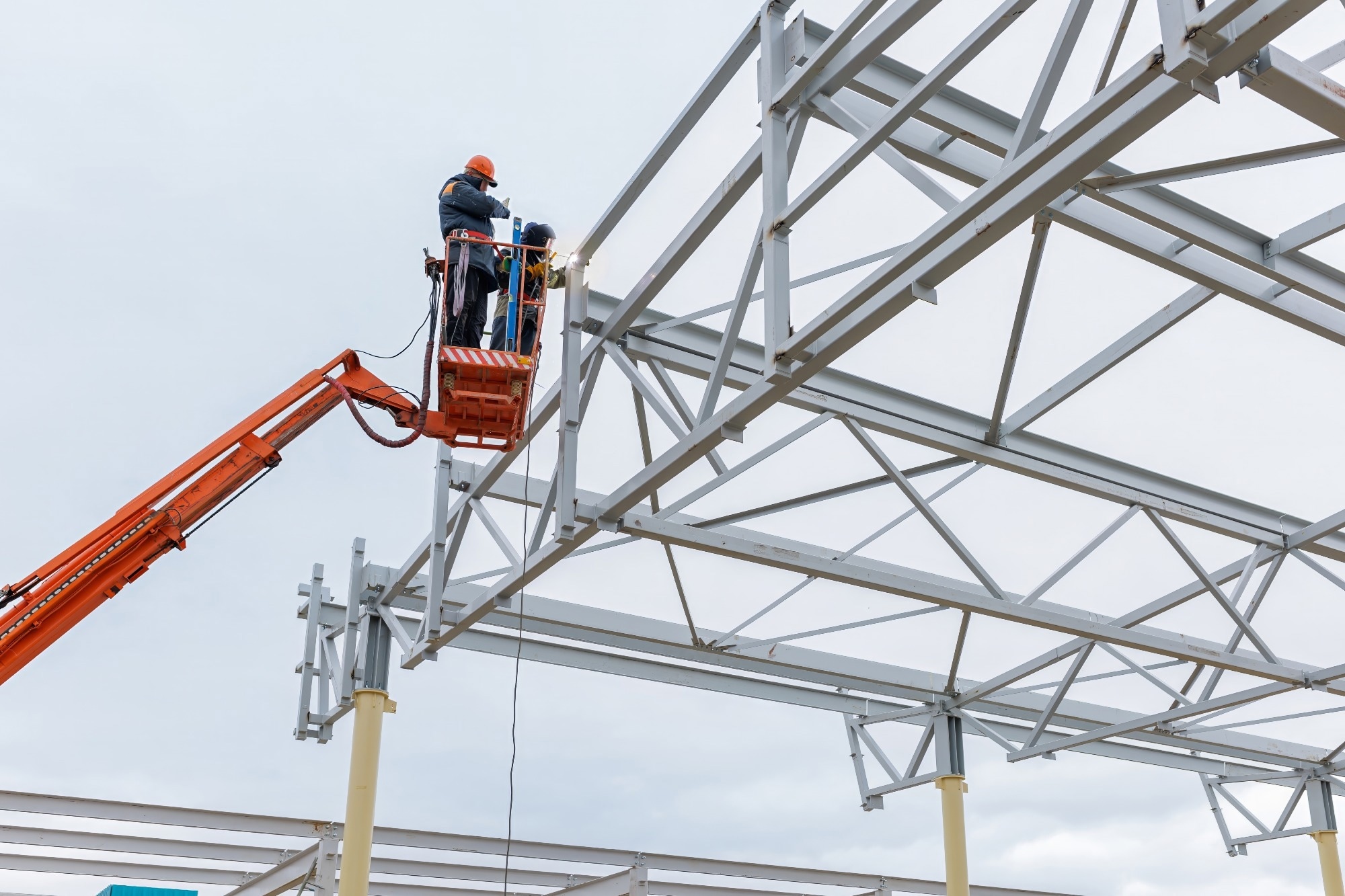 Image Credit: Deek/Shutterstock.com
The combination of grain refinement and precipitation strengthening gives HSLA steel a strength-to-weight ratio that conventional carbon steels struggle to match. This allows engineers to reduce section thickness and total material volume without sacrificing load-bearing capacity. In practice, that can mean lighter vehicles, slimmer bridge components, and more efficient structural frames.
Weldability is retained because of the low carbon equivalent, and post-weld properties remain strong.7,8
Studies show that properly welded HSLA joints can retain yield strengths above 520 MPa, with impact toughness values exceeding 295 J in the heat-affected zone at 0 °C. Fatigue performance is supported by fine grain size and the absence of large carbide networks, both of which slow crack initiation and propagation under cyclic loading.
In weather-resistant HSLA grades, additions of copper, chromium, and phosphorus encourage the formation of a tightly adherent rust layer that acts as a diffusion barrier. This significantly lowers atmospheric corrosion rates compared with plain carbon steel.7,8
HSLA Applications Across Industries
HSLA steel plays an important role in structural performance across several major industries.
In construction, it supports lighter beams and columns for high-rise buildings and long-span bridges while still meeting seismic and load requirements. In the automotive sector, HSLA sheet steel is used in chassis components, subframes, suspension systems, and structural reinforcements, where lower vehicle mass helps improve fuel economy and reduce emissions.2, 9, 10
Pipeline applications in the oil and gas industry were among the original drivers of HSLA steel development in the 1960s. High-grade pipeline steels such as API 5L X70 and X80 use Nb-Ti microalloying to deliver the strength and fracture toughness needed for high-pressure service, including operation in arctic environments.
HSLA grades used in infrastructure, including bridges and offshore platforms, also offer improved weather resistance and durability. That helps lower maintenance costs and reduce the risk of in-service failure.2, 9, 10
Click here to learn about food-grade stainless steel.
Conclusion
HSLA steel is engineered to deliver a well-balanced combination of strength, toughness, weldability, and weight efficiency. Its performance results from the interaction among lean-alloy design, grain refinement, precipitation hardening, and tightly controlled thermomechanical processing.
Because each alloying element and each processing step contribute measurable changes to the final microstructure, HSLA steel remains a practical choice for demanding applications such as bridge girders, vehicle frames, and high-pressure pipelines.
While engineering requirements continue to push for lower weight and higher performance, HSLA steel will remain a reliable and widely used solution.
References and Further Reading
- Chen, J. et al. (2025). Micro-Alloying Effects on Microstructure and Weldability of High-Strength Low-Alloy Steel: A Review. Materials, 18(5). DOI:10.3390/ma18051036. https://www.mdpi.com/1996-1944/18/5/1036
- High Strength Low Alloy (HSLA) Steel. International Molybdenum Association. https://www.imoa.info/molybdenum-uses/molybdenum-grade-alloy-steel.php
- Sun, Lu-yan. et al. (2022). Review on niobium application in microalloyed steel. Journal of Iron and Steel Research International. DOI:10.1007/s42243-022-00789-1. https://link.springer.com/article/10.1007/s42243-022-00789-1
- Liu, G. et al. (2023). Revealing the precipitation kinetics and strengthening mechanisms of a 450 MPa grade Nb-bearing HSLA steel. Materials Science and Engineering: A, 884, 145506. DOI:10.1016/j.msea.2023.145506. https://www.sciencedirect.com/science/article/abs/pii/S0921509323009309
- Frátrik M. et al. (2022). AN ANALYSIS OF STRENGTHENING MECHANISMS OF TMCP HSLA STEELS. ENGINEERING MECHANICS, Milovy, Czech Republic, Paper #97, pp. 113–116. DOI:10.21495/512113. https://www.engmech.cz/improc/2022/113.pdf
- Kakimov, U. K. et al. (2025). Thermomechanical processing of HSLA steels: Overview. Engineering Journal of Satbayev University, Volume 147, Issue 4, 9-15. DOI:10.51301/ejsu.2025.i4.02. https://repository.satbayev.university/uploads/03d9c7a79585419212ad42504.pdf
- T. Hamryszczak. (2024). Hot Rolling of HSLA Steels – a Review of Recent Studies. Arch. Metall. Mater. 69, 3, 1151-1157. DOI:10.24425/amm.2024.150937. https://www.imim.pl/files/archiwum/Vol3_2024/38.pdf
- Patel, K. K. et al. (2025). Welding and Characterization of HSLA Steel. Research & Development in Material Science. 21(4). DOI:10.31031/RDMS.2025.21.001020. https://crimsonpublishers.com/rdms/fulltext/RDMS.001020.php
- McClements, D. (2023). HSLA Steel: Uses, Composition, and Its Properties. Xometry. https://www.xometry.com/resources/materials/hsla-steel/
- Ma, G. et al. (2025). High-Strength Low-Alloy Steels for Automobiles: Microstructure and Mechanical Properties. Materials, 18(20). DOI:10.3390/ma18204660. https://www.mdpi.com/1996-1944/18/20/4660
Disclaimer: The views expressed here are those of the author expressed in their private capacity and do not necessarily represent the views of AZoM.com Limited T/A AZoNetwork the owner and operator of this website. This disclaimer forms part of the Terms and conditions of use of this website.