SuperLIX, an ultra-high precision thermal expansion measurement instrument, has an accuracy of 1×10⁻⁸/K or less.
Thermal Expansion Measurement with the World-Class, Ultra-High Accuracy
Application Case
- Development of negative thermal expansion material and anode materials
- Development of standard materials
- Development of materials for actuators
- Development of zero-expansion materials
Applications
- High-precision dilatometry of materials (glasses, ceramics, metals, etc.) with a very low expansion rate, such as 10–8/K
- Materials that need to be extremely precise, like those used in the aerospace industries
- Lithography system spare parts for semiconductor manufacturing
- Materials for an extremely accurate photogram substrate
- Spare parts of the precision stage
- Quality control of low expansion materials
Features
- The influence of the vibration disturbance can be mitigated by introducing an elimination mechanism into the system, allowing the standard analytical electronic balance (resolution 0.01 mg) to be employed in a stable environment (patent applications: 2016-058190, 058191, and 058192).
- The displacement of a sample can be measured using the laser wavelength (632.8 nm). Stray light could be avoided by integrating optical elements, which increases the signal-to-noise ratio of fringe signals. Special displacement calibration does not involve any measurements or operations
- The image sensor detects interference fringes and processes the images to determine displacement (expansion/contraction) at high resolution, even during sample measurement. Users can also look at the rate of expansion
Specifications
Source: Orton Ceramic Foundation
| . |
. |
| Model |
SuperLIX-R |
| Temperature range |
Standard type 5~50 ℃ (highly accurate water circulation system used) |
| Sample size |
φ5 or □5 ± 0.5 x L20 (mm)
(standard sample size φ5 x L20 (mm), end-face finishing with R-shape) |
| Atmosphere |
Reduced-pressure helium (He) atmosphere |
| Measurement method |
Dual-path Michelson laser interferometry |
Utility
Source: Orton Ceramic Foundation
| . |
. |
| Space requirement |
Approximately 1200 (W) x 760 (D) x 1600 (H) (mm)
*2500 mm (H) or more space is required for removing a chamber. |
| Power |
PC (monitor, desktop): AC 100 V 15 A (plug and earth cable included), two locations
Exhaust system: AC 200 V three-phase 15 A one location
Gas feeding system: AC 100 V single-phase 15 A one location
Water circulation system: AC 100 V 15 A (plug and earth cable included) one location |
| Grounding |
D type (ground resistance 100 Ω or below) one location |
Measurement Example
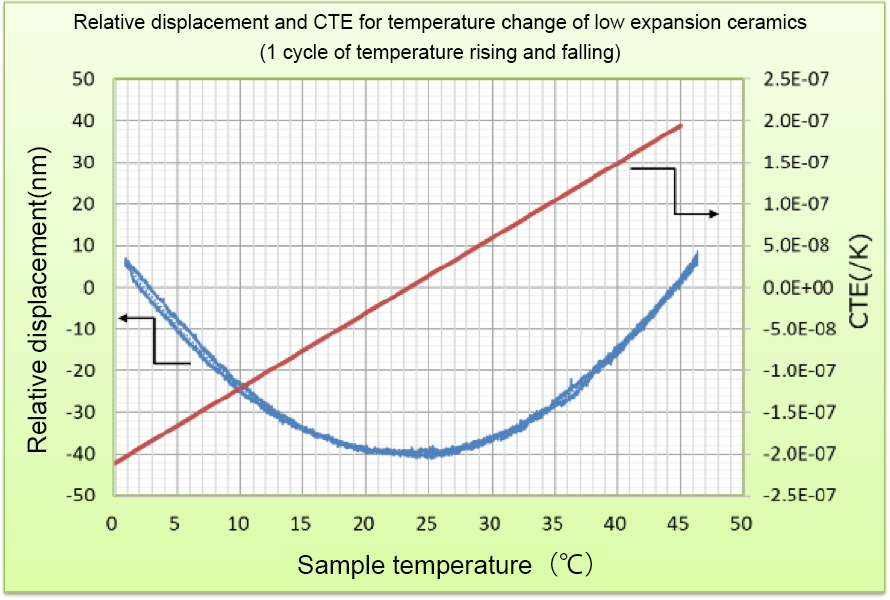
Measurement of low-expansion ceramics. Image Credit: Orton Ceramic Foundation
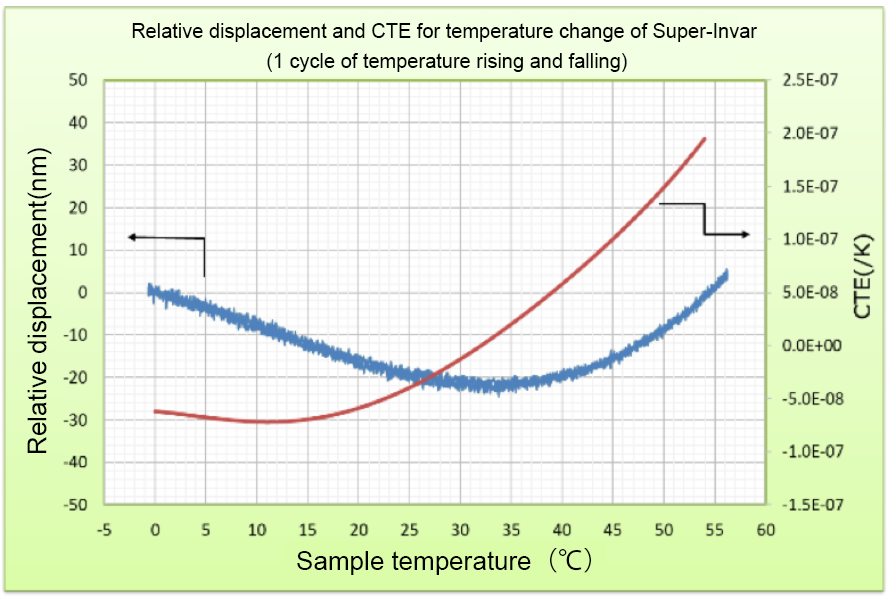
Measurement of metal (super-invar). Image Credit: Orton Ceramic Foundation