The Park NX1 is a compact AFM made for reliable, high-resolution imaging. The system has a rigid structure that works in conjunction with a thermally stable body to provide atomic-scale imaging in ambient conditions while preserving the user-friendly nature typical of Park Systems instruments.
Mechanical stability is enhanced by a small mechanical loop between the probe and the sample. Kovar is used in the AFM core body to lessen thermal drift. The system consists of a tungsten (W) carbide stick-slip stage with kinematic contacts for Z approach and an XYZ tube scanner for imaging.
Stick-slip XY motion can be used to position the sample. During operation, both the probe and the sample can be observed using an on-axis optical microscope. Standard AFM probes and optional qPlus (quartz tuning fork) sensors are supported by the system.
Key Features
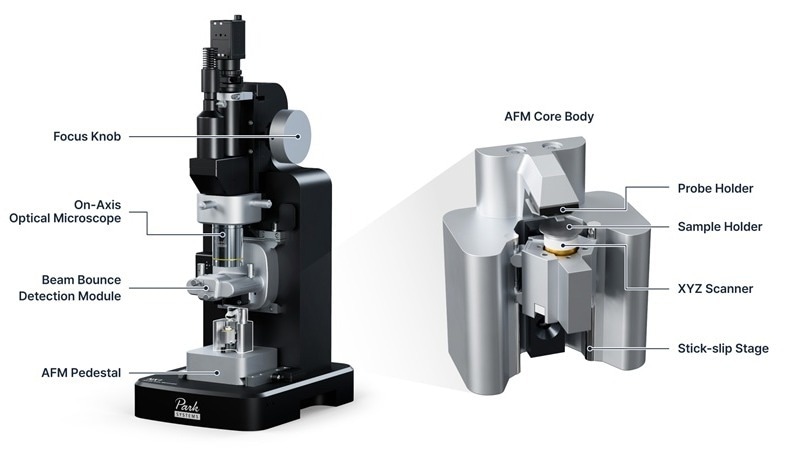
Image Credit: Park Systems
Optimized AFM Architecture
Low noise and excellent stability are made possible by the NX1's small, mechanically stiff construction, which reduces the probe-to-sample mechanical loop. The combination of a tungsten carbide stick-slip stage, kinematic connections, and a precision XYZ tube scanner facilitates stable positioning. Low-thermal-expansion materials minimize drift for reliable atomic-resolution imaging.
Intuitive Laser Beam Alignment
To maintain measurement stability, the NX1 employs a beam-bounce detection system with a separate detecting module. Stable signal detection is supported by the quick laser positioning on the cantilever and easy setup made possible by the intuitive alignment design.
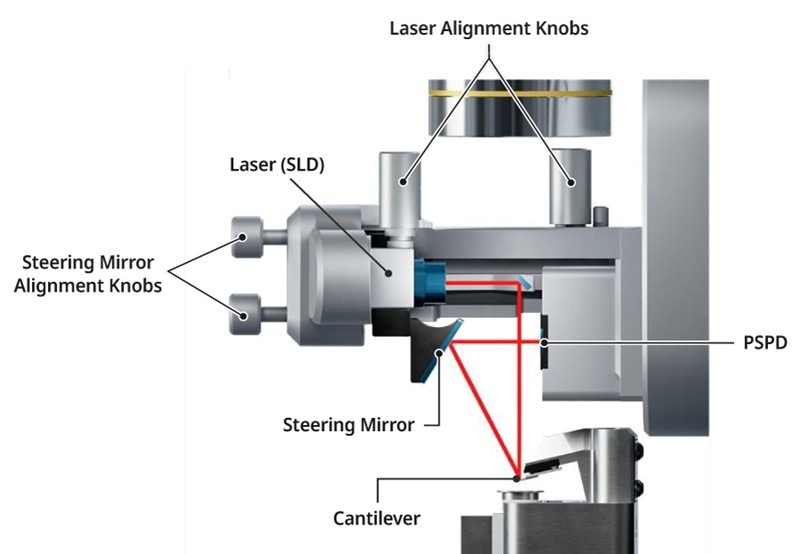
Image Credit: Park Systems
Low Noise Performance
Due to its optimized architecture, the NX1 achieves a noise level that is approximately an order of magnitude lower than that of standard AFM systems. Atomic-resolution imaging and reliable signal detection are supported by this low noise level, which creates a steady measurement environment.
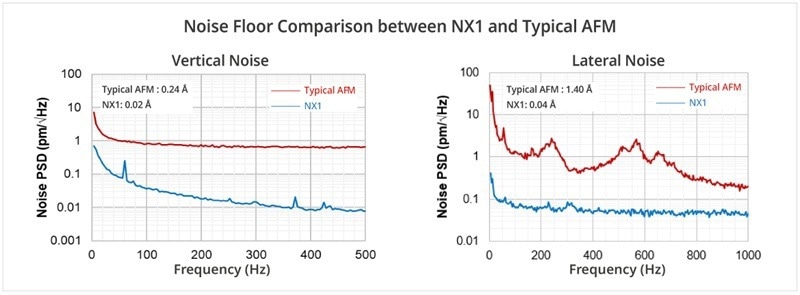
Image Credit: Park Systems
On-Axis Optical Microscope
Accurate tip alignment and effective sample navigation are made possible by the NX1's high-resolution on-axis optical microscope, which offers a direct view of the probe and sample. Reliable measurements are supported, and setup is made easier with integrated illumination, which offers good visibility across sample types.
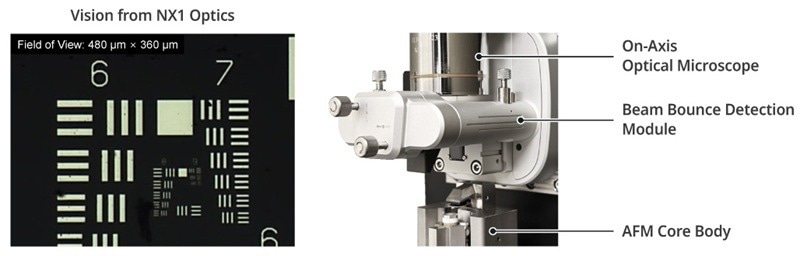
Image Credit: Park Systems
qPlus® Sensor Option
An optional quartz tuning fork-based qPlus sensor is supported by the NX1 to enable sophisticated atomic-scale measurements. Because of its high stiffness, it can operate steadily at picometer-scale amplitudes, reducing jump-to-contact.
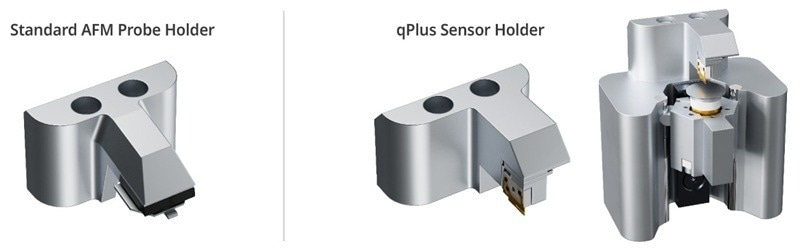
Image Credit: Park Systems
Softwares
Park SmartScan™
With an easy-to-use interface and automated workflows, Park SmartScan™ simplifies AFM operation, allowing for quicker setup and high-quality imaging with less user effort.
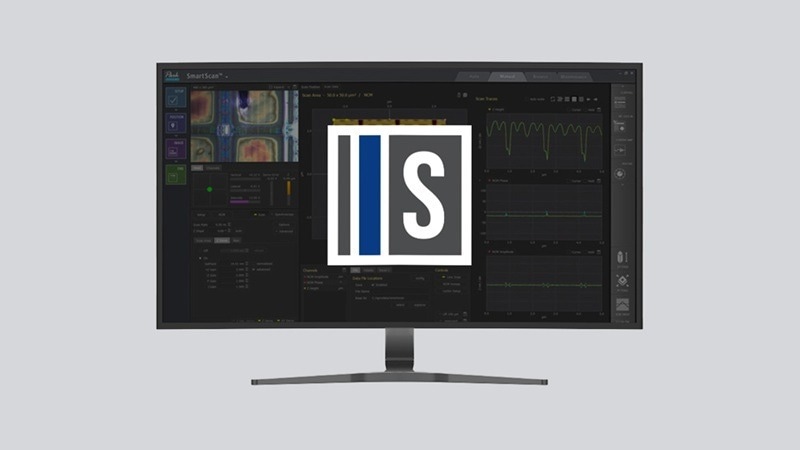
Image Credit: Park Systems
Park SmartAnalysis™
Park SmartAnalysis™ provides quick and thorough data processing, facilitating effective interpretation and lucid visualization of results. Its sophisticated features provide in-depth investigation within an easy-to-use workflow.

Image Credit: Park Systems
Applications
MoS2 Single Crystal: 2D Materials
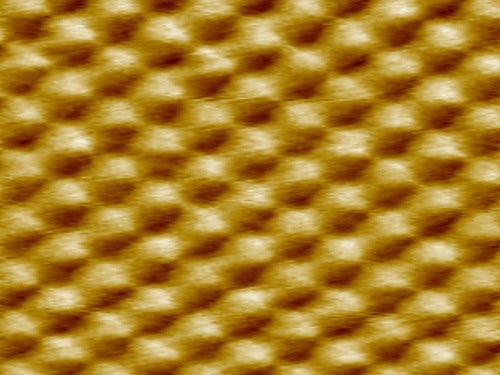
Image Credit: Park Systems
Twisted Bilayer Graphene: 2D Materials
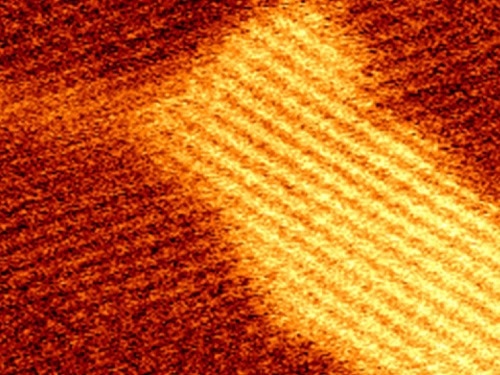
Image Credit: Park Systems
HOPG: 2D Materials
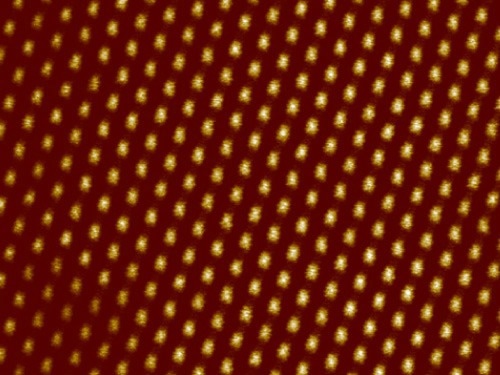
Image Credit: Park Systems
WSe2 on Graphene: 2D Materials
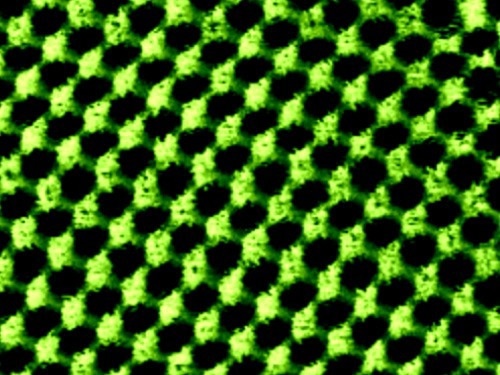
Image Credit: Park Systems