A fleet-wide life-cycle assessment shows that lithium-ion batteries can deliver major climate benefits, but only if mineral supply chains, recycling, and mining impacts are managed responsibly.
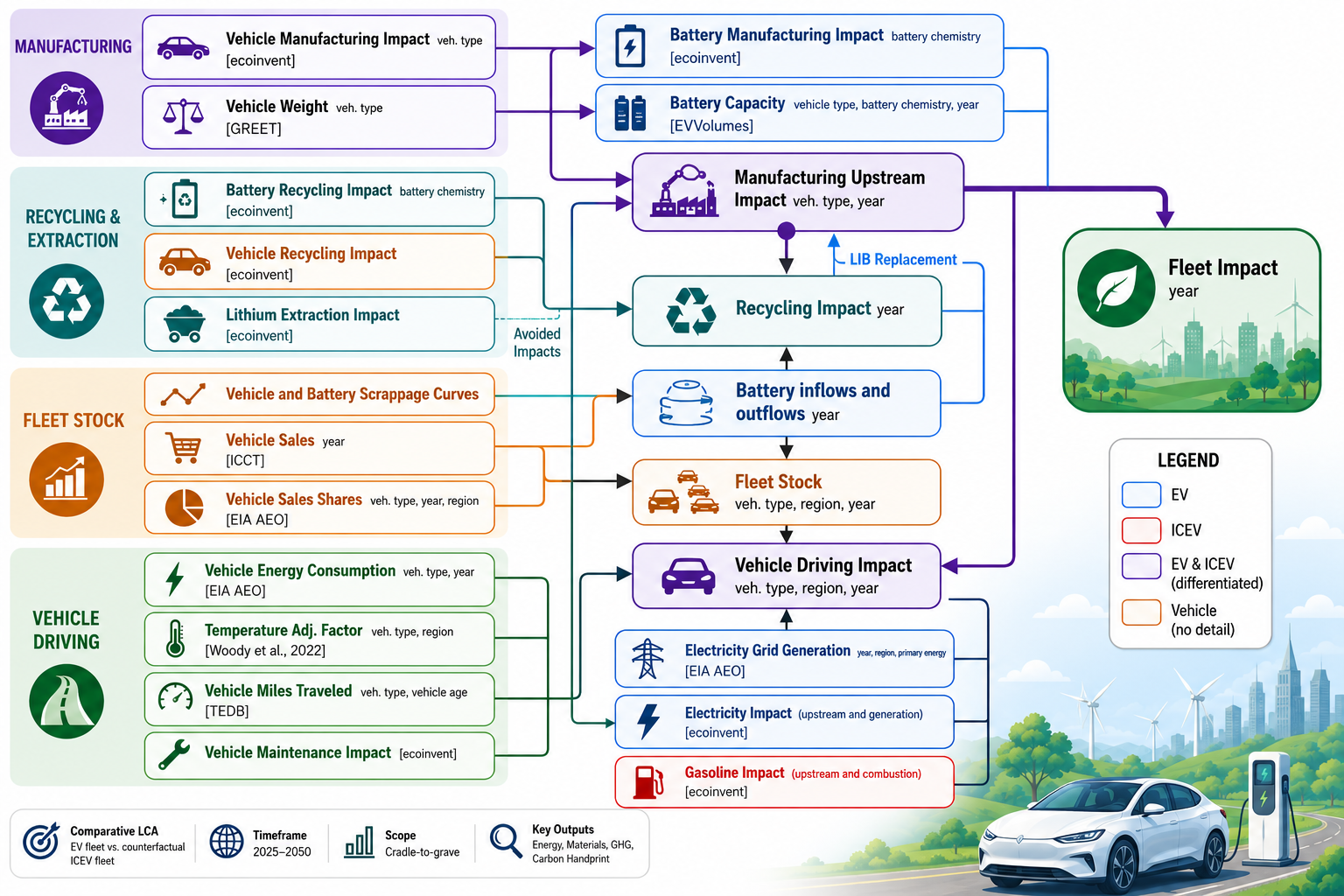
Research: Life cycle performance and carbon handprint of lithium-ion batteries in electric vehicles. Image credit: AI-generated image created using ChatGPT/OpenAI adapted from Busch P., Chen Y., et al. (2026). Life cycle performance and carbon handprint of lithium-ion batteries in electric vehicles. Journal of Industrial Ecology. DOI: 10.1007/s44498-026-00112-1
In a recent research article published in the Journal of Industrial Ecology, researchers conducted a life cycle assessment of the projected U.S. light-duty electric vehicle fleet to evaluate the environmental benefits and carbon handprint of lithium-ion batteries compared to internal combustion engine vehicles.
EV Electrification and Mineral Impacts
The electrification of the transportation sector is pivotal for mitigating greenhouse gas (GHG) emissions, with lithium-ion battery (LIB)-powered electric vehicles (EVs) offering significant reductions in emissions compared to conventional internal combustion engine vehicles (ICEVs).
While EVs demonstrate lower emissions during operation, their manufacturing supply chains, particularly LIBs and critical minerals like lithium, cobalt, and nickel, exhibit higher environmental impacts.
Prior research has predominantly focused on the environmental burdens of individual LIBs or on vehicle comparisons, with less emphasis on the system-wide benefits of large-scale EV deployment or on the role of critical mineral extraction in enabling decarbonization. The concept of a "carbon handprint" has emerged to quantify the net-positive climate outcomes of EV adoption relative to ICEVs, accounting for avoided emissions through electrification.
This study uses a comparative life cycle assessment (LCA) framework to evaluate the life cycle energy use, material use, and carbon handprint of the projected U.S. light-duty EV fleet from 2025 to 2050, contextualizing LIB production and lithium extraction within the fleet-level decarbonization benefits.
US Fleet Life Cycle Analysis
This study applies a comparative life-cycle assessment (LCA) to the U.S. light-duty vehicle fleet from 2025 to 2050, contrasting a projected EV adoption scenario with a counterfactual scenario in which those EVs are modeled as ICEVs. EVs are defined strictly as traction LIB-powered battery electric vehicles (BEVs), excluding plug-in hybrids and other powertrains.
The LCA encompasses vehicle and battery manufacturing, vehicle usage, including driving with electricity grid mix forecasts, maintenance, and end-of-life processes involving recycling. Life cycle inventory (LCI) data distinguishes between EVs and ICEVs across the manufacturing, operation, and disposal phases.
Grid electricity carbon intensities are modeled using average emissions factors, with long-run marginal emissions factors tested in a sensitivity analysis that incorporates future decarbonization trends, including renewable energy adoption.
Recycling assumptions include material recovery rates for steel, aluminum, lithium, nickel, cobalt, and other metals, with credits assigned for avoided virgin mineral extraction, sourced from a mix of lithium production methods. The carbon handprint is calculated as avoided GHG emissions per kWh of battery capacity and per kg of extracted lithium, analyzed under varying battery lifetimes, capacities, recycling rates, and grid scenarios.
Energy, Emissions, and Material Tradeoffs
The projected all-EV U.S. light-duty fleet reduces primary energy consumption by 20% and life-cycle GHG emissions by 61% compared to a counterfactual ICEV fleet, consuming 1 kWh per km versus 1.25 kWh per km for ICEVs.
This efficiency gain is largely attributable to EVs’ higher battery-to-wheel efficiency and increased reliance on low-carbon electricity sources. Material extraction decreases by 34% overall; however, metal extraction rises by 117%, and critical mineral extraction by 179%, driven primarily by LIB production.
The carbon handprint for LIBs ranges from 0.3 to 0.6 tons of CO2e avoided per kWh of battery manufactured and 5 to 12 tons CO2e avoided per kg of lithium extracted, with sensitivity analyses showing values up to about 23 tons CO2e per kg lithium and high recycling increasing avoided emissions to about 20 tons CO2e per kg lithium. Although mining generates environmental stresses, such as water use and land disturbance, recycling and circular-economy strategies can substantially mitigate these impacts by reducing the need for virgin material extraction.
However, the study also found higher acidification, particulate matter-related human health impacts, and smog formation impacts for EVs, mainly linked to LIB production, underscoring the need to manage supply-chain and local environmental burdens.
Policy implications emphasize facilitating battery mineral recycling to extend climate gains while responsibly managing mining impacts. Limitations noted include static manufacturing impacts, the omission of hybrids, the use of average grid mix assumptions, the exclusion of removed ore from mining estimates, and the exclusion of demand-side transport strategies, suggesting avenues for future research to refine the environmental assessment.
Optimizing LIB Benefits for Climate
The future U.S. adoption of light-duty EVs powered by LIBs offers a clear pathway to reduce primary energy consumption, material use, and life cycle GHG emissions compared to an ICEV-only fleet. Manufacturing one kWh of LIB can yield up to 600 kg CO2e avoided, and one kilogram of lithium extraction can avoid up to 20 tons CO2e with high recycling rates, underscoring the significant climate-enabling role of battery production and mineral extraction.
Despite higher demand for metals and critical minerals, the stock nature of these materials supports circular-economy strategies to recover them and reduce dependence on mining. Responsible mining practices, coupled with improved battery durability, energy efficiency, and established recycling infrastructure, are essential for maximizing EV climate benefits while minimizing environmental impacts rather than simply shifting them.
This work highlights the important roles of LIB production and mineral extraction in decarbonizing light-duty transportation, providing foundational insights for sustainable EV deployment and policy development.
Want to read later? Download your PDF copy by clicking here.