A China-focused model maps how tightening lithium, cobalt, and nickel supplies could reshape the pace, cost, and carbon benefits of vehicle electrification.
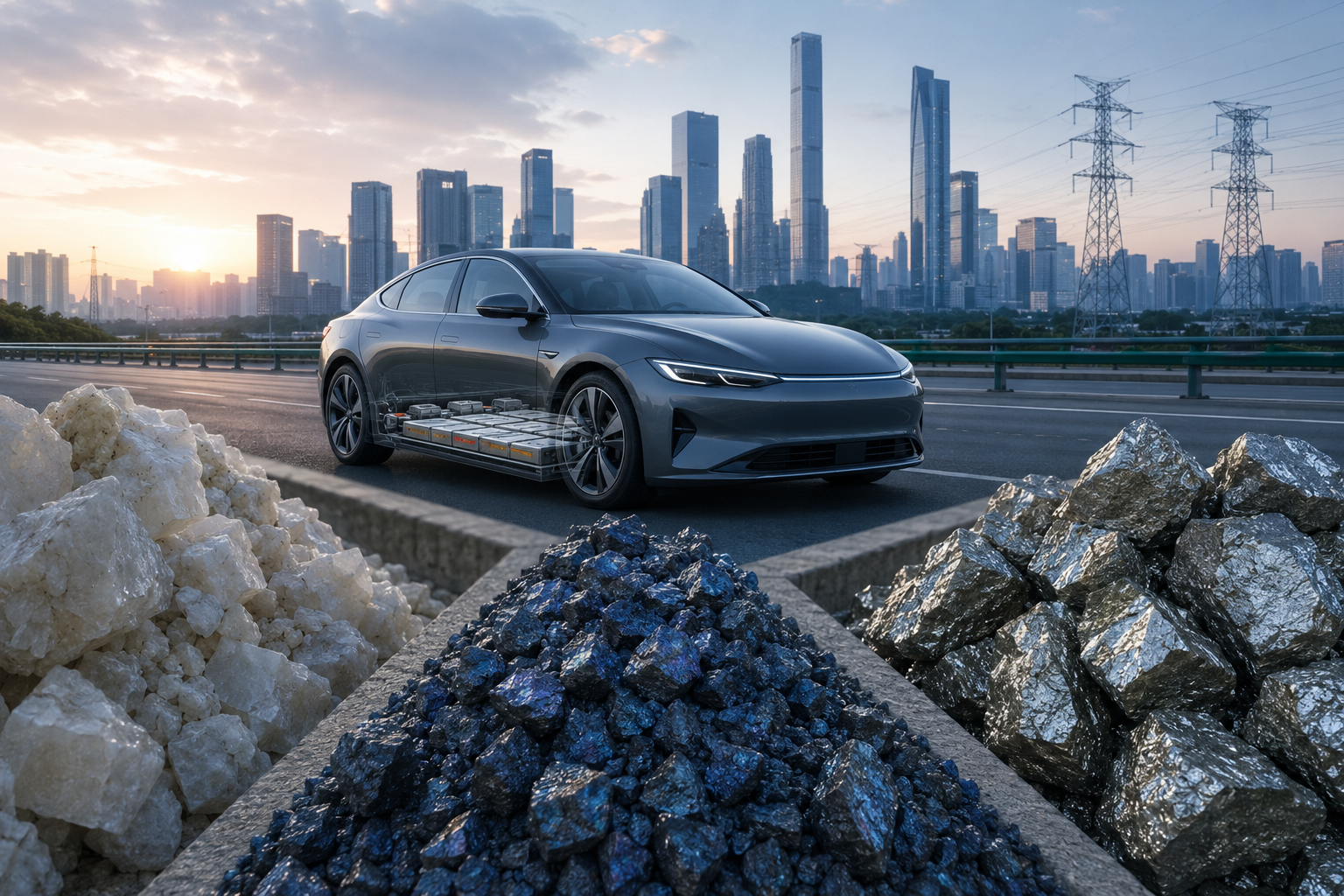
Paper: Reshaping vehicle electrification pathways under the metal-carbon trade-off. Image credit: AI-generated image created using ChatGPT/OpenAI
The rapid adoption of electric vehicles (EVs) is crucial for reducing transport-related carbon emissions; however, their long-term success depends partly on the availability of critical battery materials. A recent 'article in press' in the journal Communications Earth & Environment examined how constraints in the supply of lithium, cobalt, and nickel influence future EV adoption and emissions. Using the Collaborative Optimization Model for Carbon Emission Reduction and Metal Resource Security (COMERS), researchers estimated that ignoring these constraints could overestimate China's passenger EV ownership by as much as 42% in 2060 while underestimating cumulative passenger-car carbon dioxide (CO2) emissions and transition costs.
The findings highlight the necessity of incorporating material availability into long-term transport and climate planning to produce realistic decarbonization pathways.
The Demand-Supply Challenge of Critical Metals
The transition to low-carbon transportation relies on the widespread adoption of battery electric vehicles (BEVs) and plug-in hybrid electric vehicles (PHEVs). These vehicles depend heavily on lithium-ion batteries, whose high-energy-density cathodes require critical metals such as cobalt (Co), lithium (Li), and nickel (Ni). As countries strive to achieve net-zero emissions by 2050, the International Energy Agency projects that demand for these minerals could increase by 19 to 42 times by 2040 as compared with 2020.
Meeting this demand poses a significant challenge, as these minerals are finite and unevenly distributed, with most reserves concentrated in a few countries. This geographic concentration increases the risk of supply shortages, price volatility, and supply-chain disruptions as demand grows. As a result, the availability of critical battery materials has become an important factor in determining the pace and cost of vehicle electrification.
Bridging Vehicle Electrification and Power Generation
To investigate this material-carbon dilemma, researchers developed the COMERS model, which relates the passenger vehicle sector to the power generation system. This model captures feedback between EV deployment, vehicle retirement, recycling, electricity demand, and mineral availability. It combines multi-sector cost optimization with dynamic material flow analysis to track the life cycle of critical metals, from primary supply and battery production to vehicle use, retirement, recycling, and secondary material recovery. Vehicle ownership is projected using a Gompertz model, while long-term mineral supply is estimated with a Hubbert model.
Researchers evaluated seven scenarios representing different pathways, including variations in recycling efficiency, mineral supply constraints, international trade conditions, and battery chemistries, such as low-cobalt and cobalt-free cathodes. A separate non-metal-constraint scenario (NMS) without mineral supply limitations was also included to isolate the effects of resource scarcity on EV adoption, carbon emissions, and transition costs. Furthermore, the framework was applied to China, the world's largest EV market, where external dependence on these metals ranges from 72% to 97%.
Implications of Ignoring Mineral Constraints
The optimization results showed that ignoring critical mineral constraints leads to overly optimistic projections for transport decarbonization. Compared with the six material-constrained scenarios, the unconstrained NMS scenario overestimated EV deployment while underestimating cumulative carbon dioxide emissions by up to 57%, equivalent to 6.1 billion tonnes, and passenger-car transition costs by up to 6%, equivalent to 16.9 trillion renminbi (RMB), at constant 2023 prices between 2025 and 2060. It predicted an earlier automotive carbon peak in 2027, whereas incorporating mineral constraints delayed the peak to 2030-2034 as slower EV adoption extends the use of internal combustion engine vehicles.
The analysis identified a scenario-dependent sequential supply bottleneck for battery materials: lithium is the primary constraint before 2035, while declining cobalt production becomes the dominant limiting factor thereafter in the REF, FRS, HCS, and LCS scenarios. Under the low-cobalt and cobalt-free scenarios, lithium remained the sole modeled bottleneck until approximately 2046. Across the modeled scenarios, cumulative demand for lithium and cobalt across all end uses in China could exceed China's 2023 reserves by factors of 2.2-3.1 and 49-86, respectively. Although lithium supply is projected to continue growing through 2060, global primary nickel and cobalt production are expected to peak around 2035 and 2045 before declining.
Recommendations for Sustainable Battery Development
The results provide practical guidance for battery development and resource planning. Reducing cobalt dependence through low-cobalt chemistries, such as NMC811, and cobalt-free lithium iron phosphate (LFP) batteries can ease pressure on cobalt supplies while lowering modeled cumulative CO2 emissions by 1.4-1.7 billion tonnes. However, under the ETS scenario in 2060, NMC811 increased demand for lithium and nickel, while LFP continued to require lithium, showing that chemistry changes redistribute rather than eliminate mineral pressures. The authors emphasize the importance of developing lower-cobalt battery technologies to improve the resilience of EV supply chains.
The analysis also highlights the role of a circular battery economy. In an idealized full-recycling scenario in which collection of batteries and other end-of-life products reaches 100% by 2060, secondary materials could supply up to 69% of lithium, 79% of cobalt, and 88% of nickel demand in that year. The authors recommend establishing strategic mineral reserves, prioritizing immediate lithium reserves and cobalt reserves before 2035, to help buffer against supply disruptions and price volatility. Together, these measures could help provide a secure material foundation for large-scale vehicle electrification.
Planning for a Low-Carbon Transportation Future
In summary, the COMERS model demonstrates that achieving low-carbon transport requires coordinated planning across the vehicle, material, and power sectors. The analysis shows that incorporating critical mineral constraints into the strategy yields more realistic projections of EV adoption, emissions, and transition costs than models that assume unlimited material availability. While improvements in battery chemistry and recycling can reduce resource pressure, they are insufficient to achieve net-zero transport without a carbon-neutral or negative-emissions power system or the removal of residual emissions through carbon sinks.
The framework provides practical guidance for policymakers and industry leaders seeking to align mineral supply, battery manufacturing, vehicle deployment, and power-system expansion. Because COMERS was applied empirically only to China, its relevance to Germany, Japan, Korea, and other manufacturing economies is inferred rather than directly modeled. Incorporating material constraints into long-term planning could nevertheless help reduce investment risks and strengthen supply-chain resilience.
However, the projections are conditional on assumptions about future mineral production, battery-market shares, vehicle use, recycling, and China's electricity emission factor declining to zero by 2060. The model also excludes sodium-ion batteries, hydrogen vehicles, and potential constraints involving aluminum, copper, and steel, and its emissions estimates do not represent a complete cradle-to-grave assessment.
Disclaimer: The views expressed here are those of the author expressed in their private capacity and do not necessarily represent the views of AZoM.com Limited T/A AZoNetwork the owner and operator of this website. This disclaimer forms part of the Terms and conditions of use of this website.