A symmetry-guided search through millions of organic molecules shows how interpretable machine learning can narrow a vast chemical landscape and point researchers toward promising magnetic materials.
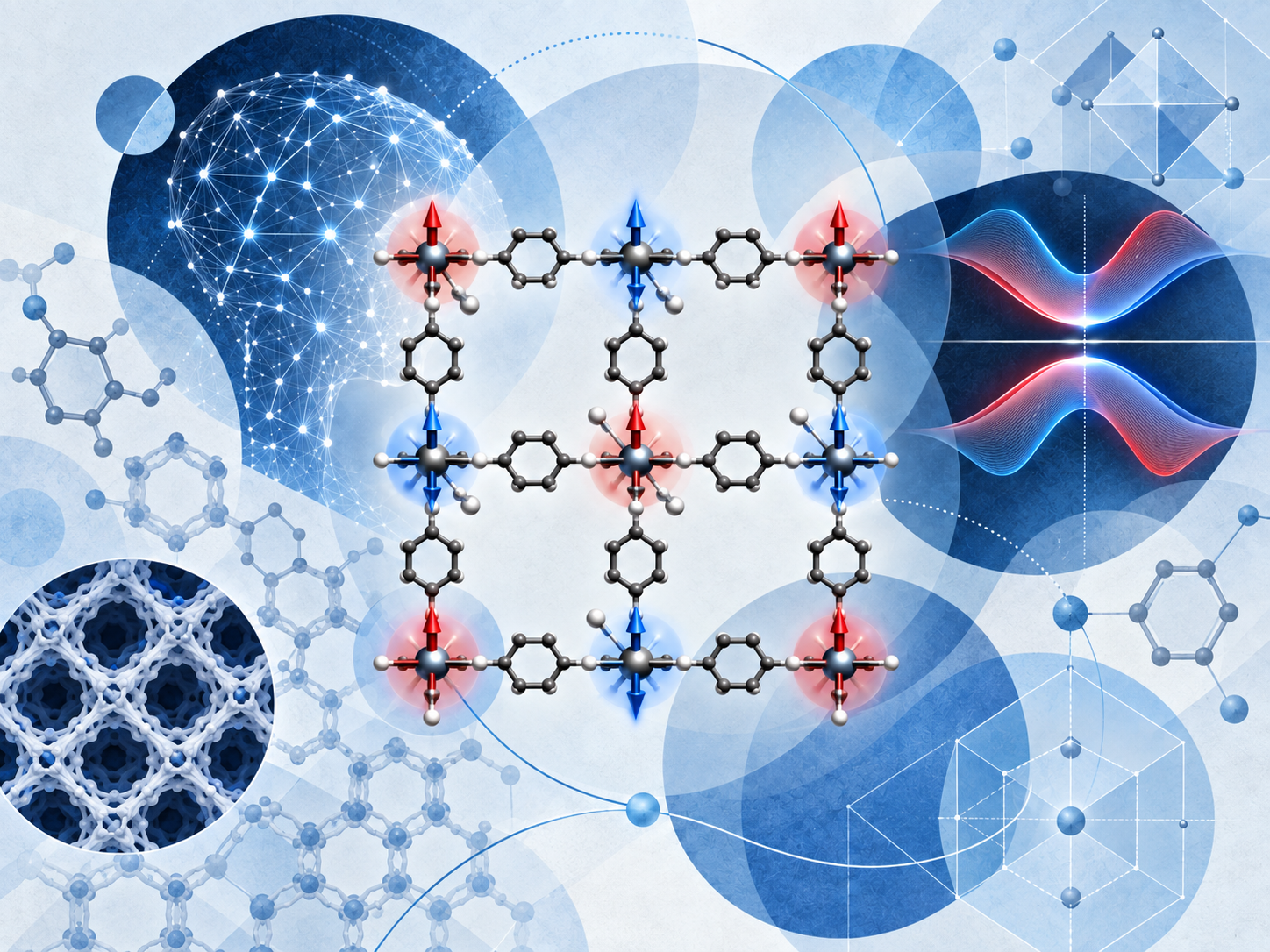
Paper: AI-accelerated discovery of altermagnetic metal-organic frameworks via interpretable machine learning. AI-generated abstract conceptual image created using ChatGPT/OpenAI
Researchers have computationally identified 15 previously unreported two-dimensional chromium-based MOFs predicted to exhibit altermagnetism, more than doubling the number of monolayer altermagnetic MOFs reported to date. Their study, published in the journal npj Computational Materials, used an AI-assisted pipeline to screen organic linkers and identify promising candidates.
The approach combined machine learning with high-throughput density functional theory calculations to investigate P4-symmetric, chromium-based MOFs and their magnetic properties. The findings expand the pool of computational candidates for studying complex electronic structures and demonstrate how computational screening can accelerate materials discovery.
The Third Class of Collinear Magnetism
Altermagnetism is a third type of collinear magnetism, distinct from ferromagnetism and antiferromagnetism. It combines compensated antiparallel spin order in real space with momentum-dependent, non-relativistic spin splitting in reciprocal space. This combination gives altermagnetic materials a unique magnetic property that differs from those of conventional magnetic phases.
Historically, research on altermagnetism has largely focused on inorganic materials. Extending the search to organic and hybrid materials, including MOFs, porous metal-organic materials assembled from metal nodes and organic linkers, could yield additional structures with tunable properties. The large number of possible chemical and structural combinations favors the use of high-throughput computational methods to screen these materials and identify suitable candidates for further study.
Methodological Pipeline for High-Throughput Screening
To explore the extensive chemical space, researchers developed a two-stage machine learning pipeline based on crystalline symmetry requirements. They focused on tetragonal space group 75, which provides the required C4 rotational axis but lacks an inversion center between the opposite spin sublattices. The initial screening considered over 122 million organic molecules from PubChem. Structural filters and a large language model narrowed the pool, after which clustering and coordination filters produced a representative set of 350 organic linkers.
These linkers were combined in silico with magnetic chromium transition-metal nodes to generate P4-symmetric MOF models. Density functional theory calculations were performed on the resulting structures to assess their electronic and magnetic properties.
Because of the complexity of applying quantum-mechanical calculations to the entire library, the study trained the XGBoost classification model to screen 65,578 candidates, narrowing the selection to 145 high-probability linkers. K-Nearest Neighbors and CatBoost models were then used to predict altermagnetic classification and spin-splitting magnitudes. Finally, SHapley Additive exPlanations (SHAP) analysis was used to identify the physicochemical descriptors most closely associated with the predicted magnetic properties.
Altermagnetic MOFs and Predictive Model
The computational workflow identified 15 DFT-confirmed altermagnetic MOFs. In the initial evaluation of 350 organic linkers, density functional theory calculations pinpointed six MOFs with altermagnetic properties. XGBoost screening then revealed six additional altermagnets among the 145 selected candidates. The ML-guided screen achieved a 2.4-fold enrichment in discovery efficiency compared to unguided screening. The authors designed XGBoost as a coarse screening tool with a limited goal: to narrow the candidate pool to a size suitable for DFT calculations.
The second-stage spin-splitting regression used only 20 samples, which limits how broadly its performance can be interpreted.
The K-Nearest Neighbors and CatBoost models were assessed for altermagnetic classification and spin-splitting prediction, respectively. SHAP analysis provided insights into the structural and electronic features associated with these properties. It suggested that continuous conjugated aromatic backbones are more likely to support altermagnetism, with their rigidity potentially stabilizing in-plane magnetic exchange pathways and limiting conformational fluctuations.
The analysis also found that moderate-strength push-pull electronic groups attached to these aromatic backbones may narrow the HOMO-LUMO gap of the organic ligand, thereby permitting greater ligand spin polarization and increasing spin splitting. Strong electron-withdrawing groups did not follow this pattern and could disrupt the material's electronic density. Based on these relationships, researchers designed three new MOF candidates using selected organic linkers, all of which were confirmed by density functional theory calculations to have altermagnetic ground states. HSE06 calculations also supported the altermagnetic character of all three designed materials. One material exhibited a spin splitting of 23.1 meV, bringing the total number of DFT-confirmed altermagnetic MOFs identified in the study to 15.
Implications for Altermagnetic Materials Research
The identification of 15 altermagnetic MOFs expands the set of candidates available for experimental study. Their predicted electronic structures require synthesis and magnetic characterization before the calculated properties can be established in physical materials.
The design principles established in the study could guide the development of materials with tunable magnetic properties. Adjusting the conjugated backbones and push-pull functional groups may enable control over spin splitting and related electronic characteristics. The authors also used a separate machine learning model to suggest viable synthesis routes for the three SHAP-guided candidates, providing starting points for experimental work.
A Roadmap for Future Material Exploration
The study demonstrates how interpretable AI can facilitate the discovery of altermagnetic materials. By integrating symmetry-guided dataset curation with machine learning and density functional theory, researchers successfully identified 15 DFT-confirmed altermagnetic MOFs. SHAP analysis also helped explain which structural and electronic features drove the model predictions.
The computational pipeline could be adapted for further materials screening across various crystallographic space groups and structural classes. This approach may also extend to three-dimensional (3D) architectures and related materials such as COFs. Such applications could help identify additional magnetic materials with tunable electronic and spin-dependent properties.
Disclaimer: The views expressed here are those of the author expressed in their private capacity and do not necessarily represent the views of AZoM.com Limited T/A AZoNetwork the owner and operator of this website. This disclaimer forms part of the Terms and conditions of use of this website.
Source:
- Ran, Y., Duan, J., Chen, Y., Jiang, W., & Yao, Y. (2026). npj Computational Materials. DOI: 10.1038/s41524-026-02323-3, https://www.nature.com/articles/s41524-026-02323-3