Researchers combine scaffold architecture, control of Zn/Mg composition, and defect engineering to probe how charge transport and material structure shape hydrogen generation from water.
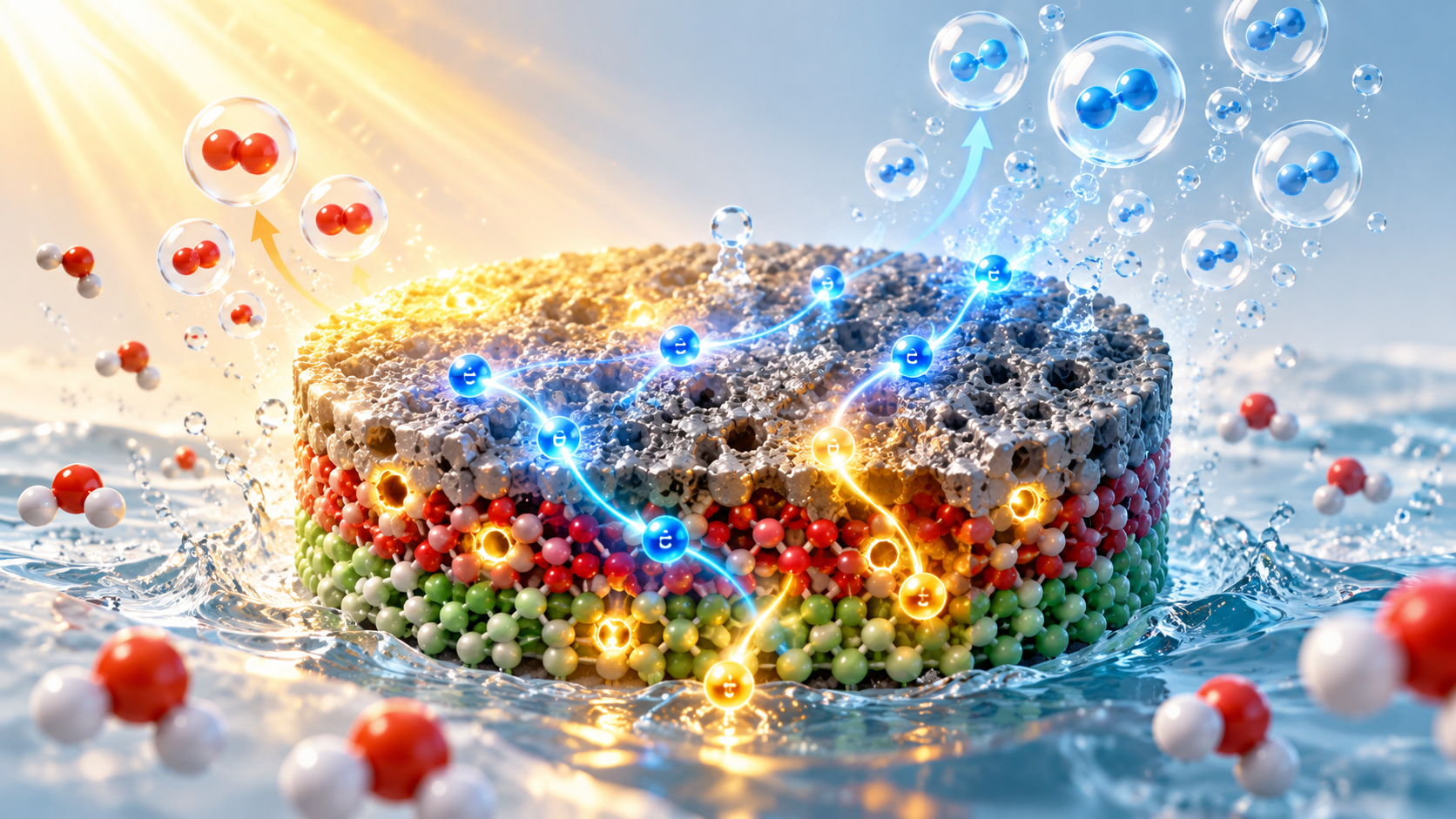
Paper: Stable and efficient n-type scaffolded semiconductor for photocatalytic hydrogen production under tungsten light irradiation. AI-generated abstract conceptual image created using ChatGPT/OpenAI
In a recent research article in npj Clean Energy, researchers reported synthesizing an n-type scaffolded Si–Zn0.3Mg0.7O semiconductor composite for photocatalytic hydrogen production without sacrificial electron donors. Under laboratory irradiation from a 100 W tungsten lamp, the best-performing Si–Zn0.3Mg0.7O scaffold achieved a hydrogen evolution rate of 1,954 μmol h-¹ cm-².
Green H2: Why Scaffolds Matter
The global energy crisis has increased interest in sustainable energy options such as green hydrogen (H2), which can be produced using renewable energy without direct greenhouse gas emissions from the hydrogen-generation step. Many powder-based photocatalysts show promise for light-driven H2 generation, but slow electron-transfer kinetics, material loss, and poor recyclability can limit hydrogen output.
The researchers developed an n-type scaffolded Si–ZnxMg1-xO semiconductor composite. Its self-supporting form addresses issues with suspended powder catalysts while enabling hydrogen production without sacrificial electron donors.
They varied the zinc (Zn) to magnesium (Mg) ratio to study how composition and defect content affect photocatalytic behavior. The work also assessed scaffold strength after different calcination temperatures and times. Commercial-scale operation was not tested.
Si-ZnMgO Scaffold Fabrication
The Si–ZnxMg1-xO composites, with x values of 0.1, 0.3, and 0.5, were synthesized via a controlled solid-state route in a cylindrical closed-reactor system designed to ensure uniform heat distribution and minimize compositional gradients.
The process began with precipitation-derived nanosilica. Hydrochloric acid was added to sodium silicate solution, followed by heating, washing, drying, and calcination. Silicon dioxide, zinc powder, and magnesium powder were then weighed in stoichiometric proportions and blended into homogeneous mixtures.
The mixtures underwent magnesiothermic reduction in a stainless-steel reactor at 800 °C for 6 hours. The product was ground into a fine powder and compacted under 1 MPa pressure in a hydraulic press into a cylindrical scaffold with a cross-sectional area of 27.72 cm². The compacted structures were calcined at 650-950 °C for 1-7 hours to improve mechanical strength and structural integrity.
X-ray diffraction (XRD), scanning and transmission electron microscopy (SEM and TEM), and X-ray photoelectron spectroscopy (XPS) were used to examine crystal structure, morphology, particle size, and surface chemistry.
UV-vis-NIR diffuse reflectance spectroscopy estimated the band gap energy, photoluminescence (PL) measurements examined charge-carrier recombination, and Raman spectroscopy studied defects and impurities.
Transient photocurrent measurements, electrochemical impedance spectroscopy (EIS), and Mott–Schottky (M-S) analysis assessed charge transport, n-type semiconductor behavior, and flat-band potentials.
First-principles calculations using CASTEP, together with COMSOL Multiphysics® and FDTD simulations, examined electronic band structure, charge-carrier behavior, and electromagnetic field distribution.
Defect-Engineered H2 Output
The synthesis produced scaffolded Si–ZnxMg1-xO heterostructures, with the ZnO/MgO ratio affecting electronic structure, defect states, and hydrogen evolution.
Mechanical strength peaked after calcination at 900 °C for 6 hours, reaching about 0.67 MPa. Mott–Schottky analysis supported n-type semiconductor behavior in all three catalysts, with flat-band potentials and conduction band positions varying with the Zn/Mg ratio.
Optical absorption measurements gave apparent optical band gaps of about 2.04 eV, 2.02 eV, and 2.10 eV for Si–Zn0.1Mg0.9O, Si–Zn0.3Mg0.7O, and Si–Zn0.5Mg0.5O, respectively.
Photocatalytic activity varied strongly with the ZnO/MgO ratio. Si–Zn0.3Mg0.7O produced the highest hydrogen evolution rate at 1,954 μmol h-¹ cm-², compared with 260 μmol h-¹ cm-² for Si–Zn0.1Mg0.9O and 940 μmol h-¹ cm-² for Si–Zn0.5Mg0.5O.
The paper's photocatalytic results section reports 17.72 cm² as the illuminated area, while the abstract reports 27.72 cm² as the illuminated surface area, and the Methods section lists a 27.72 cm² scaffold. This internal discrepancy matters because the reported evolution rates are normalized by area.
The best-performing sample reached an apparent quantum yield (AQY) of 36.47% under monochromatic irradiation at 600 nm without sacrificial electron donors. It also produced H2 and O2 in a 1.96:1 molar ratio, close to the 2:1 ratio expected for overall water splitting.
The authors link the higher activity to heterojunction formation and defect engineering. They propose that MgO-associated oxygen vacancies trap electrons, extend carrier lifetimes, and improve photocatalysis.
Hydrogen production also changed with the water source, with rates of 1,954, 1,501, and 205 μmol h-¹ cm-² in distilled water, tap water, and seawater, respectively.
The authors linked the lower seawater rate to dissolved salts that may occupy active sites on the catalyst surface. Si–Zn0.3Mg0.7O produced nearly identical hydrogen evolution rates across ten consecutive 180-minute cycles, totaling 30 hours of irradiation. Post-reaction tests found a slight decrease in crystallinity and microcracks associated with structural stress, so longer-term durability remains to be established.
Scaffold H2 Outlook
The work produced an efficient n-type scaffolded Si–ZnxMg1-xO semiconductor composite for photocatalytic hydrogen production under tungsten light irradiation.
The findings indicate that scaffold architecture, composition, and defect control can improve charge separation and hydrogen output in this system. Tests under natural sunlight, over longer operating periods, and at larger scale are still needed before its suitability for practical hydrogen production can be judged.
Source:
- Islam A., Hossain M.M., et al. (2026). Stable and efficient n-type scaffolded semiconductor for photocatalytic hydrogen production under tungsten light irradiation. npj Clean Energy 2, 30. DOI: 10.1038/s44406-026-00046-4, https://www.nature.com/articles/s44406-026-00046-4