Researchers paired two frustrated magnetic oxides to tackle the low-temperature heat-capacity gap that has limited rare-earth-free cryocooler regenerators near 4 K.
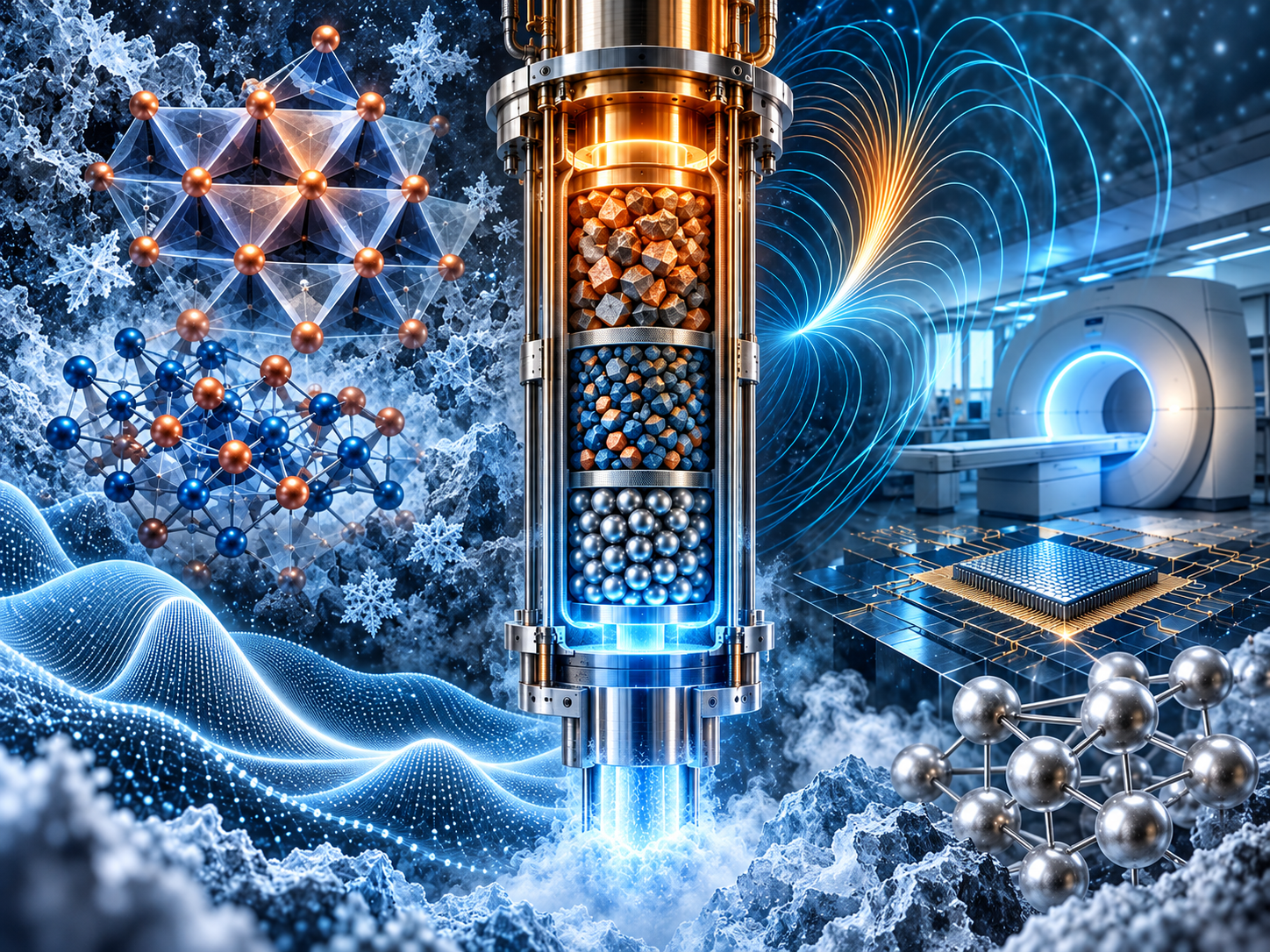
Paper: Rare-earth-free regenerator materials for enhanced 4-K cryocooler performance. AI-generated abstract conceptual image created using ChatGPT/OpenAI
*Important notice: This news reports on an unedited version of an accepted paper and is awaiting final editing. Therefore, the paper should not be regarded as conclusive or treated as established information.
A recent study in Communications Materials introduced a new rare-earth-free regenerator system that increased cooling capacity at 4.2 K by about 40% compared with a CFAO-based regenerator.
Under equivalent operating conditions, its performance reached 73% of the cooling capacity of the benchmark rare-earth material HoCu2.
The tested system combines two frustrated magnetic oxides: manganese niobate-tantalate (MnNb2-xTaxO6) and copper-iron-aluminum oxide (CuFe1-xAlxO2), with lead occupying half of the best-performing regenerator by volume. It contains no rare-earth elements.
The Limitations of Existing Cryogenic Technologies
Gifford-McMahon (GM) cryocoolers can reach temperatures near 4 K without a continuous supply of liquid helium. Below 10 K, they require regenerator materials with high heat capacity to absorb heat as helium gas cycles through the system.
Cryocooler regenerators often rely on heavy rare-earth materials, including HoCu2 (holmium copper), Er3Ni (erbium nickel), and Gd2O2S (gadolinium oxysulfide). HoCu2 and Gd2O2S are widely used in commercial 4-K GM cryocoolers. These materials use the magnetic properties of holmium, erbium, and gadolinium ions to absorb heat. But rare-earth supply chains face price volatility and geopolitical risks.
Synthesis of Manganese Niobate-Tantalate
To develop a regenerator material suited to the 4-7 K range, researchers synthesized MnNb2-xTaxO6 (MNTO) with different tantalum concentrations (x = 0, 0.5, 1.0, 1.5, and 2.0). They mixed MnO2 (manganese dioxide), Nb2O5 (niobium pentoxide), and Ta2O5 (tantalum pentoxide) powders in stoichiometric ratios.
The powders underwent successive high-temperature heating and sintering steps before the particles were separated into the 180-500 μm size range for use in packed-bed regenerators.
The study used X-ray diffraction (XRD) and Rietveld refinement to identify the crystal phases. Field-emission scanning electron microscopy examined the microstructure. Magnetic properties and heat capacity were measured with Quantum Design MPMS and PPMS instruments, respectively, with specific heat measured by the relaxation technique. Thermal conductivity was measured on a polycrystalline MnNb2O6 sample prepared with a floating-zone furnace, using a PPMS two-thermometer, one-heater method.
The design uses magnetic frustration, in which competing interactions can lower the temperature at which long-range magnetic order begins, even when magnetic exchange is strong. This helps preserve useful magnetic heat capacity at low temperatures. The low-temperature peak makes MNTO well suited to the coldest part of the regenerator, where CFAO's heat capacity falls sharply below about 6-7 K.
Performance Evaluation in Cryocooler Systems
For operational testing, a multi-segment regenerator was assembled in the second stage of a commercial two-stage GM cryocooler.
MNTO particles filled the cold end at 4.2 K, CFAO (CuFe1-xAlxO2) particles occupied the intermediate-temperature section, and spherical lead particles filled the warm end at 35 K.
The cryocooler operated at approximately 1.2 Hz, with helium pressures of 0.8 and 2.1 MPa. Heat transfer and gas flow were modeled using REGEN3.3 simulation software.
Thermal Capacities and Cooling Efficiency
Structural analysis showed that MnNb2-xTaxO6 forms an orthorhombic columbite structure. Magnetic Mn2+ ions form zigzag chains along the c axis, arranged in an isosceles triangular lattice within the ab plane.
The Néel temperature, the temperature below which antiferromagnetic order develops, increased from 4.4 K in manganese niobate (MnNb2O6, x = 0) to 5.7 K in manganese tantalate (MnTa2O6, x = 2.0). The peak volumetric heat capacity reached 0.31 J·K-1·cm-3, close to the 0.32 J·K-1·cm-3 measured for HoCu2.
Cryocooler tests showed that a hybrid regenerator containing about 30% MNTO (x = 1.0), 20% CFAO, and 50% Pb (lead) achieved a cooling capacity of approximately 0.163 W at 4.2 K. This was higher than the values measured for the CFAO/Pb configuration (0.117 W) and the best MNTO/Pb configuration (0.088 W).
The hybrid also exceeded the cryocooler's nominal specification of 0.1 W, reaching about 73% of HoCu2's 0.220 W output.
REGEN3.3 simulations predicted a cooling capacity of 0.148 W for the hybrid, close to the experimental value of 0.163 W.
The authors caution that the one-dimensional model uses idealized heat-transfer and gas-flow assumptions, so it supports the proposed mechanism rather than providing exact quantitative predictions. After repeated cooling cycles, the oxide granules showed no physical fractures or changes in their intrinsic physical properties.
Potential for Cryogenic Applications
The authors cite MRI, quantum computing, and superconducting magnets as areas that depend on cryogenic cooling. Rare-earth-free GM regenerators could reduce heavy rare-earth use in such systems, but this study tested only the regenerator in a GM cryocooler.
Further testing is needed to assess performance and reliability in applications beyond the GM cryocooler examined in the study.
Directions for Improved Cooling Performance
The study shows that frustrated transition-metal oxides can replace heavy rare-earth materials in cryogenic regenerators. The low-temperature heat capacity of MnNb2-xTaxO6 compensates for the decline in the heat capacity of CuFe1-xAlxO2 below about 6-7 K, without rare-earth elements.
Thermal conductivity measurements for MnNb2O6 ranged from 2 to 40 W·m-1·K-1 between 4 and 20 K, compared with 0.28 W·m-1·K-1 for HoCu2. The authors estimated that this conductivity was high enough for heat exchange within each refrigeration cycle.
The current regenerator used irregular crushed particles, resulting in a packing fraction of about 60%. Future work should focus on nearly spherical granules to raise the packing fraction above 65%, reduce pressure loss, and improve cooling performance.
Disclaimer: The views expressed here are those of the author expressed in their private capacity and do not necessarily represent the views of AZoM.com Limited T/A AZoNetwork the owner and operator of this website. This disclaimer forms part of the Terms and conditions of use of this website.