Researchers put a luminescent terbium complex through security, forensic, and biological tests to see how far the material could go.
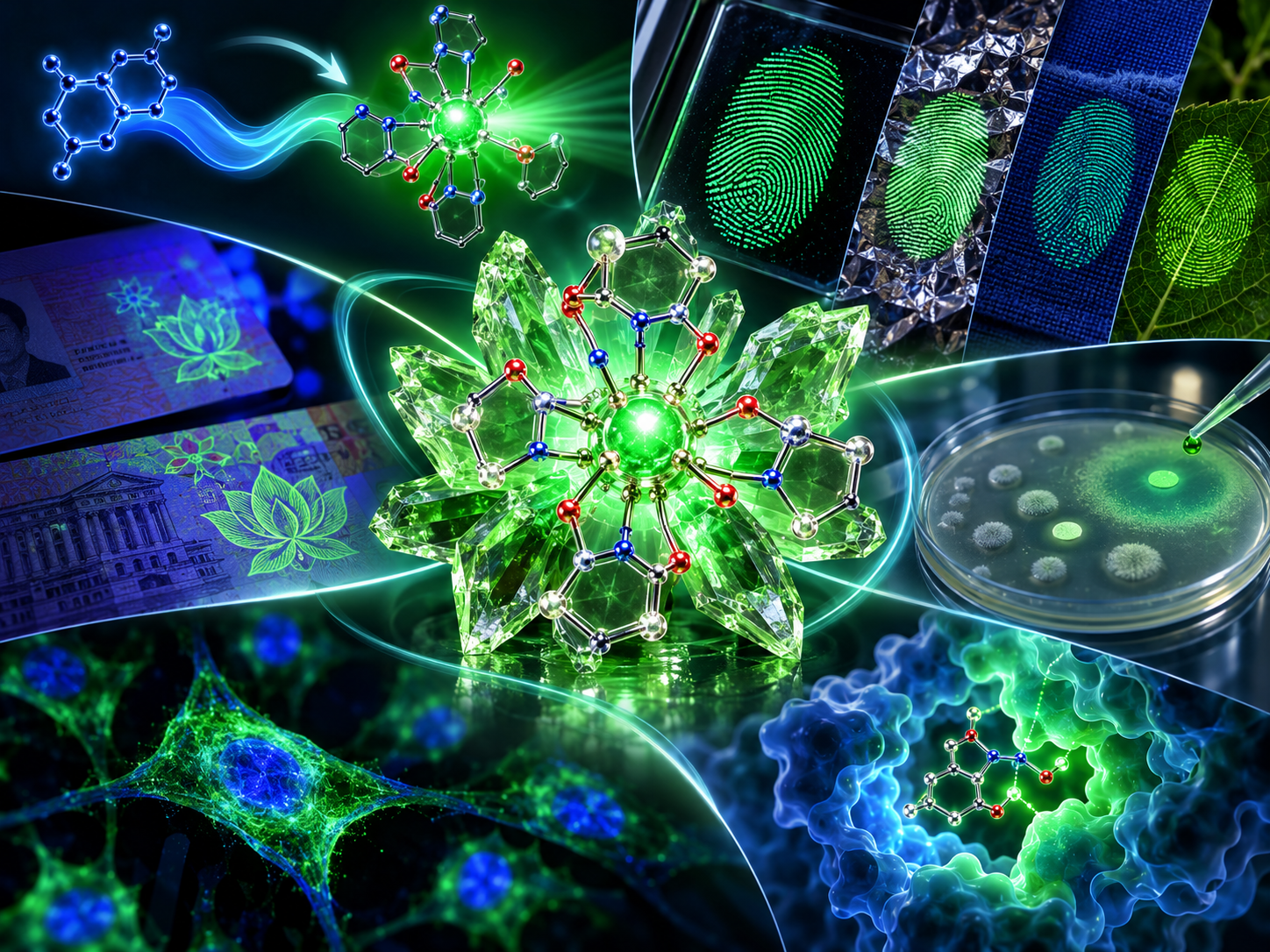
Paper: A multifunctional Tb3+–salicylic acid hydrazide phosphor for anti-counterfeiting, forensic fingerprint visualization, and biological applications. AI-generated abstract conceptual image created using ChatGPT/OpenAI
A recent study in Scientific Reports describes a multifunctional terbium-based luminescent material tested for anti-counterfeiting, forensic fingerprint visualization, and bioactivity. The findings show how coordination between a metal ion and an organic ligand can produce a material with potential uses in security technologies, forensic investigations, and research on bioactive materials.
Designing a multifunctional luminescent material
Luminescent materials absorb energy and release it as light, making them useful for security printing, sensing, imaging, and biological research. Their practical performance depends on emission color, stability, processability, and compatibility with different surfaces and environments. But most materials target specific applications, making it difficult to combine several functions in a single system.
The researchers developed a terbium(III) complex using salicylic acid hydrazide (SAH) as an organic ligand that binds to metal ions. They investigated whether combining the ligand's optical properties with terbium's characteristic emission could produce a material suitable for anti-counterfeiting and forensic fingerprint detection, while also testing how terbium coordination affected the ligand's biological activity.
Terbium complexes can produce intense green emission through the antenna effect. The organic ligand absorbs excitation energy and transfers it to the terbium ion, which then emits light. This interaction gives the complex distinctive optical properties that could support its use in security markings and other luminescent systems.
The study also examined its ability to reveal latent fingerprints and measured its antioxidant, antimicrobial, cytotoxic, and enzyme-inhibitory activities.
Synthesis and characterization of the terbium complex
The researchers synthesized the terbium complex, designated Tb(SAH), using a solution-based method. They first mixed salicylic acid hydrazide (2 mmol) with lithium hydroxide monohydrate (2 mmol), then added terbium nitrate (1 mmol). After refluxing the mixture for eight hours, they obtained yellow crystals for characterization and testing.
The complex contained terbium and ligand in a 1:2 metal-to-ligand ratio. The researchers compared its luminescence with that of the free SAH ligand to determine how terbium coordination affected its optical behavior.
They examined the material in several environments, including dimethylformamide (DMF), polyvinyl alcohol (PVA), polymethyl methacrylate (PMMA), and silica xerogel. The emission remained measurable across these environments, but its color and purity varied with the surrounding medium.
Forensic and security evaluations focused on latent fingerprint visualization, security ink performance, and emission stability. The fingerprint demonstration used impressions from one participant on non-porous, semi-porous, and porous surfaces. The researchers tested fingerprint detection across surfaces and examined whether the security ink retained luminescence during storage and water exposure.
Laboratory assays measured antioxidant activity, antimicrobial performance, cytotoxicity against HepG-2 liver cancer cells, and α-glucosidase inhibition. The researchers also used molecular docking to investigate possible interactions with DNA gyrase B. Taken together, the experiments provided an initial assessment of the material's optical, forensic, security, and biological properties.
Optical performance, fingerprint detection and biological activity
The terbium complex produced predominantly green emission, whereas the free salicylic acid hydrazide ligand emitted blue light. The authors attribute this change to ligand-mediated energy transfer to terbium through the antenna effect. Spectroscopic measurements and calculations support that interpretation, but do not directly prove the transfer pathway.
The complex revealed latent fingerprints on porous and non-porous substrates, including multicolored surfaces. It captured ridge patterns and finer identifying features, supporting further forensic study. The controlled laboratory test involved one participant, so it does not amount to operational forensic validation.
Security inks containing Tb(SAH) remained visibly luminescent under UVA light after six months of ambient storage and 24 hours of water immersion. These were qualitative durability checks, and testing across a wider range of environmental conditions is needed to measure long-term reliability.
Alongside the optical and forensic work, the researchers carried out several laboratory assays. In the DPPH radical-scavenging assay, a standard chemical test of antioxidant activity, the detailed results report an IC50, the concentration required to produce 50% inhibition, of 0.38 μM for Tb(SAH) after 30 minutes, compared with 0.78 μM for SAH and 2.10 μM for ascorbic acid.
The complex inhibited Staphylococcus aureus, producing an inhibition zone of 8.7 mm, compared with 6.9 mm for SAH. Both were less active than the antibiotic control. The researchers also reported stronger inhibition of Escherichia coli after complex formation, with the inhibition zone increasing from 3.7 mm for SAH to 8.4 mm for Tb(SAH).
In tests against HepG-2 liver cancer cells, Tb(SAH) exhibited an IC50 of 112.96 ± 1.66 μg/mL, compared with 349.05 ± 3.68 μg/mL for SAH. This difference indicates greater cytotoxic activity against the tested cell line but does not establish cancer-cell selectivity or therapeutic efficacy.
In the α-glucosidase assay, Tb(SAH) achieved an IC50 of 14.38 ± 1.2 μg/mL, compared with 35.18 ± 1.3 μg/mL for acarbose and 44.66 ± 1.5 μg/mL for SAH. α-Glucosidase is an enzyme involved in carbohydrate digestion.
Molecular docking against DNA gyrase B, a bacterial enzyme involved in DNA replication, examined possible binding interactions but did not establish a biological mechanism.
The biological findings remain preliminary because they come from chemical, microbial, enzyme, and cell-culture tests. More biological work is needed to establish safety, selectivity, and mechanisms of action. Forensic and security uses require broader practical validation under conditions that reflect routine use.
Toward multifunctional luminescent applications
The study shows how terbium coordination can combine distinctive luminescence with several potentially useful functions. The shift from blue ligand emission to predominantly green terbium-centered emission provides a recognizable optical signature. Tests in different matrices also show that the surrounding medium changes the emission color and purity.
The controlled fingerprint experiments and qualitative security-ink durability tests provide proof-of-concept evidence for forensic and anti-counterfeiting uses, not validation for routine practice.
Larger forensic studies would need to test more donors, fingerprint ages, deposition conditions, substrates, and comparison procedures. Security markings would also need testing under a broader range of environmental and handling conditions.
The reported antioxidant, antimicrobial, cytotoxic, and α-glucosidase-inhibitory activities come from chemical, microbial, enzyme, and cell-culture assays. They do not establish clinical benefit or safety. Future research must examine biological selectivity, toxicity, mechanisms of action, and performance in more representative models before assessing biomedical use.
The study provides an early laboratory demonstration of a Tb(SAH) material that combines luminescent security marking and fingerprint visualization with preliminary biological assay data.
Disclaimer: The views expressed here are those of the author expressed in their private capacity and do not necessarily represent the views of AZoM.com Limited T/A AZoNetwork the owner and operator of this website. This disclaimer forms part of the Terms and conditions of use of this website.
Source:
- Nasser, H., Abdelrhman, E. M., et al. (2026). A multifunctional Tb3+–salicylic acid hydrazide phosphor for anti-counterfeiting, forensic fingerprint visualization, and biological applications. Scientific Reports, 16:31853. DOI: 10.1038/s41598-026-71747-0, https://www.nature.com/articles/s41598-026-71747-0