Microscopic surface patterns may tune how biodegradable packaging behaves during use and after microbial exposure.
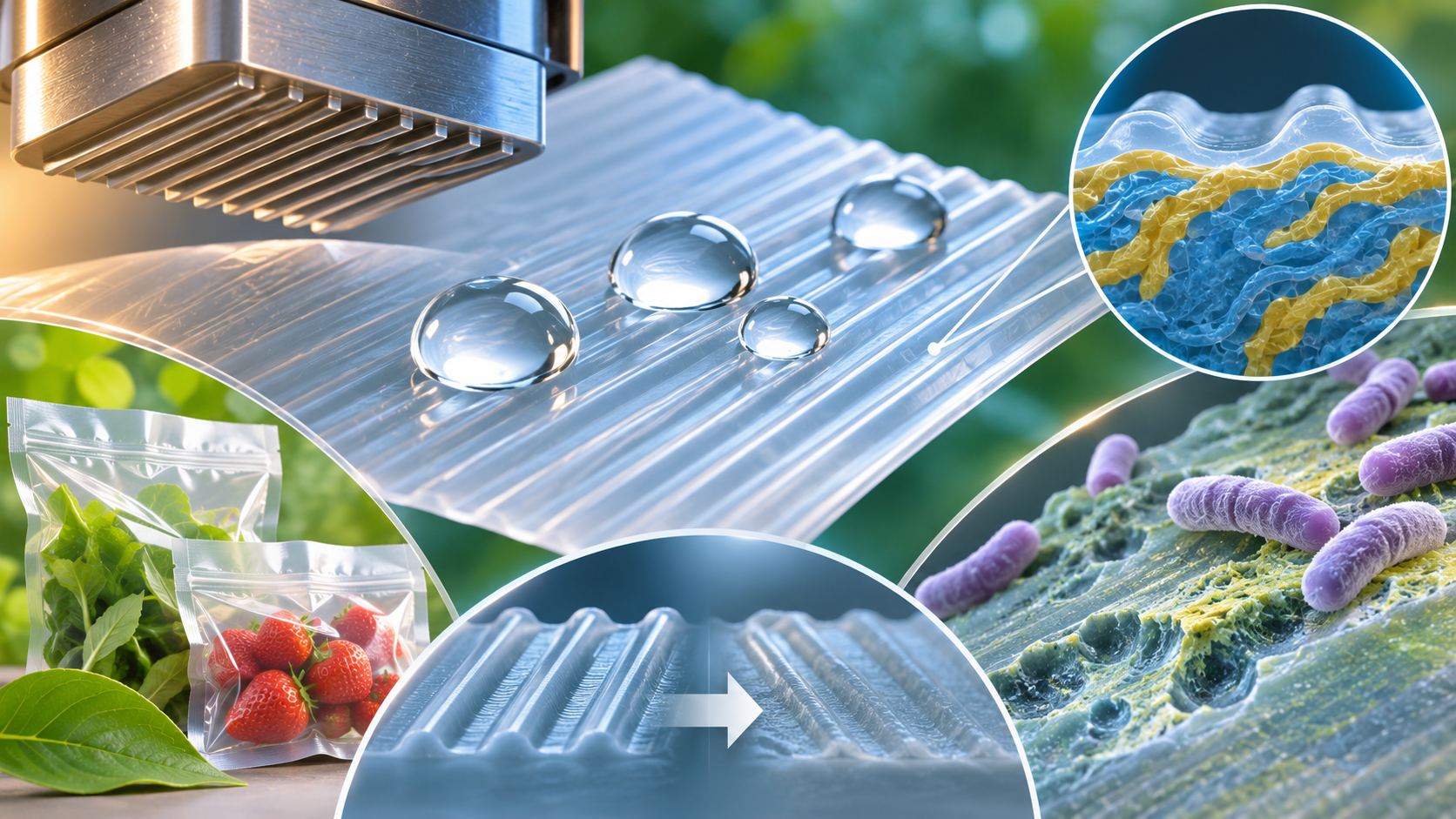
Paper: Triggering biodegradation of PLA and PBAT blend films by microembossing. AI-generated abstract conceptual image created using ChatGPT/OpenAI
Biodegradable plastics are a useful alternative to conventional plastics, but they face a challenge: they need to resist water during use while degrading after disposal.
A recent study published in the journal npj Materials Degradation introduced a chemical-free microembossing method to alter the biodegradation rate of a 70% PLA/30% PBAT film blend.
By adding microscopic line patterns to the polymer surfaces, researchers produced films with previously reported water-repellent behavior and stronger water droplet pinning during use, while losing more mass during controlled bacterial incubation.
Environmental Impact of Conventional Plastics
Petroleum-based plastics, such as polyethylene and polypropylene, generate large amounts of waste each year and contribute to plastic pollution and microplastic buildup on land and in oceans.
Recycling can recover some of these materials, but contamination often makes mechanical recycling difficult and costly. Under suitable conditions, enzymatic and microbial processes can break down biodegradable plastics into biomass, water, and carbon dioxide.
Poly(lactic acid) (PLA) provides stiffness, while poly(butylene adipate-co-terephthalate) (PBAT) provides flexibility. Blending them helps balance their mechanical properties. PLA/PBAT degradation also depends on temperature, humidity, microbial activity, crystallinity, and surface characteristics.
Methods used to speed degradation, including chemical surface treatments and natural additives that create porosity, can require extra processing steps or alter the material's composition and properties. This led the team to test whether changing only the film surface could increase biodegradation without changing the blend itself.
Development of Microembossed Biopolymer Films
The team prepared a 70% PLA and 30% PBAT blend without chemical compatibilizers or other additives. The team compounded the dried polymers in a twin-screw extruder, pelletized them, and then film-extruded them with a single-screw machine to a thickness of approximately 290 ± 20 μm.
To modify the film surfaces, the researchers used a precision press at 25°C with a compression force of 48 kN and a holding time of three seconds. The researchers used laser-machined metal stamps with parallel line patterns spaced 100 and 200 μm apart and a structure height of about ±20 μm.
For comparison, the study also prepared untreated films and films pressed with smooth, pattern-free stamps under the same conditions. The authors then tested biodegradation using Bacillus subtilis DSM 10. They placed sterilized polymer samples on nutrient-limited agar, where the bacteria could use the films as their primary carbon source.
The tests ran for 77 or 115 days at 30°C. During this period, the team examined changes in surface structure and appearance using white-light interferometry, variable-pressure scanning electron microscopy, and laser scanning microscopy.
They also used confocal Raman microscopy, attenuated total reflectance Fourier-transform infrared (ATR-FTIR) spectroscopy, X-ray diffraction, energy-dispersive X-ray analysis, and differential scanning calorimetry to study changes in chemical composition, elemental distribution, and crystallinity.
Mechanisms Behind Increased Biodegradation
Microscopic analysis confirmed that microembossing reproduced the stamp patterns, creating regular grooves and raised lines on the film. Contact angle hysteresis increased from 41.7° in untreated films to 64.8° and 65.9° in patterned films, indicating stronger adhesion and greater pinning of water droplets on the textured surfaces. Earlier work by the researchers showed that the films remained water-repellent.
Confocal Raman depth profiling showed that the pressing process also changed the distribution of the two polymers.
At room temperature, PBAT was rubbery while PLA was glassy. The PBAT fraction fell slightly at the surface and rose below it, peaking near 45% at 2.8 μm. The topmost region was relatively richer in PLA because PBAT made up a smaller share at the surface.
Energy-dispersive X-ray analysis also found higher oxygen concentrations in the grooves before biodegradation. After 115 days of bacterial exposure, the patterned films lost more mass than the untreated samples, and the smooth stamp control lost 3.45%. Films with 100 μm and 200 μm patterns lost 6.33% and 7.50% of their mass, respectively, compared with 1.97% for untreated films.
Surface measurements also showed that the raised patterns gradually flattened as the material degraded.
Raman, FTIR, and X-ray diffraction analyses supported preferential degradation of the PLA-rich near-surface regions, leaving a higher relative PBAT fraction near the surface. Thermal analysis showed a lower cold crystallization temperature and broader melting transitions, changes that the authors linked to possible chain cleavage and greater heterogeneity in the crystalline structure.
The altered distribution of PLA and PBAT just below the surface may also affect where degradation begins.
Potential Industrial and Packaging Applications
The authors describe mechanical embossing as a method that could be expanded to industrial production and propose it as a possible route to biodegradable packaging films.
The study did not test continuous production or a commercial packaging system. The patterned films retained the previously reported wetting behavior and showed stronger water droplet pinning, but the experiments did not test moisture barrier performance or handling stability during transport and storage.
Because the embossing step is mechanical, it requires no additional compatibilizers or chemical surface treatments. The bacterial test showed greater mass loss related to biodegradation in this laboratory setup. It did not show complete breakdown, and performance in soil or compost remains to be tested.
Future Directions in Chemical-Free Bioplastic Design
An important next question is how broadly these effects apply beyond the tested blend and laboratory conditions.
Future studies could test continuous roll-to-roll embossing in production, other surface patterns and biodegradable polymer blends, and soil or compost conditions. That work would help determine whether the laboratory results translate to commercial packaging.
Disclaimer: The views expressed here are those of the author expressed in their private capacity and do not necessarily represent the views of AZoM.com Limited T/A AZoNetwork the owner and operator of this website. This disclaimer forms part of the Terms and conditions of use of this website.
Source:
- Liu, H., Grimm, L., Akintunde, M., Pflaum, M., Taha, I., Weber, K., & Albrecht, J. (2026). Triggering biodegradation of PLA and PBAT blend films by microembossing. npj Materials Degradation, 10, 131. DOI: 10.1038/s41529-026-00900-x, https://www.nature.com/articles/s41529-026-00900-x