A modified fluoroelastomer changes how PPS forms its internal structure, offering clues to how high-temperature motor insulation could better withstand repeated bending and electrical stress.
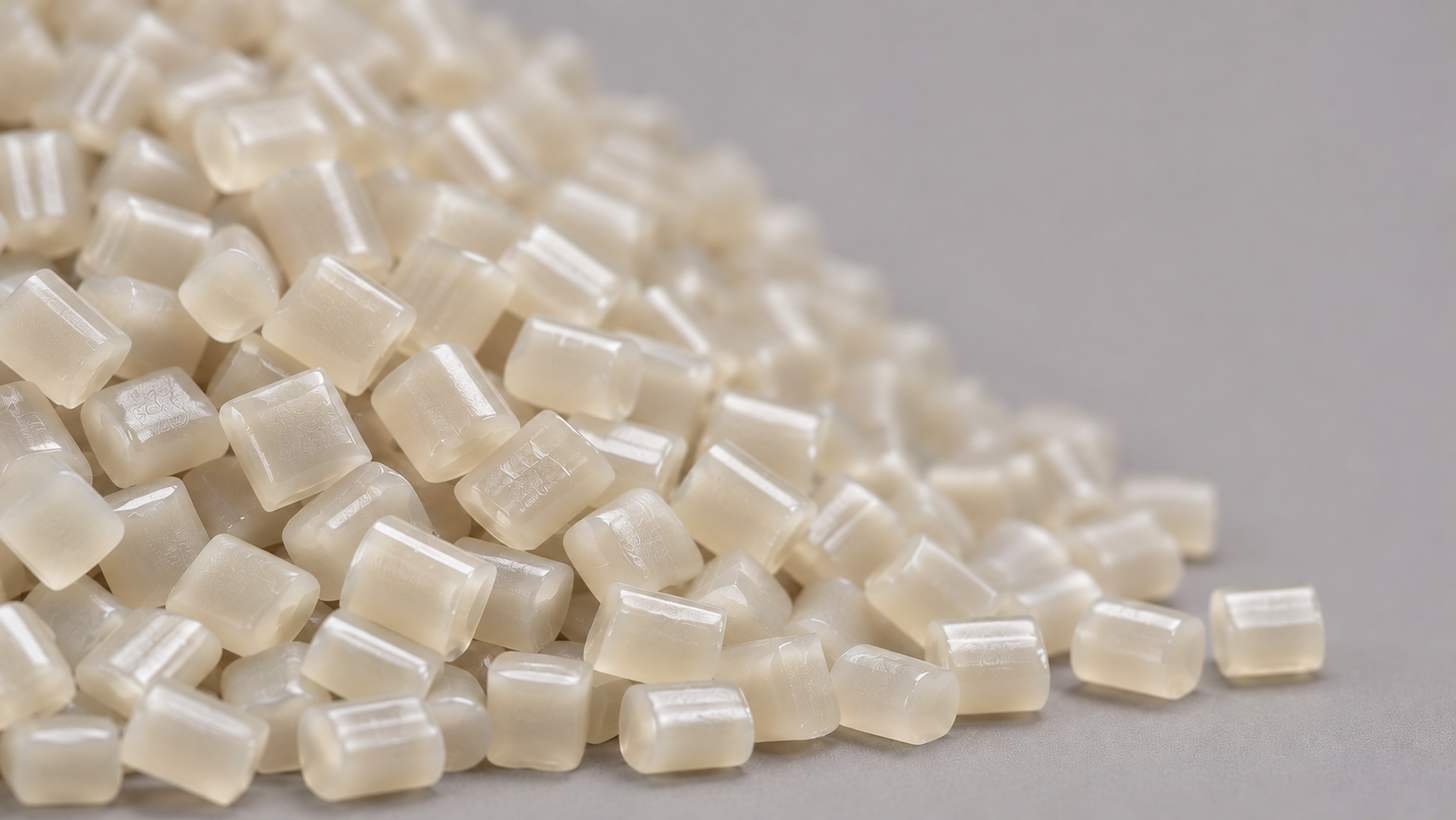
Paper: Improving the electrical and mechanical properties of poly(phenylene sulfide) via reactive blending with an iodine-terminated fluoroelastomer. AI-generated abstract conceptual image created using ChatGPT/OpenAI
Combining strong electrical insulation performance with mechanical flexibility remains a challenge for engineering thermoplastics used in modern power systems.
A recent study published in the Polymer Journal examined an interfacial engineering approach to improve the mechanical properties of poly(phenylene sulfide) (PPS) while maintaining electrical insulation performance at elevated temperatures.
Researchers used reactive melt blending with an iodine-terminated fluoroelastomer (mFEPM) to produce a polymer alloy that reduces brittleness and improves folding fatigue resistance while preserving high partial discharge inception voltage (PDIV). The findings point to a possible route for EV motor insulation at high temperatures.
Challenges of Conventional Thermoplastics
Modern high-power electric drives operate under severe thermal, mechanical, and electrical stresses. In electric vehicle (EV) motors, rapid inverter switching generates repetitive voltage surges that can trigger partial discharges in internal voids within the insulation, leading to dielectric breakdown. Insulating materials need high partial discharge inception voltage (PDIV) and low dielectric permittivity.
PPS is a suitable thermoplastic matrix because of its low dielectric permittivity, high thermal stability, and favorable cost-performance balance. Its rigid molecular structure makes it brittle, which can lead to microcracks during manufacturing. Conventional blending with flexible rubbers is challenging because PPS and FEPM are inherently immiscible, which can produce coarse phase separation and weak interfacial adhesion.
Reactive Compatibilization at the PPS-FEPM Interface
To address phase separation, researchers investigated reactive compatibilization between linear PPS and fluoroelastomers. They compared an unmodified tetrafluoroethylene-propylene copolymer with a modified version containing terminal iodine atoms.
Researchers selected mFEPM because its carbon-iodine bonds may thermally cleave at temperatures above 270 °C during melt processing, generating radicals that may react with the aromatic rings of PPS to form interfacial PPS-g-mFEPM species. The paper treats this reaction pathway as plausible rather than established, since competing radical reactions may also occur.
The polymer alloys were prepared using a 30 mm twin-screw extruder operated at 200 rpm. PPS and each fluoroelastomer were fed separately from independent hoppers at a 70:30 weight ratio and compounded across four heating zones maintained between 270 °C and 290 °C.
After strand pelletization, the formulations were processed into uniform 150 μm films using a single-screw extruder with a 250 mm coat-hanger die, with temperatures maintained between 300 °C and 330 °C.
Structural Improvements and Performance Changes
Microstructural analysis showed clear differences between the blends.
The unmodified fluoroelastomer blend exhibited coarse sea-island phase separation with large rubber domains and weak interfacial cohesion. In the reactive blend, the domains were much finer and more uniform, with a number-average diameter of approximately 0.38 μm.
The authors interpreted this refinement as consistent with possible in situ graft-copolymer formation at the interface, which could lower interfacial tension and limit domain coalescence during processing.
Thermal analysis indicated that the fine mFEPM-containing interfaces may act as heterogeneous nucleation sites in the PPS matrix. The unmodified elastomer restricted crystalline growth, leaving much of the matrix amorphous during cooling. The paper states that the reason for this inhibition remains unclear.
Compared with the unmodified blend, the reactive blend crystallized faster, as shown by an increase in the reciprocal of the half-crystallization time. Polarized optical microscopy showed no distinct spherulites, suggesting that heterogeneous nucleation promoted the formation of fine microcrystals.
The refined morphology was associated with improved mechanical durability, while the PDIV increase was shared by both elastomer blends.
In folding fatigue tests, the reactive blend exhibited approximately four times the endurance of both neat PPS and the non-reactive blend. It maintained its folding endurance after annealing at 200 °C for 1 hour, while PPS and the non-reactive blend showed large drops in folding endurance. The authors linked this loss to crystallization embrittlement likely associated with large spherulites.
Both elastomer blends demonstrated higher PDIV values than unmodified PPS across the tested temperatures, including 150 °C, though PDIV fell for every sample at 150 °C. The authors proposed that electron trapping by fluorine atoms and the low dielectric constant of the FEPM domains contributed to the higher PDIV.
Annealing increased crystallinity in all three materials but produced almost no change in PDIV, indicating that crystallinity was not the main factor behind the electrical result under these test conditions.
Future Implications for Electric Transportation
Developing flexible PPS alloys with higher PDIV could help meet the thermal and electrical demands of modern electric transportation.
The paper focuses on EV drive motors, where insulating films in windings and slot liners can undergo severe bending during manufacturing and face surge voltages during operation. The reactive alloy's improved folding endurance suggests potential use in motor slot liners and winding insulation components.
Other electrical applications and chemically demanding environments would require separate testing before similar performance could be assumed. The electrical experiments measured PDIV rather than long-term discharge erosion, dielectric lifetime, or breakdown lifetime, so service-life claims remain outside the evidence reported here.
Study Limitations and Next Steps
The results indicate that controlling the PPS-mFEPM interface can markedly improve folding endurance without sacrificing the higher PDIV associated with adding a fluoroelastomer. The study does not establish which structural change contributes most to the mechanical improvement. Interfacial adhesion, phase refinement, faster crystallization, and changes in crystal structure may all contribute to the improved fatigue resistance.
The study also does not establish whether the same reactive blending approach would produce similar results in other high-performance polymers. Further research is needed to separate these individual contributions, which the authors identify as an unresolved question. Long-term electrical aging studies would also be needed before the alloy's service life under repeated inverter stresses could be assessed.
Disclaimer: The views expressed here are those of the author expressed in their private capacity and do not necessarily represent the views of AZoM.com Limited T/A AZoNetwork the owner and operator of this website. This disclaimer forms part of the Terms and conditions of use of this website.
Source:
- Takenaka, S., Kuboyama, K., & Ougizawa, T. (2026). Improving the electrical and mechanical properties of poly(phenylene sulfide) via reactive blending with an iodine-terminated fluoroelastomer. Polym J. DOI: 10.1038/s41428-026-01272-4, https://www.nature.com/articles/s41428-026-01272-4