By pairing two materials that swell at opposite ends of the pH scale, researchers created microscale structures that change shape as their chemical environment shifts.
Paper: 4D printing of multi-state pH-responsive microstructures. AI-generated abstract conceptual image created using ChatGPT/OpenAI
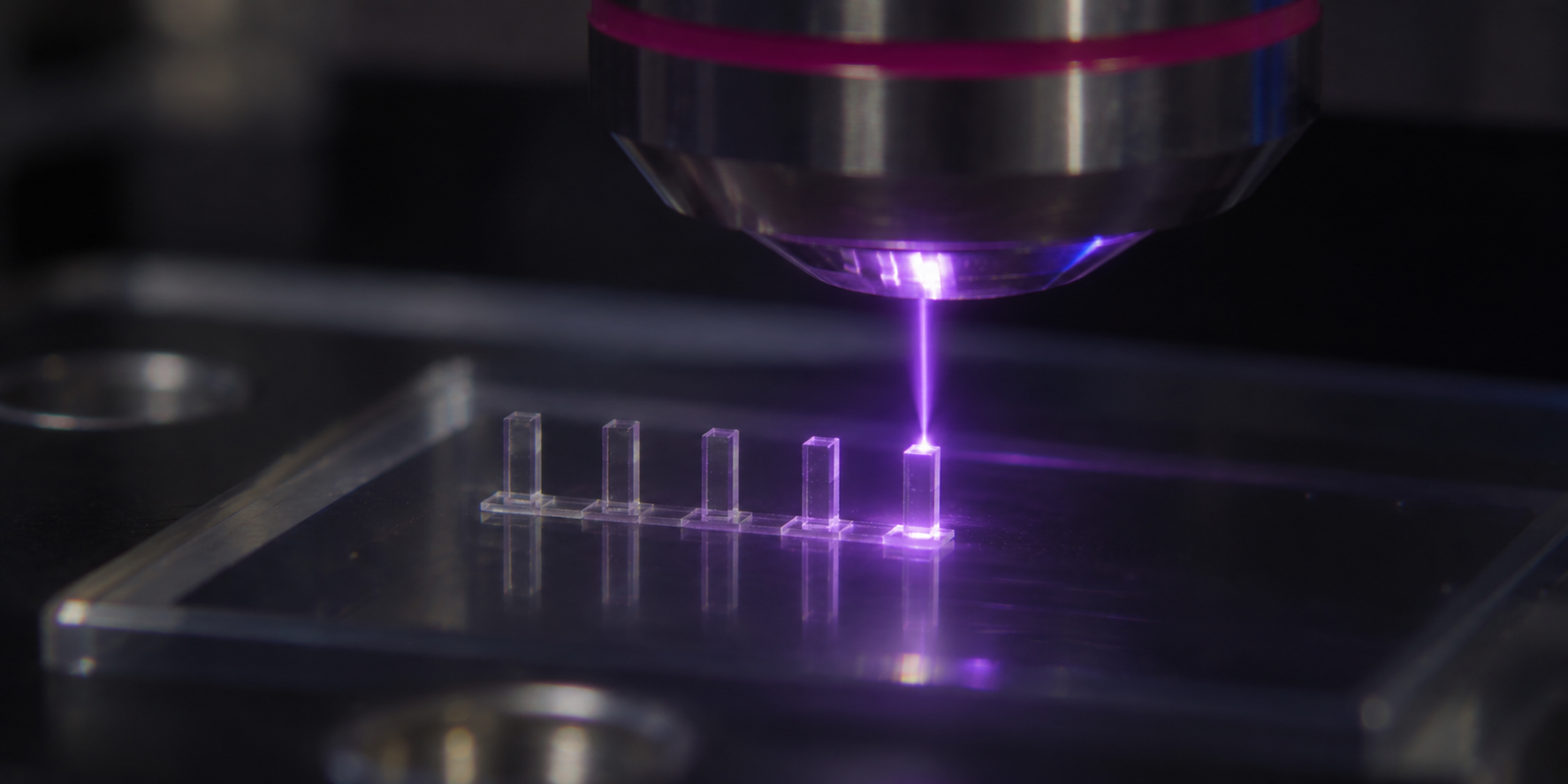
In a recent research article published in the journal Nature Communications, researchers developed two pH-responsive, polymerizable deep eutectic system inks for multiphoton 3D laser printing, enabling the fabrication of multi-state microactuators with broad printability and bidirectional actuation under acidic and basic conditions.
Polymerizable DESs for 3D printing
Polymerizable deep eutectic systems (DESs) are being studied as tunable materials for 3D printing because their chemistry and physical properties can be adjusted. DESs have also been discussed in connection with sustainability and green chemistry, though this study did not assess the environmental impact of the inks or printing process.
DESs typically form liquids at room temperature through strong molecular interactions between components, yielding materials with low vapor pressure, high thermal stability, and adjustable polarity.
Beyond their role as solvents, polymerizable DESs containing reactive groups can form soft polymer networks with ionic functionality. DESs have recently been used in macroscale 3D printing to make stimuli-responsive components, but their use in microscale fabrication through multiphoton 3D laser printing (MPLP) remains underexplored.
MPLP offers submicrometer resolution and can produce intricate geometries. pH-responsive microactuators that swell reversibly as acidity changes could support work in soft microrobotics and sensing, but reported hydrogel-based systems often have narrow processing windows, can require moderate to high crosslinker content that restricts swelling, and frequently use bilayer architectures with a limited number of actuation states.
MPLP fabrication and characterization
The vinyl phosphonic acid-based DES (DES-PO3H2) was prepared by mixing vinyl phosphonic acid with zinc chloride, yielding a viscous, homogeneous liquid stabilized by strong coordination and hydrogen-bonding interactions. The imidazole-based DES (DES-Im) was prepared from vinyl imidazole and lithium bis(trifluoromethanesulfonyl)imide (LiTFSI).
The researchers tested solvent-free formulations in which the DES itself served as the liquid phase. They printed micropillar arrays with a commercial MPLP system at different laser powers and scan speeds to assess printability and mechanical properties. Nanoindentation measured the elastic moduli of the cured networks.
The researchers assessed pH-responsive swelling by exposing micropillar arrays to buffer solutions from pH 2 to 11 and measuring dimensional changes relative to the original model dimensions.
Nuclear magnetic resonance (NMR) spectroscopy supported the presence of supramolecular interactions in the DESs, while Fourier-transform infrared (FTIR) spectroscopy tracked pH-dependent protonation and deprotonation in the printed materials. Confocal microscopy provided three-dimensional views of swelling.
Multi-material bilayer microstructures combining both DES-based inks were made through sequential printing with registration markers, followed by development and rehydration steps to observe their combined actuation.
Multi-state pH-responsive actuation
NMR signal broadening indicated increased viscosity and restricted molecular mobility, while FTIR spectra supported coordination within the supramolecular networks.
The inks printed across wide ranges of laser power and scan speed without structural collapse or delamination. The authors compare this behavior with the narrower processing windows commonly reported for responsive hydrogel inks.
Nanoindentation gave reduced elastic moduli of about 0.9 to 1.1 MPa for DES-PO3H2 and 4.8 to 6.9 MPa for DES-Im across the tested laser powers, with DES-Im showing a stronger dependence on laser power.
The two materials showed distinct, opposing pH-dependent behavior. DES-Im networks swelled under acidic conditions because protonation of imidazole groups increased positive charge density and osmotic pressure, producing a swelling degree of 66% relative to the 3D model dimensions at pH 2. Swelling fell at pH 11.
DES-PO3H2 networks showed negligible swelling at acidic pH but swelled sharply under basic conditions. Stepwise deprotonation of phosphonic acid groups produced negative charges and drove swelling to 73% relative to the 3D model dimensions at pH 11.
The reported 66% and 73% values came from single measurements at each condition, with no error bars, so they represent individual measurements rather than statistically estimated means.
When combined in bilayer microstructures, the opposing swelling profiles produced reversible bending in opposite directions under acidic and basic conditions, while the structures remained straight near neutral pH.
Repeated cycling showed stable, reproducible swelling of the printed structures. Individual micropillars had characteristic swelling time constants of about 0.2 to 0.3 seconds and reached about 95% of their swelling response in roughly 1.2 to 1.4 seconds.
The modest crosslinker content preserved high chain mobility, allowing pronounced dimensional changes while maintaining mechanical integrity. Because the DES itself formed the liquid phase, the inks contained no water before aqueous exposure. Printed structures were developed in isopropanol and then rehydrated in water, so the study does not attribute the response to an absence of residual processing solvent.
Finite element simulations using a hyperelastic model reproduced the observed bending and shape changes in very good agreement, without fitted model parameters.
The authors also reported small differences between experimental beams that the simulations did not reproduce, possibly reflecting variations introduced during printing.
The modeling supports using measured swelling ratios to design more complex microscale actuator geometries. The results extend the accessible pH-controlled shape states beyond the passive-active bilayer concepts discussed in the paper.
Implications for soft microrobotics
This work develops two pH-responsive, polymerizable DES formulations based on vinyl phosphonic acid and vinyl imidazole for multiphoton 3D laser printing of microscale actuators.
Opposing swelling responses to protonation and deprotonation allow the same structure to bend in different directions as pH changes.
The solvent-free DES inks combined low crosslinker content with reliable microscale printing and pronounced pH-responsive swelling across the tested printing conditions.
The combination of ink formulation, precise MPLP fabrication, and predictive modeling supports further development of complex soft microrobots, sensors, and adaptive microdevices. The authors identify autonomous actuation, sequential shape changes, microscale chemical sensing, adaptive biomedical devices, and soft microrobots as possible future applications rather than technologies demonstrated in the present study.
The study provides a materials route for microscale 4D-printed devices in which chemical inputs control reversible shape change.