The surge in popularity and acceptance of Fourier transform infrared (FTIR) spectrometers for use in quality assurance (QA) laboratories and on production floors is one of the major developments impacting industrial settings over the past few years.
FTIR spectroscopy provides analytical opportunities across multiple areas of manufacturing and quality control. It encompasses a wide variety of chemical applications, particularly in organic compound analysis.
FTIR has seen more widespread use in quantitative determinations in recent years, driven by improvements in signal-to-noise performance and the development of innovative statistical analysis algorithms.
Owing to its miniaturized design and robustness, the instrumentation can be in either the analytical laboratory or near the manufacturing line. Reduced cost, high speed, and ease of analysis make FTIR a method of choice for multiple industrial applications.
Thermo Scientific™ Nicolet™ FTIR Spectrometers provide numerous benefits over other analysis methods. The most important include a significant reduction in data acquisition time, improved component specificity, and enhanced sensitivity.
Additional advantages include internal wavelength calibration, which ensures analysis precision. With constant improvements in computing power, contemporary spectroscopy software, and innovative chemometric methodologies, FTIR is becoming increasingly popular across countless commercial applications.
From basic identification using library comparisons to advanced quantitative analysis, method development, spectrometer operation, and data manipulation, these methods are both simple and powerful.
Advancements in FTIR instrumentation and substantial changes in sample handling methods have led to a comprehensive range of novel accessories that simplify and, in many cases, eliminate tedious sample preparation altogether.
A number of these sampling methods involve constant optical path-length, irrespective of sample volume or thickness, thereby enabling streamlined, reproducible quantitative analysis.
Thermo Scientific offers a broad array of FTIR spectrometers that address the needs of quality control (QC) and quality assurance (QA) labs. Nicolet FTIR spectrometers provide the full benefits of FTIR technology combined with the simplicity of push-button operation.
Instrument engineering and design enable dependable, continuous operation in a wide range of industrial laboratory settings. Depending on the sampling interface, the spectrometers can be used for gas, liquid, or solid sample analysis.
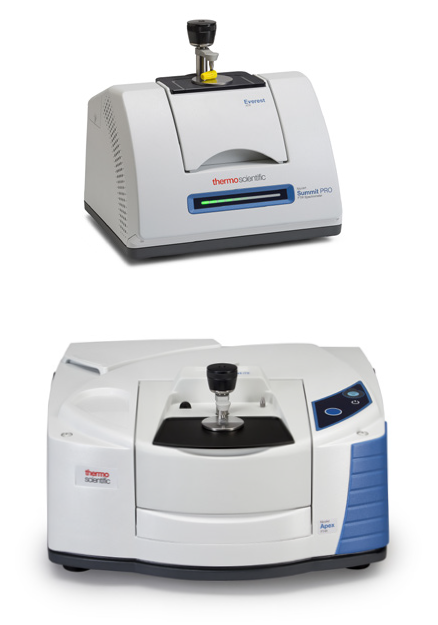
Combining compact size, reliability, and superior performance, the Thermo Scientific Nicolet FTIR Spectrometers are ideal for a wide variety of quality control applications. Thermo Scientific Nicolet Apex FTIR Spectrometer (bottom) and Thermo Scientific Nicolet Summit PRO FTIR Spectrometer (top). Image Credit: Thermo Fisher Scientific - Vibrational Spectroscopy
The spectrometers can be configured to run specific techniques designed for individual applications, making them ideal as dedicated, user-friendly QA/QC laboratory analyzers. They can be programmed with custom techniques that provide complete flexibility in data collection, analysis, and result interpretation with a single keystroke.
This setup allows non-technical personnel to operate while ensuring consistent, high-quality analytical results with the highest precision and accuracy. This note presents several examples of dedicated applications developed on previous-generation Thermo Scientific spectrometers.
Analysis of Oxygenated Extenders in Gasoline
The use of organic extenders in gasoline to enhance octane ratings and reduce emissions is increasing. Due to their distinct spectral characteristics, oxygenated extenders can be easily identified and quantified in gasoline.
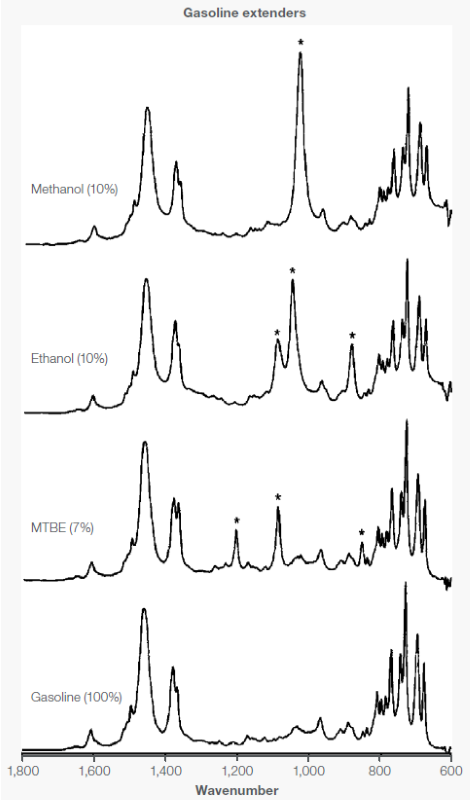
Figure 1. Methanol (10 %), Ethanol (10 %), and MTBE (7 %) in gasoline spectra. Major extender peaks marked with (*). Image Credit: Thermo Fisher Scientific - Vibrational Spectroscopy
Toluene Diisocyanate in Pre-Polymer Mixtures
Toluene diisocyanate (TDI) is utilized in a variety of resin blends for polymeric foam manufacturing. The TDI concentration in the pre-polymer mixture influences final product quality.
Attenuated total reflectance (ATR) FTIR spectroscopy can be used to quantitatively determine the TDI concentration in resin blends before polymerization to ensure product quality. After developing a calibrated method, analysis can be carried out with a single keystroke.
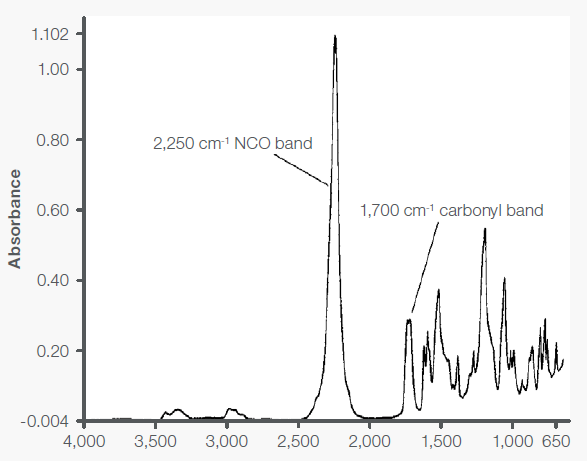
Figure 2. Toluene diisocyanate pre-polymer spectrum obtained on a horizontal ATR accessory. Bands used for quantitative determination are indicated. Image Credit: Thermo Fisher Scientific - Vibrational Spectroscopy
Monitoring of Polyethylene Fluorination Level
Chemically reinforced polyethylene is utilized in numerous industrial applications. Polyethylene surface fluorination is one method for enhancing its performance. The fluorination level can be easily monitored with a Nicolet FTIR spectrometer, offering cost and performance advantages over currently used neutron activation analysis (NAA) and electron scatter analysis (ESCA).
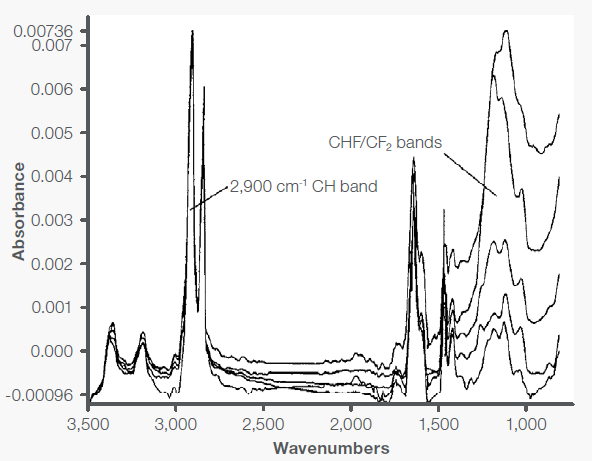
Figure 3. A series of calibration spectra obtained for fluorinated polyethylene samples. Bands used for the determination of fluorination levels are indicated. Image Credit: Thermo Fisher Scientific - Vibrational Spectroscopy
Corn Syrup
Rapid measurement of dextrose equivalent (DE) and dry substance (DS) at intermediate stages of corn syrup processing enables improved control of syrup production. The Thermo Scientific TQ Analyst quantitative analysis software was employed to develop a Partial Least Squares (PLS) method that provides a robust, rapid process for monitoring product quality.
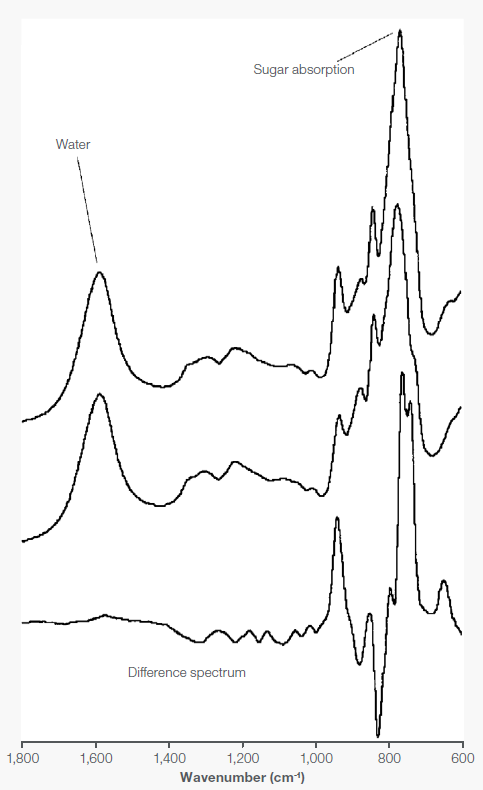
Figure 4. Spectra of corn syrup production lot samples having different DE and DS levels, with the spectral subtraction result below. Image Credit: Thermo Fisher Scientific - Vibrational Spectroscopy
Lubricating Oil Blend
Lubricating oils are blended from a wide variety of components, including base oils, additives, pour point depressants, and viscosity enhancers. FTIR can be used to determine the concentrations of these components in the finished product.
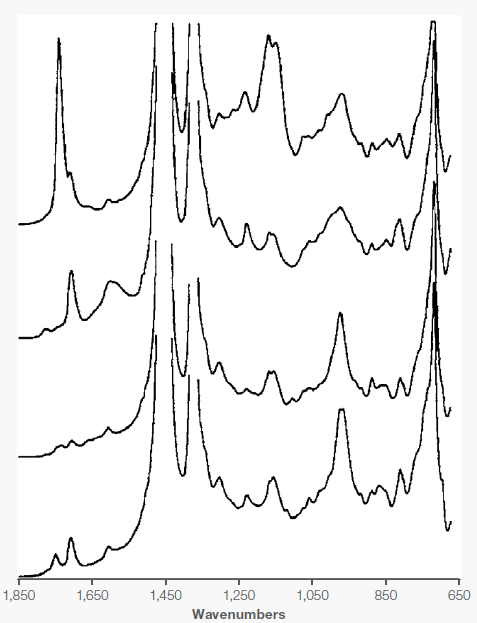
Figure 5. Overlay spectra of commercial lubricating oils showing differences in base oils and additives. Image Credit: Thermo Fisher Scientific - Vibrational Spectroscopy
Lubricating Oil Condition Monitoring
FTIR analysis of used lubricating fluids, followed by subtraction of the appropriate new oil reference, is an effective tool for monitoring lubricant changes. These changes result from oxidation processes or contamination from other mechanical system components.
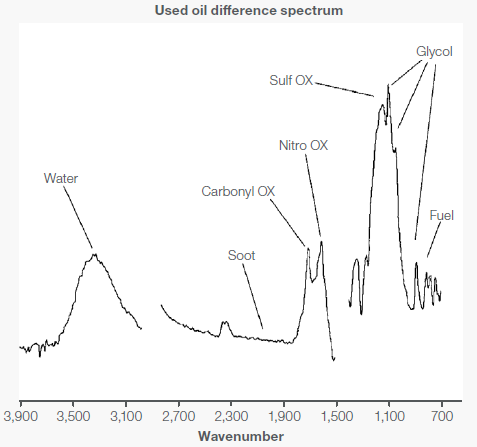
Figure 6. Typical used engine oil difference spectrum with components of interest labeled. Image Credit: Thermo Fisher Scientific - Vibrational Spectroscopy
Hydroxyl Number in Glycols
Understanding the hydroxyl group content of glycols is essential for predicting the functional properties of the resulting products. The hydroxyl value relates to molecular weight, viscosity, reaction extent, and other parameters that are both critical to and dependent on the final application. FTIR can be used to quickly and easily assess this value.
Conclusion
As demonstrated by these examples, FTIR spectrometers can be easily integrated into quality assurance and quality control labs. Their speed, specificity, ease of operation, and durability often make FTIR the instrument of choice. The broad range of offerings from Thermo Fisher Scientific spans multiple price points and capabilities, providing short-term return on investment and long-term dependability, even in heavily regulated sectors.
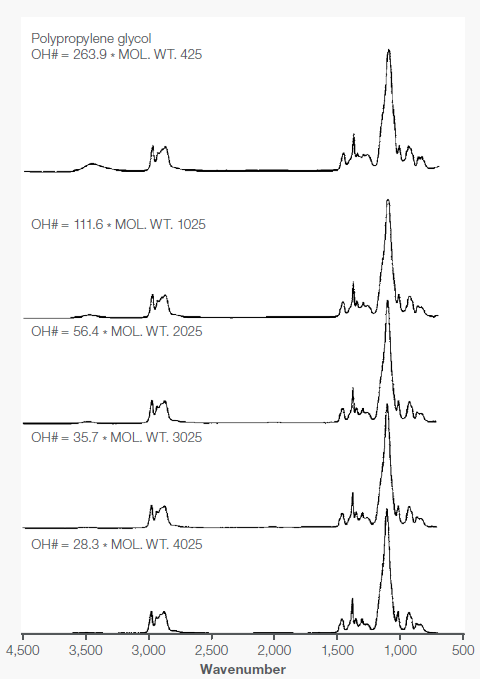
Figure 7. Spectra of polypropylene glycol samples with different hydroxyl values. Image Credit: Thermo Fisher Scientific - Vibrational Spectroscopy

This information has been sourced, reviewed, and adapted from materials provided by Thermo Fisher Scientific - Vibrational Spectroscopy.
For more information on this source, please visit Thermo Fisher Scientific - Vibrational Spectroscopy.