Routine QC/QA labs can conduct material assessments using single-range, basic Fourier transform-infrared (FT-IR) tool configurations.
However, contemporary analytical labs face growing workloads from a wide variety of sample types, along with concurrent pressure for faster results and more complex sample characterization.
As a result, the flexibility to analyze multiple sample types becomes essential for rapid response to diverse application needs.
Such diversity requires reconfiguring laboratory tools for specific measurements multiple times each day, diverting time from other vital activities. It also requires lab personnel to possess the skills and experience needed to determine the optimal instrument configuration for a given application.
Additionally, frequent handling of fragile optical parts increases the risk of costly instrument failure. Consequently, many industrial labs choose to outsource complex analyses. These constraints inevitably limit the lab’s ability to address urgent business needs.
The Thermo Scientific™ Nicolet™ iS™ 50 FT-IR spectrometer meets many of these productivity challenges by automating FT-IR system configuration for multi-spectral range experiments (> 20,000 cm-1 to 80 cm-1) and by integrating methods such as FT-Raman, near-IR, and mid/far-IR attenuated total reflectance (ATR) into a single workflow.
The Nicolet iS50 spectrometer has been engineered for unattended, risk-free operation, boosting laboratory efficiency, sample throughput, and user consistency. This capability is provided in a cost-effective, miniaturized system (63 cm of linear bench space), allowing laboratories to utilize multiple methods for their analysis.
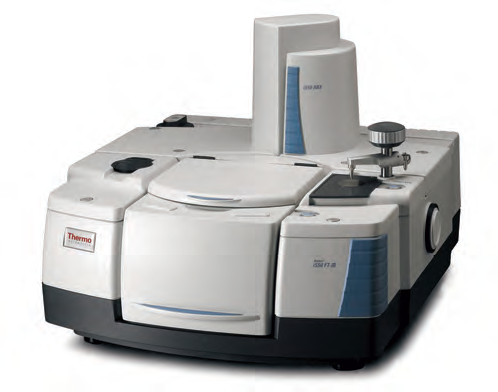
Image Credit: Thermo Fisher Scientific - Vibrational Spectroscopy
Flexibility and Value-Added Activities
Analytical flexibility is essential for working laboratories to address a wide range of situations in which answers are crucial to decision-making. Examples include deformulating mixtures to support patent infringement cases, detecting counterfeit materials for product safety alerts, evaluating forensic samples for criminal investigations, conducting failure analysis to reduce production run delays, analyzing process scale-up options for new product launches, and troubleshooting client complaints.
Such application diversity requires selecting and installing the appropriate instrument accessory, as well as choosing the optimal source, beamsplitter, detector, optical path, and experimental conditions.
Manually changing parts and sampling parameters requires expertise and may expose costly optics to environmental conditions such as dust, fingerprints, or water vapor.
Moreover, altering these parameters can lead to extended wait times to equilibrate the tool before the next measurement can be performed.
These manual reconfigurations add little value to the laboratory workflow. Users must plan and set up batch experiments to minimize the number of steps, creating bottlenecks that limit access to the instrument’s full capabilities.
Consequently, laboratories are less able to respond to “emergency situations” without interrupting the batch run and resetting instrument parameters.
For example, analyzing a polymer containing additives requires mid-IR and far-IR spectroscopy, as well as Raman spectroscopy. This would involve three beamsplitter changes, along with the associated risks of handling costly parts and instrument recovery times between changes.
The productivity enhancements provided by the Nicolet iS50 FT-IR spectrometer arise from two primary features. First, the internally mounted iS50 ABX Automated Beamsplitter Exchanger provides one-button simplicity (referred to as a Touch Point) for instrument configuration and operation, enabling a “one touch and done” workflow. Eliminating both manual handling and preventing optics exposure to the environment ensures immediate readiness.
Second, users no longer need to worry about which optics are installed. As shown in Table 1, the risk of error in manual operations is clear when the large number of possible component combinations is considered.
However, with the Nicolet iS50 spectrometer, the user simply presses the Touch Point on the tool to automatically set up and prepare the instrument. For instance, selecting the Touch Point on the iS50 NIR module automates the configuration without requiring any knowledge of the optics in use.
The focus should be on conducting NIR analysis – rather than selecting the correct components. The instrument manages this step. Integration of the spectrometer with its modules and components expands capabilities and increases productivity with features including:
- As many as three detectors (e.g., near-, mid-, and far-IR)
- The iS50 Raman sample compartment module
- The integrated diamond iS50 ATR sampling station
- The iS50 NIR module with integrated sphere or fiber optics
- The iS50 GC-IR module
- A sample compartment thermal gravimetric analysis-IR (TGA-IR Interface)
Figure 1 illustrates the analytical power achievable with the iS50 spectrometer for obtaining answers required for time-sensitive decisions. With just a single user interaction, the instrument can conduct numerous measurements and analyses and create a final report, even when unattended. The Thermo Scientific OMNIC™ software offers an easy-to-use interface for rapid application configuration and spectrum generation, delivering definitive answers.
By incorporating robust analytical instruments such as the Thermo Scientific OMNIC Specta™ software with a library of more than 30,000 spectra and multi-component searching (or the TQ Analyst™ software for chemometrics), a full analytical workflow from sampling to results can often be completed in under 60 seconds.
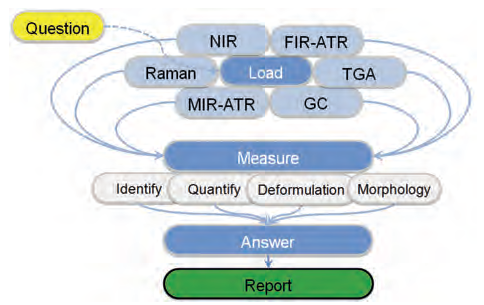
Figure 1. Nicolet iS50 analysis workflow. Image Credit: Thermo Fisher Scientific - Vibrational Spectroscopy
This article discusses the improvements enabled by integrating and automating the Nicolet iS50 spectrometer, which increases productivity while reducing the risk of damage to expensive components.
In contrast to most spectrometers, operation of the Nicolet iS50 system becomes simpler as modules are added and as more manual steps are eliminated, even during unattended operation.
Table 1. Experiments made possible with the Nicolet iS50 FT-IR Spectrometer. Source: Thermo Fisher Scientific - Vibrational Spectroscopy
| Experiment |
Source |
Beamsplitter |
Detector |
Accessory |
| Mid-IR Transmission |
Thermo Scientific Polaris™ |
KBr |
KBr-DLaTGS |
Standard Cells |
| Far-IR Transmission |
Polaris |
Solid
Substrate |
Polyethylene DLaTGS |
Cells w/Far-IR Windows |
| Near-IR Transmission |
White Light |
CaF2 |
InGaAs |
Cuvettes |
| Mid-IR ATR |
Polaris |
KBr |
Dedicated DLaTGS |
iS50 ATR |
| Far-IR ATR |
Polaris |
Solid
Substrate |
Dedicated DLaTGS |
iS50 ATR |
| FT-Raman |
Raman Laser |
CaF2 |
Raman InGaAs |
iS50 Raman |
CaF2 – calcium fluoride
DLaTGS – deuterated L-alanine doped triglycene sulphate
InGaAs – Indium gallium arsenide
KBr – potassium bromide
Automated Multi-Spectral Analysis: Mid- and Far-IR ATR Plus Near-IR
Most FT-IR users recognize the value of the mid-IR spectral range for qualitative and quantitative analyses. Although less well known, the far-IR region can provide novel and unique information. In simple terms, an increase in the mass of the atoms involved in vibrations corresponds to a decrease in the wavenumber.1
As a result, for materials such as organometallics or metal oxides, the IR absorption shifts below 400 cm-1 and below the range of standard KBr optics. Several polymers, sugars, and other large molecules also exhibit far-IR information, which can be useful or definitive to the analyst.
Historically, acquiring FT-IR spectra across both the mid-IR and far-IR regions required substantial sample preparation. This involved changing the hygroscopic optics and several detectors, as well as the risk of altered system performance from water vapor.
The Nicolet iS50 spectrometer enables rapid analysis across the full mid-IR and well into the far-IR region (4,000 cm-1 to 80 cm-1) when equipped with the iS50 ABX, iS50 ATR, and the appropriate beamsplitters.
In standard, multi-range FT-IR applications, the spectrometer must be opened to swap beamsplitters, requiring careful handling of expensive parts and exposing internal optics to the environment by disrupting purge or desiccation. This activity adds a recovery period for instrument re-equilibration before quality data can be gathered.
These wait times add no value to operations and waste valuable time. Integration and automation on the spectrometer remove non-productive wait times, thereby enhancing efficiency.
For instance, Table 2 compares the steps required to perform a complete spectral analysis from far-IR to near-IR using the manual technique (Typical) and the Nicolet iS50 technique with the integrated iS50 ATR and iS50 NIR modules.
This approach represents three spectral ranges in a single sampling operation, a unique advantage of the instrument. Most importantly, the integrated iS50 ATR optics and detector enable spectral data collection in both the mid- and far-IR regions. The analysis time is reduced from approximately 30 minutes to under seven minutes.
With the Nicolet iS50 spectrometer, two sampling locations (the built-in ATR and the Integrating Sphere module) can be loaded, and the macro can be initiated for unattended operation. In contrast, manual operation requires continuous attention to swap the beamsplitters at the correct times.
This unexpected enhancement enables unattended operation, allowing productivity through automation. Figure 2 illustrates only the mid- and far-IR spectra of acetylferrocene obtained using an OMNIC macro-controlled workflow.
The additional information provided by the far-IR spectra is evident – the low-end triplet confirms that the iron is positioned between the cyclopentadiene rings. Although the NIR data are not shown, the entire process took 7 minutes, including acquisition of the mid- and far-IR backgrounds.
Automation further shortened total hands-on time (button pressing and sample loading) to approximately 20 seconds.
Table 2. Far-infrared analysis: Typical versus Nicolet iS50 process. Source: Thermo Fisher Scientific - Vibrational Spectroscopy
| Process Step |
Typical |
Time (minutes) |
Nicolet iS50 with
Built-in ATR |
Time (minutes) |
| Sample Preparation |
Grind, Mix |
10 |
None |
0 |
| Mid-IR Background |
Collect BKG |
0.5 |
Collect BKG (2nd)* |
1. |
| Mid-IR Collect |
Load Sample, Collect Spectrum |
2 |
Load Sample,
Collect Spectrum |
1 |
| Change Optics |
Manual Exchange |
0.5 |
Automated |
0.5 |
| Recovery Time |
Wait for Purge |
5–10 |
No Recovery Time |
0 |
| Far-IR Background |
Collect BKG |
0.5 |
Collect BKG (1st)* |
0.5 |
| Far-IR Collect |
Load Sample, Collect Spectrum |
2 |
Load Sample,
Collect Spectrum |
1 |
| Change Optics (NIR) |
Manual Exchange |
0.5 |
Automated |
0.5 |
| Recovery Time |
Wait for Purge |
5 |
No Recovery Time |
0 |
| Collect Background |
Collect BKG |
0.5 |
Collect BKG |
0.5 |
| Collect Sample |
Load Sample,
Collect SAM |
1 |
Collect SAM |
0.5 |
| Data Analysis (Search) |
Perform Search |
2 |
Automated Search |
0.5 |
| Total Time |
|
29.5–34.5 |
|
6.5 |
* With the iS50 ATR present, the far-IR background (BKG) is collected, the iS50 ABX swaps beamsplitters, and the mid-IR background is collected in < 1.5 minutes. The sample is loaded, and the spectra are collected in sequence. All times are approximate.
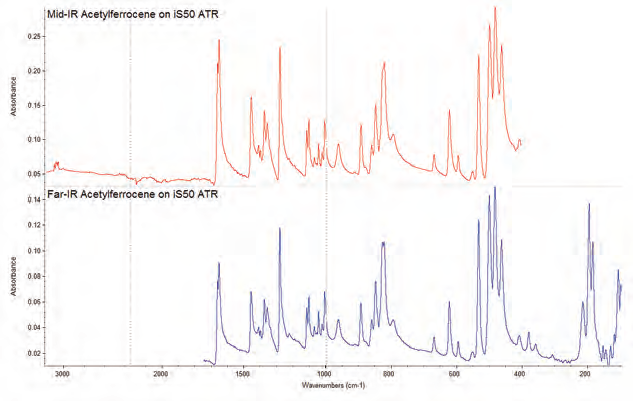
Figure 2. Mid-IR and far-IR spectra of Acetylferrocene. The far-IR optics permit collection to 1700 cm-1, which may be sufficient (fingerprint and far-IR) for many applications. Image Credit: Thermo Fisher Scientific - Vibrational Spectroscopy
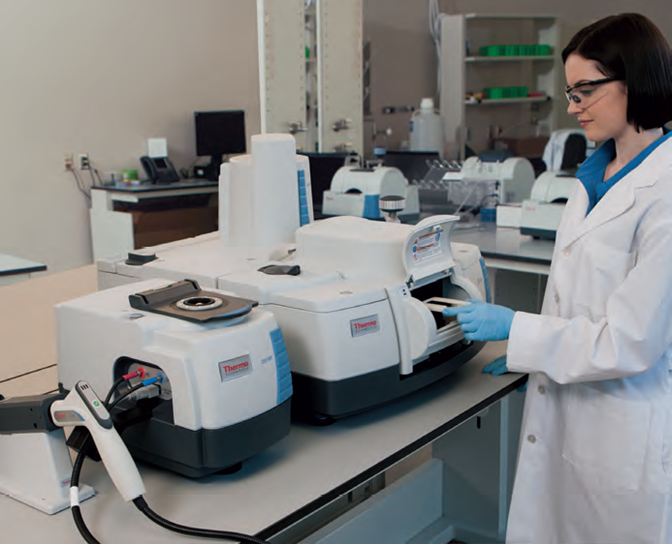
Figure 3. The Thermo Scientific Nicolet iS50 FT-IR spectrometer configured for FT-Raman, near-IR, and mid/far-IR ATR with the automated beamsplitter exchanger. Image Credit: Thermo Fisher Scientific - Vibrational Spectroscopy
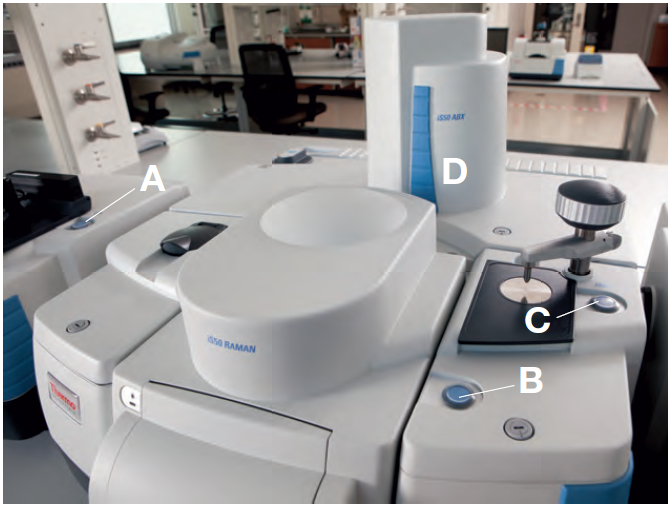
Figure 4. Touch Points on the Nicolet iS50 spectrometer employ one-button switching between modules, and the iS50 ABX automates optics set-up. Touch Point A – NIR module, Touch Point B – Raman module, Touch Point C – Built-in diamond ATR, Component D – ABX Automated Beamsplitter Exchanger. Image Credit: Thermo Fisher Scientific - Vibrational Spectroscopy
Multiple Methods and Multi-Range Analysis: Improved Flexibility
The Nicolet iS50 spectrometer can be configured for FT-Raman, NIR, and wide-range diamond ATR. Switching between these experiments raises concerns related to instrument recovery time (purge), optics exposure and handling, and potential confusion or user error. For these reasons, such experiments are commonly treated as independent activities.
The spectrometer equipped with the iS50 ABX simplifies this otherwise complex situation to a single step – macro initiation.
The Nicolet iS50 instrument depicted in Figure 3 is equipped with the iS50 NIR, iS50 Raman, iS50 ATR, and iS50 ABX modules, demonstrating the ease with which sample loading and analysis can be performed.
To operate one module at a time, the user simply presses the corresponding Touch Point. As illustrated in Figure 4, Touch Points make one-button switching between modules (sampling stations) effortless and automate optics exchange.
Instead of thinking through the required components (light source, beamsplitter, optical path, and detector) for running an experiment, you can switch from an ATR to an NIR measurement by pressing the Touch Point and waiting for the instrument to indicate it is ready to initiate.
This error-free process is completed in just 30 seconds. The analytical power of the Nicolet iS50, shown in Figure 1, is fully realized when all four measurements – mid-IR and far-IR ATR, NIR, and Raman – are performed within a single seamless workflow.
Using a traditional manual approach, collecting spectra from each of these modules required approximately 50 minutes, including sample loading, optical changes, equilibration time, and Raman signal optimization.
Throughout the experiment, the analyst was required to remain present to change beamsplitters and acquire various backgrounds for each sampling station. After 50 minutes, four spectra and their analyses were available. Actual data collection took 5 minutes, while total hands-on time was 45 minutes; an inefficient use of analyst time.
Conversely, the results shown in Figure 5 were obtained from a single OMNIC-macro-operation. The macro was programmed to initiate by acquiring mid- and far-IR ATR backgrounds, and then switch to the iS50 Raman module. The samples were then loaded onto the ATR, NIR, and Raman sampling stations.
After signal optimization using the Raman module’s autofocus feature, the macro was initiated for unattended operation. From macro initiation to final report completion, the analysis required less than 12 minutes, representing a time savings of more than 70 %. Actual data collection time again required five minutes. However, total analyst hands-on time was only two minutes – a highly efficient use of both analyst and instrument time.
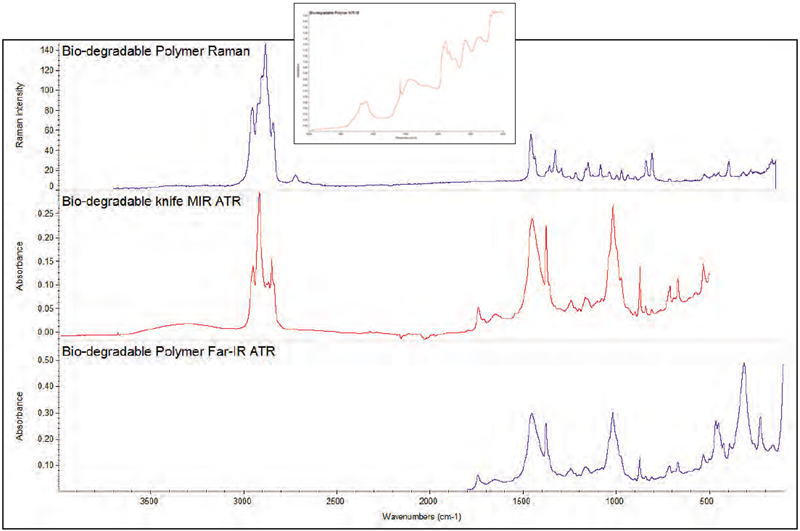
Figure 5. Multi-technique data for a recyclable plastic component using the spectrometer pictured in Figure 3. Inset shows NIR independently for clarity. Image Credit: Thermo Fisher Scientific - Vibrational Spectroscopy
Conclusion
Industrial analytical laboratories face growing pressure from multiple factors, including larger sample loads, reduced staffing, retirement of experts, and shrinking budgets. The Thermo Scientific Nicolet iS50 FT-IR spectrometer helps alleviate these challenges by providing automation in a multi-tasking, single-platform system.
The Nicolet iS50 spectrometer significantly simplifies and streamlines workflows by reducing the number of steps with one-button ease and macro-operations carried out by the analyst. Moreover, risks associated with manual operation, such as user error, environmental exposure, and extended recovery times, are eliminated. Analysts of all skill levels can successfully obtain meaningful results with reduced hands-on time.
The iS50 ABX and task-specific modules (i.e., Raman, NIR, TGA-IR, etc.) incorporate technology designed to enhance workflow efficiency. The Touch Point operation simplifies access to the full range of capabilities by automatically configuring the optics (near-, mid-, and far-IR) and switching between sampling stations (modules) within seconds for improved productivity.
For contemporary industrial laboratories, the Nicolet iS50 FT-IR spectrometer provides a robust, novel platform that goes beyond routine FT-IR to more in-depth analyses (e.g., FT-Raman and far-IR), delivering value to lab activities within a miniaturized, user-friendly system.
References
- Heavy atoms or groups of atoms shift the IR wavenumber value lower, according to the relationship
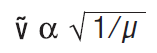
where ∼v is the IR wavenumber (cm-1), and μ is the reduced mass. As the mass (μ) increases, the IR peak shifts to lower wavenumbers.

This information has been sourced, reviewed, and adapted from materials provided by Thermo Fisher Scientific - Vibrational Spectroscopy.
For more information on this source, please visit Thermo Fisher Scientific - Vibrational Spectroscopy.