Written by Dr. Jörg Kersten, Global Platform and Commercial Leader for Battery Fire Protection Solutions.
Silicones play a critical role in automotive engineering because their material properties support both system performance and passenger safety.
In electric vehicle (EV) batteries, silicones help manage heat generated by charging and discharging battery cells and help limit thermal propagation. To promote performance, EV designers need to keep the battery at an optimal temperature and ensure a uniform heat distribution between cells. To support safety, designers need to limit and mitigate battery thermal runaway events, which can result in smoke, fire, and explosions.
Among EV battery materials, silicones stand out for several reasons.
In addition to thermal management and fire and blast protection, they can offer environmental sealing and have outstanding dielectric properties. Specialized materials can also shield battery electronics against electromagnetic interference (EMI).
Silicones are adaptable and come in a range of products for specific challenges. For example, silicone adhesives or encapsulants support the high-volume assembly of EV batteries from cells into modules and modules into packs. They are also used with battery enclosures as gaskets or protective coatings.
The Advantages of Silicone Materials
 Image Credit: Eviart/Shutterstock.com
There are many reasons why a designer should choose silicones over other materials. Silicones resist higher temperatures than epoxies, polyurethanes, or other organic materials, often above 200 °C.
In addition, they can be either thermally insulating or thermally conductive. In EV batteries, thermally insulating silicones help prevent or reduce the impact of heat on adjacent cells or components. Thermally conductive silicones transfer heat from the EV battery to the cooling system. On top of this, they are electrically isolating and have a high dielectric strength.
Both types of materials are available on the market with fire protection ratings such as UL 94V-0. There are also silicone-based materials that undergo ceramification when exposed to extreme heat or fire. This chemical process forms a ceramic layer that maintains fire, thermal, and electrical protection at these extreme conditions.
If required, designers can also choose fire-resistant non-ceramifying silicones.
Another favourable quality is silicones' ability to absorb potentially damaging impacts and their inherent stress-relief. They absorb shock and vibration during normal EV use and can help protect EV batteries in the event of a vehicle crash or a short circuit.
Silicones also absorb some of the stresses that occur when different battery materials expand and contract at different rates in response to temperature changes or charge-discharge cycles.
Importantly, silicones support manufacturing efficiency through automated mixing and dispensing. They are reworkable during product assembly and provide fast, energy-efficient curing, resulting in shorter cycle times and reduced energy use. With the right supplier's help, designers can choose silicone-based solutions that address multiple challenges while receiving application-specific support.
Silicones for Thermal Management
Silicones can be used for thermal management to help extend battery life and reduce the risk of thermal runaway. They can be combined with special fillers that increase thermal conductivity (TC), a measure of the ability to move heat.
Thermally conductive silicones have a much higher thermal conductivity than the air that would otherwise fill gaps between battery components. Filling these gaps with thermally conductive silicones promotes more efficient heat transfer to cooling systems.
Such thermally conductive silicones include adhesives that bond battery cells to cooling plates, as well as silicone-based gap fillers at the interface between the cooling plate and the battery cells. With both products, their tackiness ensures good surface contact, and their low post-cure hardness relieves stresses.
Thermally insulating silicones, rather than thermally conductive ones, also enable designers to address challenges in thermal management. For example, silicone encapsulants and gels provide thermal insulation for insulated gate bipolar transistors (IGBTs), high-speed switching devices that produce significant heat when converting direct current (DC) from the battery to alternating current (AC) for the motor.
Silicones for Battery Fire and Blast Protection
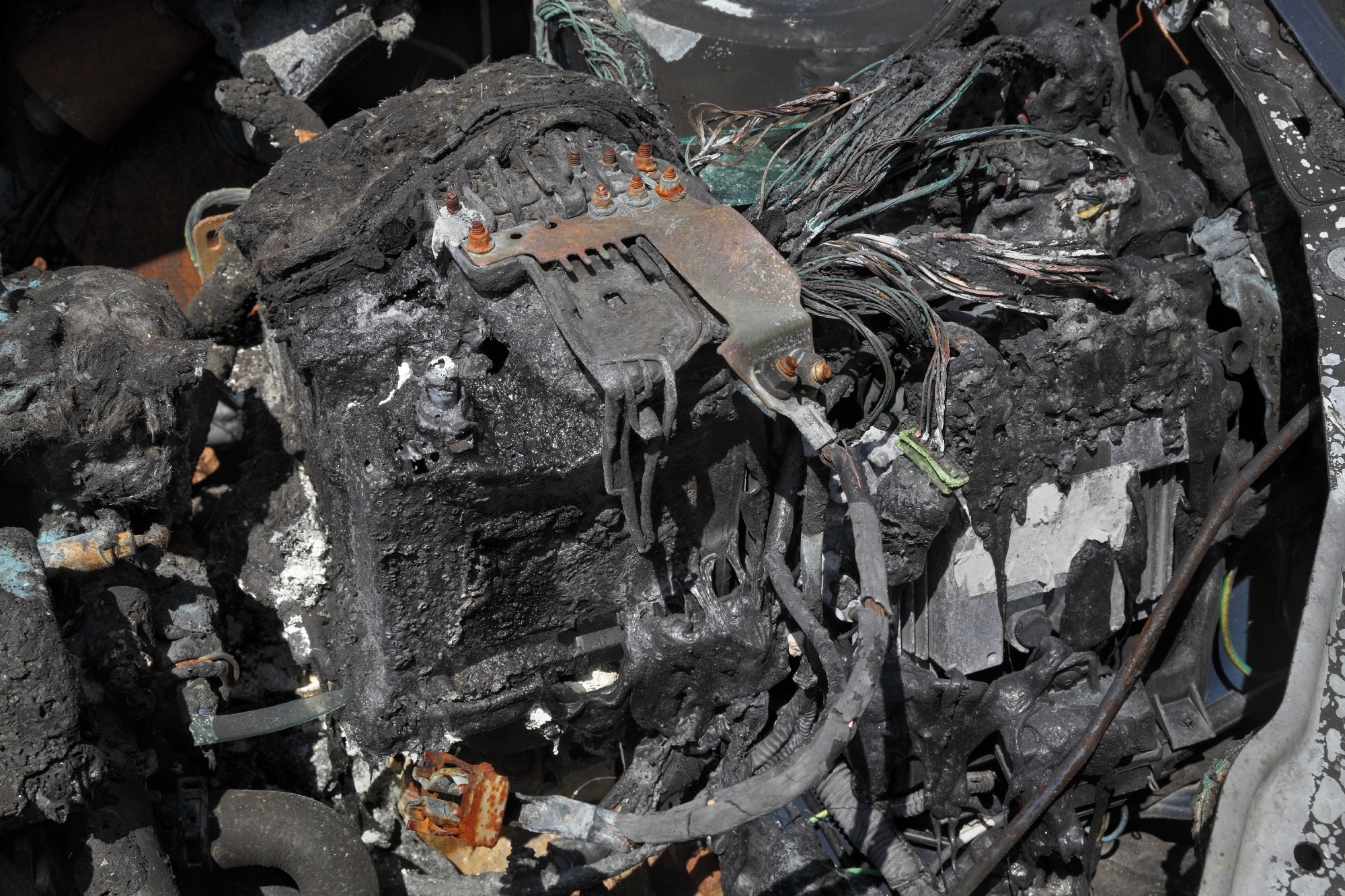 Image Credit: sima/Shutterstock.com
Silicone-based materials for fire and blast protection can support passenger safety through shock absorption and ceramification.
During normal EV battery operation, silicone foams absorb shock that could damage battery cells. During thermal runaway events, silicone foams that ceramify help protect the battery pack against heat, flame, and particle blast - the ejection of solid particles from cells.
EV Battery packs can further use ceramifying silicone coatings that resist high-powered flames at temperatures up to 1200 °C. These materials are applied to battery pack enclosures, dispensed onto panels and EV battery lids with complex geometry, and applied to vertical surfaces with high sag resistance.
Ceramifying high-consistency rubber (HCR) is another useful material here. Fire-resistant silicone HCR is often used to coat busbars and cooling lines, providing dielectric protection even in thermal runaway. HCR sheets can be installed between battery cells and battery modules, and in other areas where thermal runaway could occur, as convection and fire protection barriers.
Finally, potting foams can be applied between battery cells. Low-viscosity materials are used with cylindrical cells. Higher-viscosity potting foams are used with pouch or prismatic cells, where flow must be tightly controlled to accommodate cell geometry.
Both types of foams support vehicle lightweighting, shock and vibration absorption, and provide thermal runaway protection.
Silicones for Sealing, Electrical Insulation and EMI Shielding
Silicones for EV battery sealing must resist environmental contaminants. There is a range of products to be used here, including conformal coatings applied to printed circuit board (PCB) substrates for dust and moisture resistance, and greases that protect electrical connections from dirt, water, and road salt. Silicone greases help prevent electrical arcing and voltage drop.
Both are electrically insulating and have high dielectric strength.
Silicone's adaptability comes into play again here, as silicone adhesives for environmental sealing can be either electrically insulating or electrically conductive. Products that provide electrical insulation are used in the assembly of inverters, converters, and on-board chargers.
Electrically conductive products contain special fillers that help maintain electrical connections and shield sensitive components from EMI from nearby circuits. Silicone foam gaskets enable serviceable seals with excellent compression set and low tolerance requirements.
There are many types of silicones for EV batteries, but the right supplier can help designers select the right materials for both performance and safety.
Saving this article for later? Download a PDF here.
About the Author
Dr. Jörg Kersten is an experienced commercial and business leader with a long-standing career in the silicone and chemical industry.
Since 2023, he has served as Global Platform and Commercial Leader for Battery Fire Protection Solutions while also acting as a Key Customer Executive at Dow. Before this, he held several global and regional leadership roles in commercial management, business development, and key customer management across mobility, electronics, high-performance building, and solar markets.
He began his career in technical and scientific roles before moving into market development and sales positions at Huntsman Polyurethanes.
In 2004, he joined Dow Corning, where he progressed through roles spanning sales management, business development, and leadership responsibilities across Europe and EMEA. Over time, his focus evolved toward strategic customer leadership and global platform responsibilities. He holds a Ph.D. in polymer chemistry from the University of Stuttgart.