Micro-Epsilon provides innovative inspection and measuring systems for the aluminum and steel industries to measure the surface, profile, and thickness. The system’s quality and performance, as well as the reliability of services and products, have made Micro-Epsilon one of the prominent suppliers of inspection systems for optical thickness measurement deployed in the metals industry.
Its non-contact thickness-measuring equipment is used in applications where tracking high-precision thickness is critical for quality and control assurance. Its systems provide maximum precision and reliable measurement in hot and cold-rolling mills, continuous casting plants, and service centers. Micro-Epsilon has successfully installed several pieces of equipment in 13 countries globally in processing and milling lines.
Operating Principle of Thickness Measurement
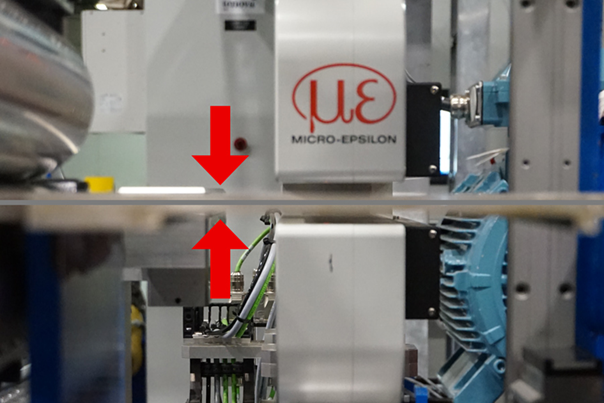
Image Credit: Micro-Epsilon
Dimensional and geometric thickness measurement is performed by placing one optical distance sensor on each side of the material. The sensors’ operating range is calibrated with a certified measurement standard, with the thickness added to the sum of the sensor signals to define the current range. The difference between the sum of the distance signals and the operating range value indicates the material thickness during production.
The thicknessCONTROL systems can be employed together with non-contact sensor equipment based on the end-use application. Laser profile sensors have various advantages and are deployed in various applications.
Innovative "Discrete Laser Line"
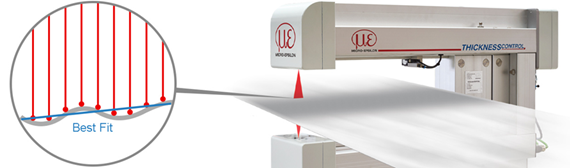
Image Credit: Micro-Epsilon
A laser beam is magnified to form a static laser line with the help of special lenses and is projected onto the target surface. The reflected light is directed onto a highly sensitive sensor matrix using a high-quality optical system. Depending on the type of sensor, each measurement records a profile of 640 or 1280 measuring points. This matrix image is used by the integrated controller to calculate the distance information (z-axis) and the position alongside the laser line (x-axis) in a two-dimensional coordinate system.
Automatic Thickness Calibration
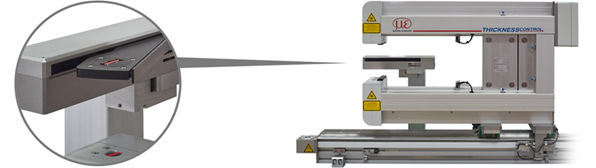
Image Credit: Micro-Epsilon
Micro-Epsilon’s optical thickness measurement systems are alloy-independent and do not require material-specific calibration. Their in-situ calibration feature enables the systems to withstand temperature changes while ensuring high accuracy. This calibration is performed by positioning the C-frame or feeding either the calibration or reference part. The calibration can also ensure proper functioning of the system at any given time. Monitoring of the fully automated test equipment capability is carried out with the analysis software.
Key Features
- Environmentally friendly alternative to radiometric thickness measurement
- No additional costs caused by hazardous waste
- Free of isotopes and X-ray radiation
- No special safety measures (laser class 2)
- Large and small material thicknesses
- High measurement accuracy, even in harsh environments
- Alloy-independent, with no specific calibration necessary
Measuring and inspection systems for the metal processing industry - thicknessCONTROL
Video Credit: Micro-Epsilon