Polyimides hold a significant role in unmanned aerial vehicle (UAV) technology due to their low density, exceptional thermal and dimensional stability, and electrical insulation.
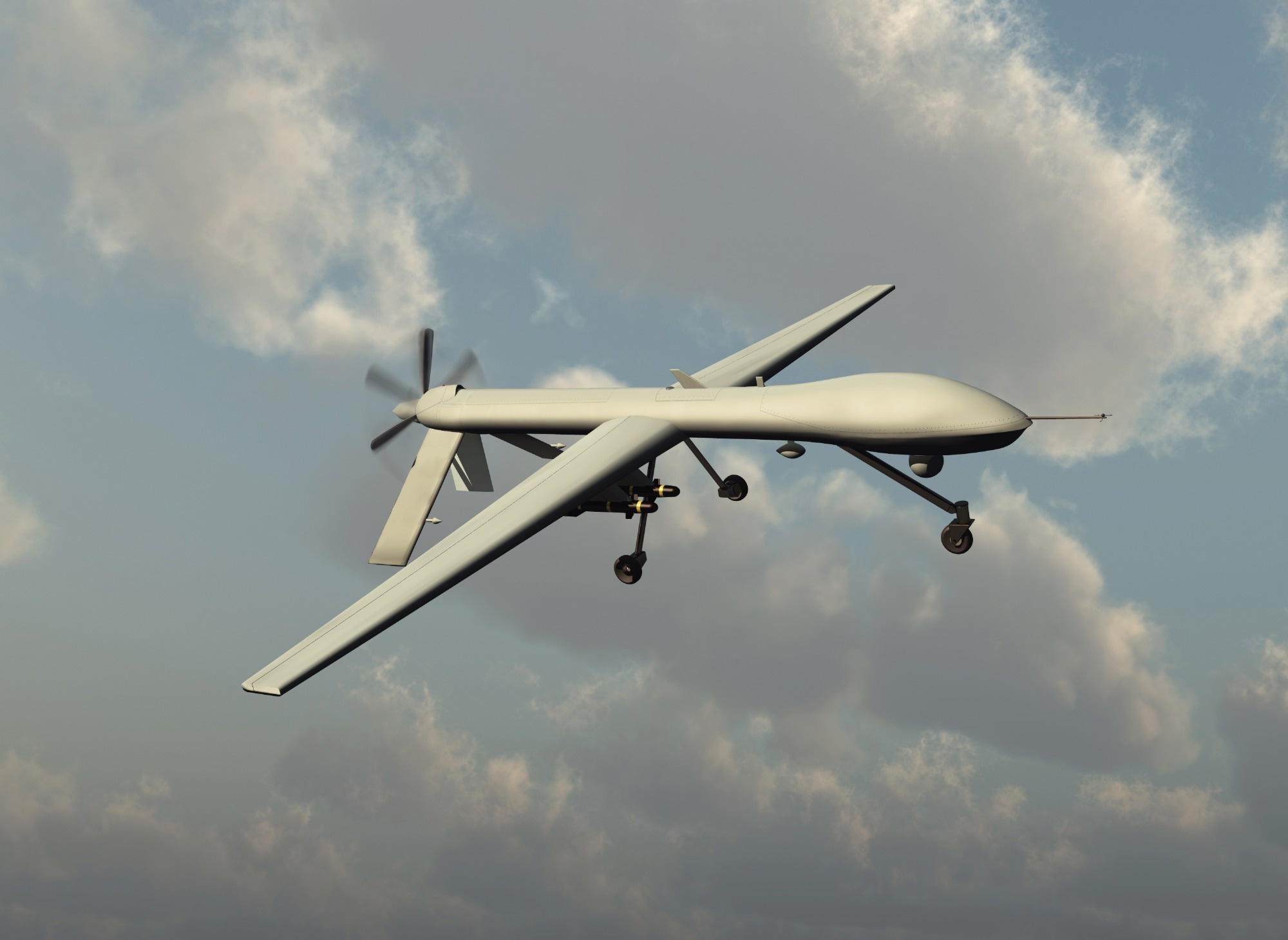
Image Credit: Esteban de Armas/Shutterstock.com
In an environment where every gram and every degree of heat tolerance is crucial, these attributes render polyimides highly valuable for components requiring consistent performance under in-flight conditions.
They prove especially beneficial in wiring insulation, flexible circuits, protective films, adhesives, coatings, and many other applications where standard materials might not offer adequate temperature resistance or long-term stability.1,2
The contribution of polyimides to UAVs is not primarily structural, unlike carbon-fiber composites, but they are nonetheless mission-critical. Modern UAVs rely on densely integrated avionics, communication systems, sensors, and power electronics, all of which generate heat and are subjected to vibration, mechanical stress, and repeated thermal cycling.
Polyimides assist in protecting these systems while adding minimal weight. Within high-performance airframes, this equilibrium is vital: reduced mass enhances payload capacity and maneuverability, while sustained electrical and thermal stability safeguards mission success.1,2,3
Polyimides are also appealing owing to their adaptability for particular functions. Certain formulations are employed where flexibility and ease of processing are paramount, while others are chosen for maximal resistance to heat, chemicals, or dielectric loss.
This adaptability makes them valuable across a wide spectrum of UAV subsystems, from motor insulation to electronic packaging and signal-supporting layers. As UAV designs become increasingly compact and electrically intensive, the need for materials capable of withstanding high operating temperatures without compromising performance continues to escalate.1,2,4
This is precisely where comonomer selection becomes particularly important. For polyimide synthesis, the choice of dianhydride stands as one of the most critical variables in determining the final material properties.
Dianhydrides impact chain rigidity, solubility, glass transition temperature, coefficient of thermal expansion, mechanical toughness, and dielectric characteristics. A rigid dianhydride can yield a polyimide with outstanding thermal stability and low expansion, whereas a more flexible or bulky dianhydride may enhance processability, toughness, or optical properties. Consequently, the selection is as strategic as it is synthetic.4,5
For UAV applications, this strategic approach is significant because different components face distinct requirements. A polyimide used in a high-heat electrical environment might necessitate a dianhydride that prioritizes thermal endurance and dimensional control.
A formulation intended for flexible circuitry or coatings might need a different equilibrium, with a greater emphasis on manufacturability and crack resistance. In essence, the dianhydride dictates whether the polyimide is optimized for extreme thermal stress, ease of processing, electrical performance, or mechanical resilience.4,5
Therefore, polyimides are considerably more than supplementary materials in UAV systems. They facilitate reliable operation in environments where conventional polymers might falter, and the judicious selection of dianhydrides ensures these materials are precisely tailored to the aircraft's specific needs.1,2,5
References
- Šostakaite, L., et al. (2024). Investigating Additive Manufacturing Possibilities for an Unmanned Aerial Vehicle with Polymeric Materials. Polymers, 16(18), pp.2600–2600. DOI: 10.3390/polym16182600. https://www.mdpi.com/2073-4360/16/18/2600.
- Cockett, N. (2026). Varnishes - dianhydrides.com. https://dianhydrides.com/polyimide/varnishes/.
- Ghedin, S. and Ghedin, S. (2026). Unmanned Aerial Vehicles (UAVs). Available at: https://www.hexcel.com/unmanned-aerial-vehicles-uavs/.
- AZoNetwork (2015). The Use of Composite Materials in Unmanned Aerial Vehicles (UAVs). Available at: https://www.azom.com/article.aspx?ArticleID=12234.
- Hasegawa, M. et al. (2014). Colorless polyimides derived from 1S,2S,4R,5R-cyclohexanetetracarboxylic dianhydride, self-orientation behavior during solution casting, and their optoelectronic applications. Polymer, 55(18), pp. 4693–4708. DOI: 10.1016/j.polymer.2014.07.032. https://www.sciencedirect.com/science/article/abs/pii/S0032386114006375.
This information has been sourced, reviewed, and adapted from materials provided by Jayhawk Fine Chemicals Corporation.
For more information on this source, please visit Jayhawk Fine Chemicals Corporation.