By replacing toxic lead with safer alternatives such as tin, bismuth, antimony, and double perovskites, researchers are charting a path toward next-generation solar cells that could combine high performance with improved environmental safety.
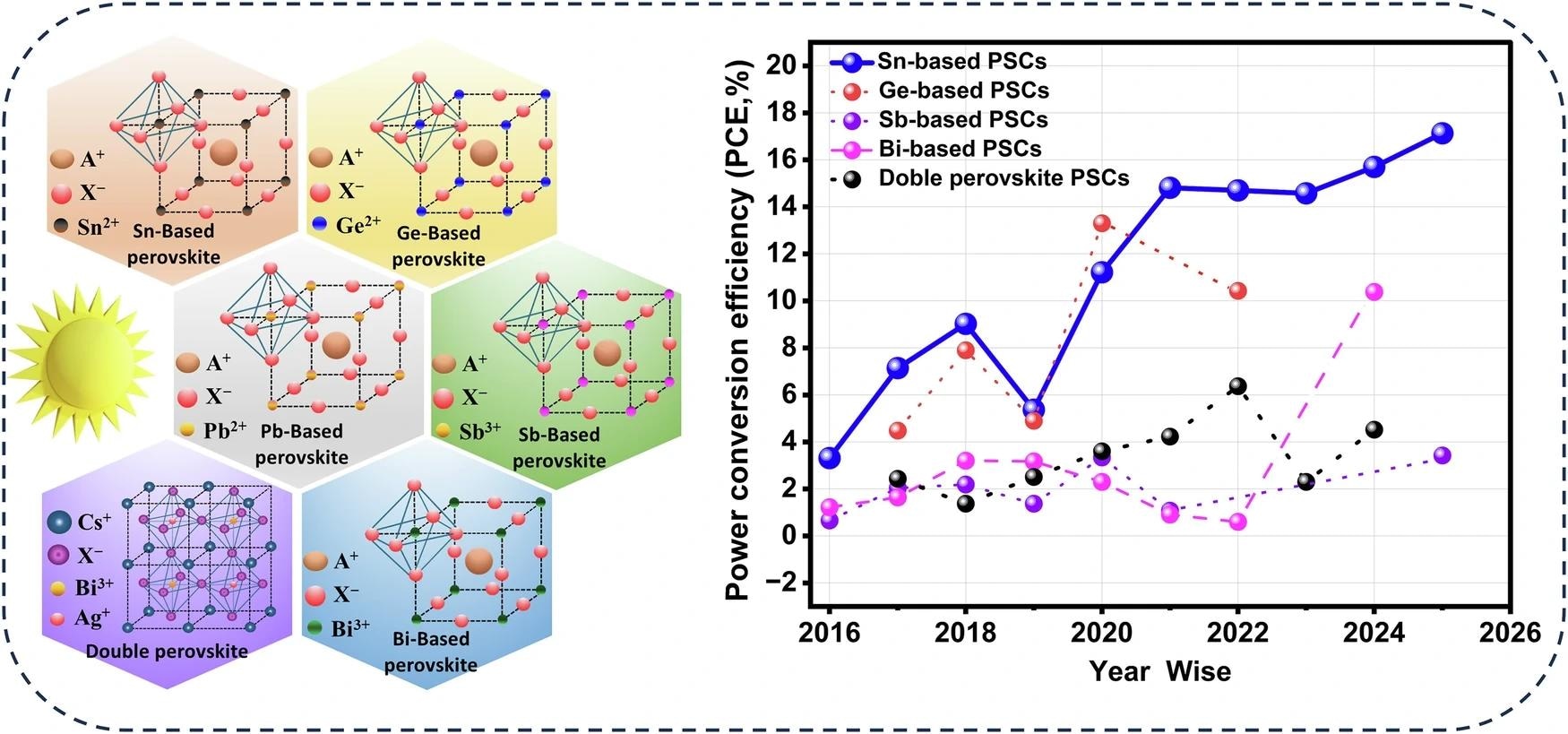
Figure oulined the schematic representation of lead-free perovskite structure (A site represents monovalent cation, X represents a halide anion with bi/trivalent cation from each type of perovskite family) and the year-wise progression of the most efficient PSCs from each lead-free perovskite family from 2016 to 2025.
The global transition toward sustainable energy infrastructure has increased demand for efficient and lower-toxicity photovoltaic (PV) technologies. In a recent review published in the journal Communications Materials, researchers examined material strategies for developing lead-free perovskite solar cells (LFPSCs). They analyzed how structural and optoelectronic engineering can improve the performance of alternative metal cations while addressing environmental concerns associated with lead-based devices.
The review highlighted key design approaches that have helped raise tin-based lead-free device power conversion efficiencies from below 1% to 17.13%, thereby providing a research roadmap for developing more scalable, high-performance, and environmentally sustainable solar technologies.
Advancements in Halide Perovskites for Sustainable Energy
PV technologies play an essential role in the transition to sustainable electricity by converting sunlight directly into electrical energy. Crystalline silicon remains the industry standard due to its strong stability and proven performance, but its manufacturing process is energy-intensive. Alternative technologies, such as organic and dye-sensitized solar cells, offer lower fabrication costs but generally achieve lower power conversion efficiencies.
Metal halide perovskites have emerged as an alternative, with power conversion efficiencies increasing from about 3% to more than 26% over the past decade. These materials possess a crystal structure similar to that of calcium titanate, in which monovalent cations occupy lattice cavities. In contrast, divalent metal cations and halide anions form an interconnected octahedral framework. This structure enables researchers to tune key properties, such as bandgap, charge transport, and light absorption, through compositional engineering. Despite their high efficiency, perovskite solar cells often rely on lead-based materials, raising concerns about toxicity and environmental contamination.
Novel Approaches to Material Engineering
To address toxicity concerns, researchers have explored alternative metal cations, particularly tin (Sn), germanium (Ge), bismuth (Bi), and antimony (Sb). Sn and Ge can more closely mimic Pb-based ABX3 structures, while Bi, Sb, and double perovskites offer alternative lead-free architectures with distinct structural and electronic constraints. However, replacing lead alters the electronic structure, crystal stability, and charge transport characteristics.
Several fabrication strategies have been developed, including one-step and two-step solution processing, where coordinated solvent systems and organic additives help regulate crystal nucleation and growth, producing uniform thin films with fewer defects. Advanced vapor-based deposition techniques enable controlled layer-by-layer growth while minimizing solvent-related degradation.
Multi-cation engineering, incorporating ions such as rubidium (Rb) and acetamidinium (AC), enhances structural stability and reduces grain boundary defects. Advanced solar cell architectures integrate specialized electron transport layers (ETLs) and hole transport layers (HTLs) to improve energy-level alignment, reduce charge recombination losses, and enhance charge extraction. Material quality and structural stability are evaluated using techniques such as Electron Microscopy">SEM and XRD.
Advancement in Efficiency and Stability
The performance of LFPSCs was strongly influenced by their crystal structure and chemical stability. Among the materials examined, Sn-based perovskites achieved the highest power conversion efficiency of 17.13%. This improvement was attributed to colloidal engineering and controlled cesium incorporation, which synchronized crystal nucleation and reduced defect densities. Time-resolved photoluminescence measurements showed a twofold increase in carrier lifetime, reaching 15.13 ns.
Sn- and Ge-based perovskites closely resembled lead-based materials in their electronic properties, exhibiting narrow band gaps of 0.75-1.30 eV. However, they remained vulnerable to oxidation, which created defects and increased charge recombination. Researchers have utilized organic ligands and Lewis base additives to passivate surface defects, enabling one reported passivated Sn-based device to retain 92% of its initial efficiency after 1,500 hours of continuous illumination.
Bi- and Sb-based perovskites offered greater chemical stability but generally suffered from lower charge mobility due to their lower-dimensional crystal structures. In Sb-based materials, chloride incorporation transformed low-dimensional phases into more continuous layered structures, reducing the bandgap to 2.05 eV. For Bi-based systems, device engineering, including optimized hole-transport layers, helped achieve reported efficiencies up to 10.45% in a Bi-based device architecture, while hydrogen plasma treatments reduced the bandgap of silver Bi double perovskites from 2.18 eV to 1.64 eV, significantly enhancing charge-transport properties. These advances led to reported efficiencies up to 10.45% for Bi-based devices and 6.37% for hydrogen-treated double perovskites, demonstrating that structural and chemical engineering can substantially improve the performance of lead-free PV materials.
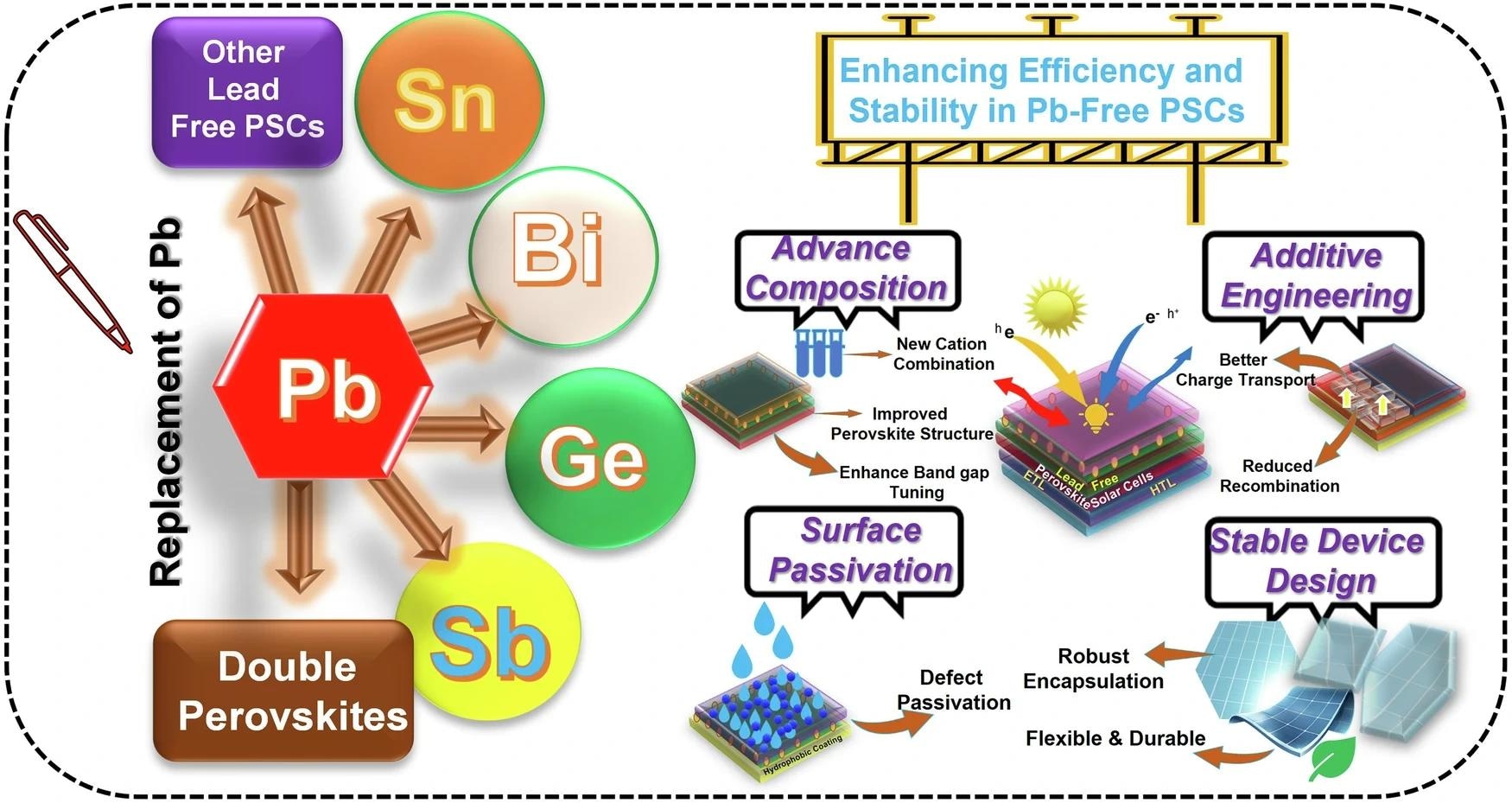
Graphical summary to illustrate lead-free alternatives and key strategies to improve efficiency and stability of LFPSCs.
Implications for Lead-Free Perovskite Technologies
The development of durable, lead-free perovskite materials creates opportunities across a wide range of optoelectronic applications. Their low-temperature processing and compatibility with flexible substrates make them attractive candidates for indoor PVs, wearable electronics, and portable energy harvesting devices. They are also being investigated for building-integrated photovoltaics, including power-generating windows and PV facades.
Beyond solar energy generation, researchers highlighted potential applications in medical X-ray detectors, wireless communication technologies, and environmental sensing systems. Lead-free perovskites offer a sustainable pathway for future large-scale commercial deployment, although further gains in efficiency, stability, reproducibility, and scalable fabrication remain necessary.
Towards Sustainable Material Design
In summary, this review highlights significant advancements toward sustainable LFPSCs, demonstrating that high PV performance can be achieved without relying on toxic lead-based materials. Material composition, crystal structure, and defect management are key factors governing both device efficiency and long-term stability.
The analysis identified a trade-off between performance and durability. While Sn-based perovskites deliver the highest efficiencies, they remain vulnerable to moisture and oxygen-induced degradation. In contrast, Bi, Sb, and double perovskite materials offer greater environmental stability, though further improvements in charge-transport and bandgap engineering are needed to enhance device performance.
Future work should focus on physics-guided materials design, multifunctional additives, and scalable manufacturing approaches such as blade coating and vacuum deposition. Combining these strategies with stable two-dimensional (2D) or three-dimensional (3D) hybrid architectures could improve both efficiency and durability, supporting the eventual large-scale deployment of lead-free perovskite technologies as part of future sustainable energy infrastructure.
Download your PDF copy by clicking here.
Disclaimer: The views expressed here are those of the author expressed in their private capacity and do not necessarily represent the views of AZoM.com Limited T/A AZoNetwork the owner and operator of this website. This disclaimer forms part of the Terms and conditions of use of this website.