From skin-mounted health monitors to robotic vision and inspection systems, flexible NIR and SWIR imagers are moving infrared sensing beyond rigid cameras, but materials stability and fully flexible electronics remain critical challenges.
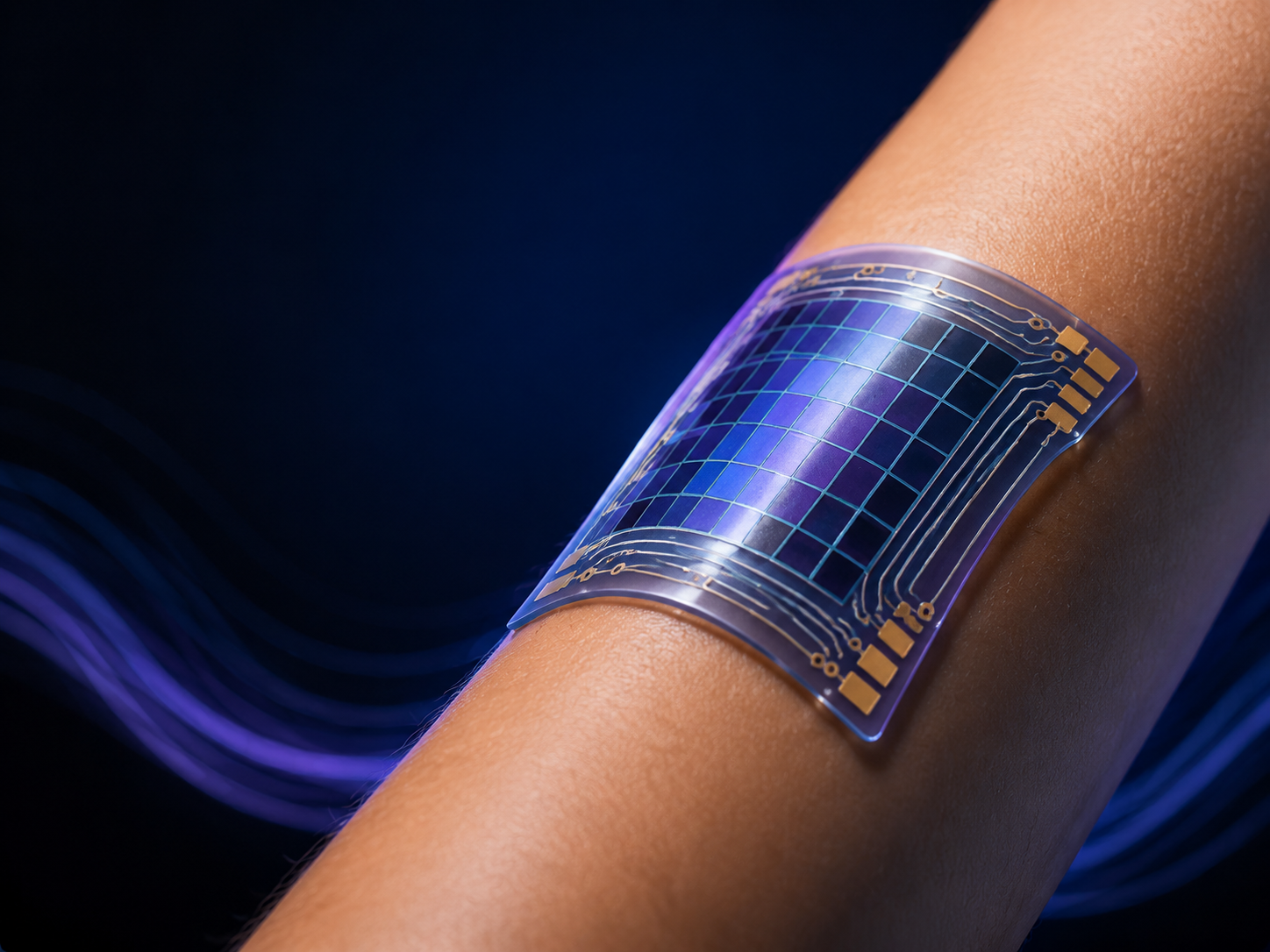
AI-generated conceptual image of a flexible infrared sensor on forearm created using ChatGPT/OpenAI, Paper: Recent advances in flexible near infrared - short wave infrared image sensors: from materials to applications
A recent review available as an 'Article in Press' in the journal npj Flexible Electronics examines advances in flexible near-infrared (NIR) and short-wave infrared (SWIR) image sensors, with a focus on photoactive materials, device architectures, readout technologies, and emerging applications.
The review highlights organic semiconductors, colloidal quantum dots, perovskites, two-dimensional materials, and hybrid systems as important platforms for flexible infrared imaging. It also identifies system-level flexibility, environmental stability, standardized characterization, and integration with flexible electronics as key challenges for practical deployment.
The Need for Flexible Infrared Imaging
Conventional image sensors rely heavily on rigid semiconductor platforms. Silicon sensors offer mature and efficient visible-light imaging but have limited sensitivity at longer wavelengths. Materials such as indium gallium arsenide (InGaAs), mercury cadmium telluride (HgCdTe), lead sulfide (PbS), and germanium-on-silicon (Ge-on-Si) can extend detection into the SWIR range. However, these technologies often require rigid substrates, epitaxial growth, and additional cooling, which increases fabrication complexity and cost.
NIR and SWIR imaging offer capabilities that visible-light sensors cannot easily provide. NIR generally covers 700 nm–1.0 μm, while SWIR extends from approximately 1.0–1.7 μm and can reach longer wavelengths in specialized applications. The NIR–SWIR region contains characteristic absorption features associated with water, lipids, hydrocarbons, and other molecular components.
Flexible image sensors address another limitation of conventional rigid cameras. Their thin and conformable structures can maintain close contact with curved and moving surfaces. This feature can improve optical coupling and reduce motion artifacts in wearable and contact-based imaging.
The review examines how material development, flexible device architectures, readout technologies, and system integration can bring NIR–SWIR imaging to applications that require both spectral sensitivity and mechanical compliance.
Materials Driving Flexible NIR–SWIR Detection
Flexible NIR–SWIR sensors require photoactive materials that combine suitable infrared absorption with low-temperature processing, mechanical compliance, and environmental stability. The review highlights four major material classes: organic semiconductors, colloidal quantum dots, perovskites, and two-dimensional materials.
Organic semiconductors offer an attractive route because they can be processed from solution at relatively low temperatures. Donor–acceptor polymers and non-fullerene acceptors have extended organic photodetector response into the NIR region while maintaining flexibility. Their compatibility with plastic substrates also supports large-area fabrication. However, photo-oxidation, morphological changes, and limited intrinsic response at longer SWIR wavelengths remain important challenges.
Colloidal quantum dots offer broader spectral tunability because their bandgap depends on particle size. PbS quantum dots have supported flexible NIR–SWIR photodetectors, while mercury telluride (HgTe) quantum dots can extend detection further into the infrared. These materials offer strong spectral flexibility but raise concerns regarding moisture and oxygen sensitivity, ligand-dependent charge transport, and the use of toxic heavy metals.
Perovskites combine strong optical absorption with favorable charge-transport properties and can be processed at low temperatures. Researchers have extended their response toward the NIR by tuning composition and incorporating elements such as tin. However, most perovskite photodetectors remain in the visible–NIR range, and their role in flexible SWIR imaging is currently more limited. Ion migration, moisture sensitivity, halide segregation, and Sn²+ oxidation can also reduce operational stability.
Two-dimensional materials provide another promising platform because their atomically thin structures can accommodate mechanical deformation. Graphene offers broad optical absorption and high carrier mobility, while transition-metal dichalcogenides provide tunable electronic properties. Many 2D systems rely on heterostructures to enhance photodetection, while narrow-bandgap materials such as black phosphorus require protection from oxygen and moisture. Hybrid systems can further combine complementary properties from organic semiconductors, quantum dots, perovskites, graphene, and other low-dimensional materials.
Flexible Architectures and Emerging Applications
Flexible imager performance depends on both the active materials and device architecture. Device architecture and readout technology control signal quality, pixel density, speed, and scalability. Passive pixel sensors offer simpler designs and high fill factors, while active pixel sensors incorporate transistors within individual pixels to improve signal-to-noise ratio, speed, and dynamic range. Monolithic integration on flexible thin-film transistor backplanes is the dominant approach, while hybrid integration accommodates detector materials with incompatible processing conditions.
Healthcare represents a major application area. Flexible NIR–SWIR imagers can conform to the body and support continuous measurements with less discomfort and fewer motion artifacts. Researchers have demonstrated applications in vital-sign monitoring, pulse oximetry, bioimaging, and biometric authentication. Flexible reflectance oximeters, for example, can measure oxygen saturation at locations such as the forehead and forearm rather than limiting measurements to conventional sites such as fingers or earlobes.
Flexible NIR sensors have been used to monitor plant health and chlorophyll fluorescence, supporting precision agriculture and early detection of plant stress. SWIR imaging can penetrate haze and support night vision, while active SWIR illumination can enable imaging in total darkness, creating opportunities in environmental monitoring, security, electronics inspection, and night vision. Organic up-conversion imagers can even convert invisible SWIR radiation into visible images, opening new possibilities for low-power imaging systems.
Challenges in Moving Flexible Imagers Toward Practical Use
Despite rapid progress, several challenges continue to limit large-scale deployment. Achieving full system flexibility remains challenging because flexible sensor arrays must often integrate with rigid readout circuits, processors, and power sources. Future systems will therefore require flexible readout electronics, power sources, and improved system-level integration.
Long-term environmental stability presents another challenge. Oxygen, moisture, sweat, and other environmental factors can degrade high-performance NIR–SWIR materials. Flexible encapsulation must protect the active layers without compromising optical performance or mechanical flexibility. Wearable devices also require protection against repeated exposure to sweat and biological fluids.
The review also cautions that commonly reported specific detectivity (D*) values may overestimate real-world sensitivity when calculated from dark current rather than directly measured noise. Standardized performance measurements are also needed. The review recommends reporting directly measured noise-current spectral density alongside noise-equivalent power, modulation frequency, device area, and bandwidth. Image-processing techniques can further correct pixel-to-pixel variations, dark-current drift, and noise in solution-processed arrays.
Toward Practical Flexible Infrared Imaging
Flexible NIR–SWIR image sensors combine infrared spectral information with the mechanical compliance needed for dynamic and curved surfaces. Advances in organic semiconductors, quantum dots, perovskites, two-dimensional materials, and hybrid systems have expanded the capabilities of flexible infrared detection and imaging. These technologies show promise in wearable healthcare, agriculture, environmental monitoring, inspection, security, and human–computer interaction.
Future research should focus on integrating flexible detectors with compliant readout electronics and reliable power sources. Ultrathin encapsulation and flexible optical components could improve long-term stability, light collection, and spatial resolution. Flexible NIR–SWIR light sources could also help create more self-contained sensing systems. Standardized performance measurements will also enable more consistent comparisons between materials and device architectures.
Computational imaging can further improve practical performance by correcting non-uniformity, signal drift, and noise while reconstructing spectral information. Combining material engineering with image processing and in-sensor computing could reduce power and data-transfer requirements.
Continued progress across these areas could enable lightweight, conformable imaging systems for healthcare, robotics, environmental sensing, and other applications where rigid cameras are difficult to deploy.
Disclaimer: The views expressed here are those of the author expressed in their private capacity and do not necessarily represent the views of AZoM.com Limited T/A AZoNetwork the owner and operator of this website. This disclaimer forms part of the Terms and conditions of use of this website.
Source:
- Sharma, S., Awakura, S., et al. (2026). Recent advances in flexible near-infrared, short wave infrared image sensors: From materials to applications. npj Flexible Electronics. DOI: 10.1038/s41528-026-00628-3, https://www.nature.com/articles/s41528-026-00628-3