The TriboLab HD high-torque friction materials tester delivers more accurate and repeatable laboratory studies of brake friction, wear, and particle emissions than previously achievable.
Equipped with advanced technology, the system offers an extensive range of testing capabilities, greater control over test parameters and conditions, the highest force and torque available in a research testing system, and support for brake particle analysis.
By simulating SAE J2522 protocols and other industry standards in the laboratory, TriboLab HD provides the data required to make informed decisions earlier in the brake material development process, helping bridge the gap between initial design and dynamometer testing of brake pad and rotor materials.
TriboLab HD gives engineers and manufacturers a unique solution for shortening development cycles, meeting evolving standards and customer expectations, lowering costs, and maintaining a competitive advantage.
Up to 50 Nm Torque
Enables the coefficient of friction to be measured at high loads and speeds.
Advanced Test Design and Reporting Software
Accelerates data collection and processing while replicating SAE J2522 and other test requirements.
Unique Capabilities and Integrations
Enable the widest variety of friction material testing possible, including simple integration for particle collecting and analysis.
Features
Bridging the Gap Between Drawing Board and Dynamometer Testing
Traditionally, dynamometer testing has been the primary method for evaluating new brake pad formulations under simulated driving conditions before conducting actual on-road vehicle testing.
TriboLab HD offers the significant advantage of performing comprehensive material testing under the various driving conditions required for regulatory compliance or certification much earlier in the development process. This enables researchers to optimize material formulations more thoroughly before moving to costly dynamometer testing.
Dynamometer Testing
- Increases development costs when brake material formulations fail to meet standards during initial testing
- Takes place at a relatively late stage of the development process
- Requires testing to be carried out over multiple days
- Offers limited insight into the mechanisms responsible for test failures
- Restricts comprehensive evaluation of brake particle emissions
TriboLab HD
- Lowers material costs while accelerating time-to-market
- Evaluates critical components earlier in the development process
- Streamlines test design, setup, and execution, enabling testing to begin on the first day
- Facilitates straightforward monitoring and comparison of test results
- Enables brake particle collection and analysis
Accelerating the Development Cycle
As engine technologies continue to advance and environmental concerns gain greater importance, new brake materials are required to satisfy increasingly rigorous standards for performance, comfort, cost, and safety. The conventional development cycle for these materials can take as long as five years before they reach the market.
Purpose-built to improve development efficiency and shorten development timelines, the TriboLab HD high-torque friction material tester supports faster advancement of next-generation materials. By focusing on only the most promising formulations, developers can achieve better outcomes while gaining a significant advantage in a highly competitive market.
TriboLab HD Offers Significant Improvements Over Currently Available In-Lab Testing
- Accurately measures COF at high loads and speeds with torque up to 50 Nm
- Lowers material testing expenses through the use of coupons
- Recreates SAE J2522 test conditions for general-purpose roads
- Maintains temperature during fade testing with direct heating up to 550 °C
- Integrates easily with third-party particle analysis systems
Providing Exceptional Performance and Ease of Use
TriboLab HD simplifies the generation of meaningful test results. Combining advanced hardware with intuitive software, the system is purpose-built for automotive friction material testing and includes:
- Heavy-duty motor capable of providing 8.5 MPa pressure at 120 km/hr
- High-precision, low-noise integrated load and torque sensor
- In-situ heating to maintain temperature between snubs and provide external rotor heating
- Durable hardware engineered to withstand demanding friction material testing and replicate real-world conditions
- Pre-programmed, easily customizable scripts that accelerate testing and analysis
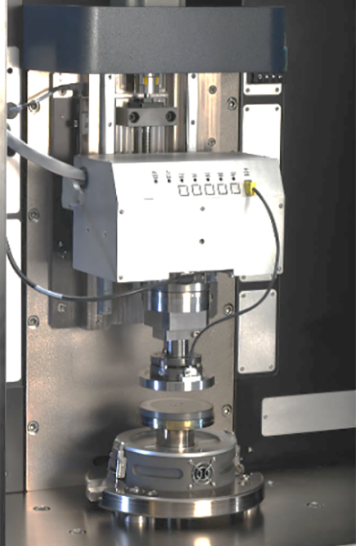
The TriboLab HD high-torque friction material tester. Image Credit: Bruker Nano Surfaces and Metrology
Enabling Particle Emissions Studies
The health and safety concerns associated with airborne particles generated by brake wear are receiving growing international attention. As regional environmental standards continue to evolve, regulations governing brake component approval and consumer expectations are expected to become increasingly stringent. To reduce particle emissions, developers will need to adjust the physical properties of new formulations or refine existing ones.
The TriboLab HD particle collection chamber integrates seamlessly with third-party particle analyzers, enabling manufacturers to easily evaluate the entire wear process.
Critical Functions for Precise and Repeatable In-Lab Wear Studies Include:
- Collection of particles from both conventional and newly developed materials
- Reliable, representative, and repeatable sampling and characterization of brake wear particles
- Measurement of particle mass, number, and concentration under variable, highly dynamic conditions
- Particle size analysis across a broad range (< 10 nm–10 µm)
TriboLab HD Addresses These Functions With:
- Seamless integration with commercial particle analyzers
- Precise control of test parameters with simulation of various driving conditions and regulatory standards
- High-accuracy simulation of abrasion processes that produce direct particulate emissions
- Easy-to-clean surfaces that minimize contamination and improve the reliability of environmental particle screening
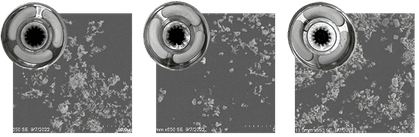
To exhibit how TriboLab HD could be employed to study particle emissions, Bruker integrated a third-party 3-filter impactor with a vacuum pump to collect PM of 1, 2.5, and 10 µm. Image Credit: Bruker Nano Surfaces and Metrology
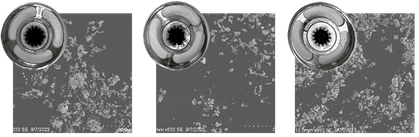
The filters were then analyzed externally using SEM to provide the chemical composition of the particles collected. Image Credit: Bruker Nano Surfaces and Metrology
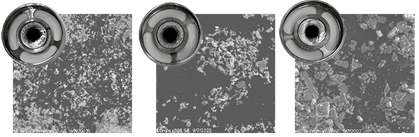
The particle collection chamber can be easily cleaned to reduce cross-contamination between runs. Image Credit: Bruker Nano Surfaces and Metrology