An engineered liquid metal-semiconductor interface turns a traditionally passive conductor into a current-controlling component, opening new possibilities for circuits that can stretch, reshape, and reconfigure in real time.
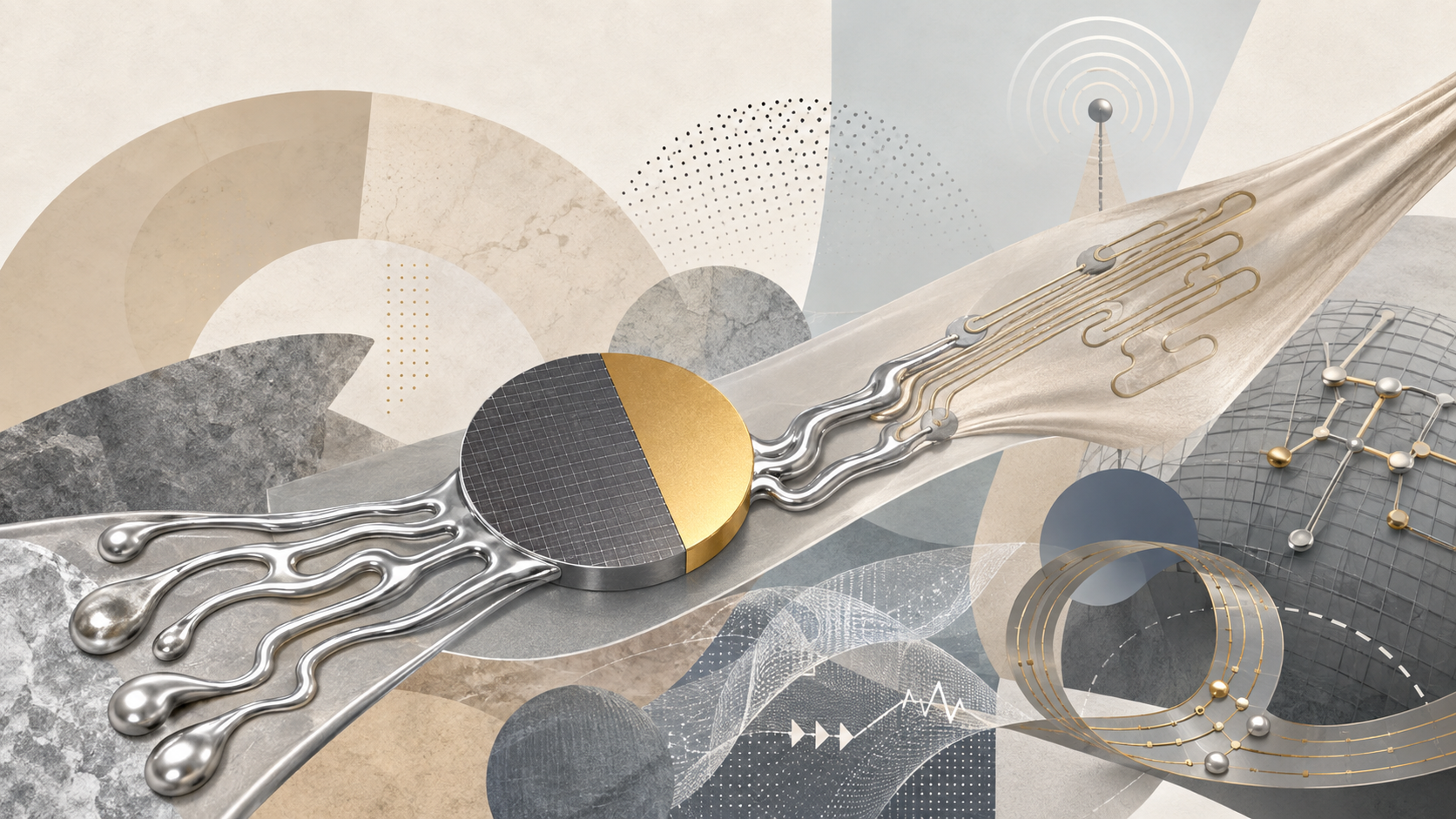
Paper: Regulated liquid metal via semiconductor valve toward highly stretchable topological circuits. AI-generated abstract conceptual image created using ChatGPT/OpenAI
Researchers have developed a liquid metal-semiconductor valve that retains directional electrical function when incorporated into circuits stretched to approximately 1000% tensile strain while maintaining controlled electrical regulation. Their study, published in the journal Nature Communications, demonstrated a unidirectional conductive valve created through innovative interfacial barrier engineering.
By controlling charge-carrier transport in liquid-metal conductors, this approach transforms them from passive electrical pathways into active current-gating components. This architecture could support flexible, three-dimensional (3D) circuit designs that retain electrical functionality under large strains.
Challenges in Flexible Electronic Materials
The growing demand for wearable electronics, electronic skins, and soft robotics requires conductive materials that combine 3D integration with high mechanical performance. Conventional solid-state conductors often necessitate a trade-off between electrical conductivity and stretchability, limiting their use in highly deformable systems.
Room-temperature liquid metals offer an attractive alternative due to their intrinsic fluidity and high conductivity. However, their predominantly Ohmic behavior restricts them to passive conductive interconnects, preventing independent regulation or directional control of current. Addressing this limitation has traditionally required external discrete components, which can compromise mechanical compliance and integration density in soft electronic architectures.
New Design of the Fluid-Semiconductor Interface
To introduce asymmetric charge transport into a fluidic conductor, researchers developed a liquid metal-semiconductor valve based on an engineered heterointerface. The device used a lightly doped p-type silicon wafer as the semiconductor, with a 100-nanometer-thick gold layer on one side. This asymmetric coating created distinct interfacial barriers when the silicon was embedded in the liquid metal. The gold-coated side formed an approximately Ohmic contact, while the uncoated liquid metal/silicon interface formed the rectifying barrier responsible for directional current flow.
The silicon component was vertically secured inside an elastic silicone tube. A vacuum-filling technique introduced the liquid metal into the tube, allowing the flowing metal to contact both the gold-coated and uncoated silicon surfaces. Shear forces generated during injection disrupted surface oxide layers, promoting direct electrical contact. Gallium served as the primary liquid metal, with gallium-indium compositions and indium contacts tested to alter the metal work function and resulting interfacial barrier.
Characterization techniques, including scanning electron microscopy (SEM) and energy-dispersive X-ray spectroscopy (EDS), were used to analyze the interface morphology and elemental distribution. Ultraviolet (UV) photoelectron spectroscopy measured the metals' work functions, helping the researchers explain how changes at the interface altered the energy barrier and the direction of current flow.
Exceptional Performance and Reconfigurability
The fabricated valve demonstrated high electromechanical resilience, maintaining unidirectional conductivity when incorporated into circuits stretched to tensile strains of up to 1000%. During fatigue testing, it effectively preserved consistent forward and reverse current characteristics through 1,000 stretching cycles at approximately 500% strain. The device operated reliably from -5 to 100 degrees Celsius and retained rectification from 1 Hz to 5 MHz, although output voltage declined above approximately 100 kHz.
The researchers also showed that the switching voltage could be tuned by changing the metal composition, increasing from 0.43 volts for gallium to 0.80 volts for indium. This behavior was linked to changes in work function as indium concentration increased.
The liquid metal's fluidity enabled dynamic reconfiguration of conductive pathways. Operations such as stacking, connecting, and blocking the flexible conductors allowed the circuit to switch between OR and AND logic functions, with logic swings exceeding 1.4 volts. The material's high surface tension and room-temperature fluidity further enabled autonomous restoration of conductive pathways after mechanical constraints were removed, showing its potential for reconfigurable and resilient electronic circuits.
Applications in Radio-Frequency Logic Systems
Integrating this regulated fluidic conductor could support highly deformable, 3D electronic systems for applications such as skin-integrated devices. By incorporating liquid metal-semiconductor valves into soft circuit architectures, engineers can develop circuits that maintain electrical functionality while conforming to dynamic surfaces.
To demonstrate the concept, researchers combined a stretchable rectenna with an LM-SV-based AND gate to create a radio-frequency logic system in which harvested wireless energy provided an input to logic operations under up to 200% mechanical strain. The rectenna used conventional low-threshold diodes for radio-frequency rectification, while the LM-SV performed the logic function.
Although RF-to-DC conversion efficiency declined substantially with stretching, the remaining output at 200% strain was sufficient to preserve logic functionality. This combination of energy harvesting, signal rectification, and computation within a deformable architecture could support smart textiles, bio-integrated sensors, and soft robotic systems that require continuous electronic operation during repeated movement and stretching.
Conclusion and Future Directions
In summary, engineering an asymmetric interfacial barrier in a liquid-metal system is a promising approach for active electrical regulation in highly deformable conductors. By combining semiconductor physics with the fluidity of liquid metals, this study extends flexible conductive materials beyond passive signal transmission toward programmable electrical control. This architecture provides a foundation for adaptive electronic systems.
Future work should focus on miniaturizing the fluid-semiconductor interfaces to reduce contact-area-related stress and improve high-frequency performance. Further development of intrinsically soft semiconductors, building on the study's proof-of-concept P3HT-based valve, together with locally doped liquid metal-semiconductor heterostructures, could further improve mechanical compatibility and help advance the technology toward practical wearable and soft electronic devices.
Disclaimer: The views expressed here are those of the author expressed in their private capacity and do not necessarily represent the views of AZoM.com Limited T/A AZoNetwork the owner and operator of this website. This disclaimer forms part of the Terms and conditions of use of this website.