Scientists at Massachusetts Institute of Technology (MIT) have designed a micro-thermophotovoltaics (TPV) power generator using a material whose surface is etched with billions of nanoscale ridges or cavities that help the surface to emit light with wavelengths suitable for producing optimum electricity by the device.
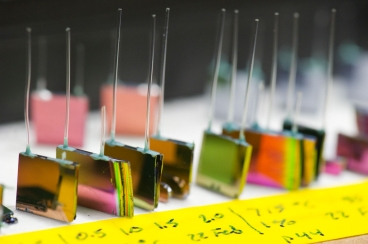 Different silicon chip micro-reactors devolped by the MIT research team
The heat source for the material could be the sun, a decaying radioisotope or a hydrocarbon fuel. The button-sized power generator utilizes propane or butane as its heat source. Warren K. Lewis and Klavs Jensen of Chemical Engineering designed the power generator’s vital part called the micro-reactor and the generator is developed in the Microsystems Technology Laboratories.
Ivan Celanovic, a research engineer of the Institute for Soldier Nanotechnologies (ISN) at MIT, stated that the solution to develop the TPV generator is to engineer a thermal emitter that emits only particular wavelengths suitable for the PV diode to produce optimum electricity, while repressing other wavelengths. The innovative material can be developed by producing a photonic crystal using a sample of the material and creating certain nanoscale patterns such as ridges or depressions on its surface. The resulting material allows the propagation of light in a different manner.
According to Marin Soljaèiæ, ISN researcher and professor of physics, materials with unique optical properties can be fabricated based on the design of the nanostructure. The resulting material has the capability to manipulate and control the light behavior.
The micro-TPV power generator using hydrocarbon fuels as its heat source has an operating life three times more than a lithium-ion battery with the same weight and size. It can be instantaneously recharged by a small cartridge of fresh fuel. The generator that uses radioisotope as its heat source could produce electric power for about three decades with no need for refueling or servicing. This device is suitable for powering spacecrafts committed to long missions.
Celanovic further said that producing electricity by converting heat from different sources without transporting parts would offer more advantages. He also believes that his research team could increase the energy density to three times from the current value. If it is made possible, smartphones powered by the TPV device could keep the charge for an entire week, he said.