Atomic-level defect control pushes the light-emission efficiency of indium phosphide magic-sized clusters from below 1% to over 18%.
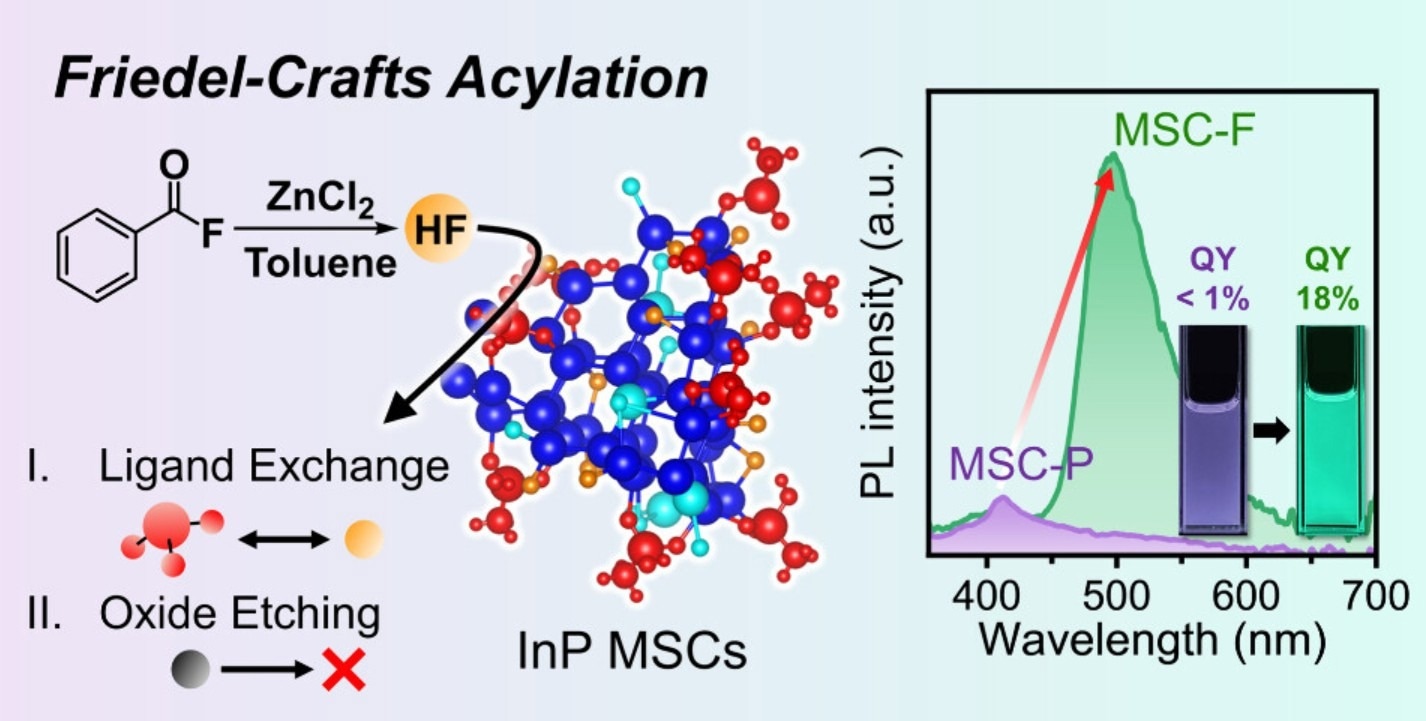 Schematic illustration of overcoming emission efficiency limits via atomic-scale precision control. Image Credit: Korea Advanced Institute of Science and Technology (KAIST)
Researchers at KAIST have developed a groundbreaking technology to manipulate the surface of indium phosphide (InP) magic-sized clusters (MSCs) at the atomic level. These nanoscale semiconductor particles are viewed as promising next-generation eco-friendly semiconductor materials.
The study was recently published in the Journal of the American Chemical Society.
Light-emitting semiconductors are integral to daily life, found in devices such as televisions, smartphones, and various lighting solutions. Significant technical challenges persist in the quest to create environmentally sustainable semiconductor materials.
Nanoscale semiconductors, which are tens of thousands of times smaller than a human hair (approximately 100,000 nanometers), theoretically possess the ability to emit bright light; however, they have been hindered by exceedingly weak emission in practice. The researchers have recently introduced a novel surface-control technology that addresses this limitation.
The material under investigation by the team is referred to as a “magic-sized cluster,” which is an ultrasmall semiconductor particle made up of several tens of atoms. Given that all particles share the same size and structure, these materials are theoretically capable of emitting exceptionally sharp and pure light.
However, their 1 to 2 nm size means that even the slightest surface imperfections result in the loss of most emitted light. As a result, luminescence efficiency has remained below 1 % to date.
In the past, this issue was solved by etching the surface with potent chemicals such as hydrofluoric acid (HF). However, these aggressive reactions frequently caused damage to the semiconductor itself.
Professor Cho's team implemented an alternative method. Rather than eliminating the surface in one go, they developed a precision etching technique that facilitates chemical reactions to occur in a controlled, step-by-step fashion. This approach permitted the targeted removal of only the defect sites that obstructed light emission, while maintaining the integrity of the semiconductor's overall structure.
Throughout this defect-removal step, fluorine produced by the reaction interacted with zinc species present in the solution to create zinc chloride, which subsequently stabilized and passivated the exposed nanocrystal surface.
The research team enhanced the luminescence efficiency of the semiconductor from less than 1 % to 18.1 %. This achievement marks the highest performance reported thus far among indium phosphide-based ultrasmall nanosemiconductors, indicating an 18-fold increase in brightness.
The study is particularly noteworthy as it illustrates, for the first time, that the surfaces of ultrasmall semiconductors, previously deemed nearly impossible to manipulate, can be accurately engineered at the atomic level. The technology is anticipated to be used not only in next-generation displays but also in advanced domains such as quantum communication and infrared sensing.
This work is not simply about making brighter semiconductors, but about demonstrating how critical atomic-level surface control is for achieving desired performance.
Himchan Cho, Professor, Korea Advanced Institute of Science and Technology (KAIST)
Journal Reference:
Joo, C., et al. (2025) Overcoming the Luminescence Efficiency Limitations of InP Magic-Sized Clusters. Journal of the American Chemical Society. DOI: 10.1021/jacs.5c13963.