By linking magma chemistry to the thickness of Earth’s rigid outer shell, scientists have developed a new way to narrow the search for rocks that may host valuable rare earth elements.
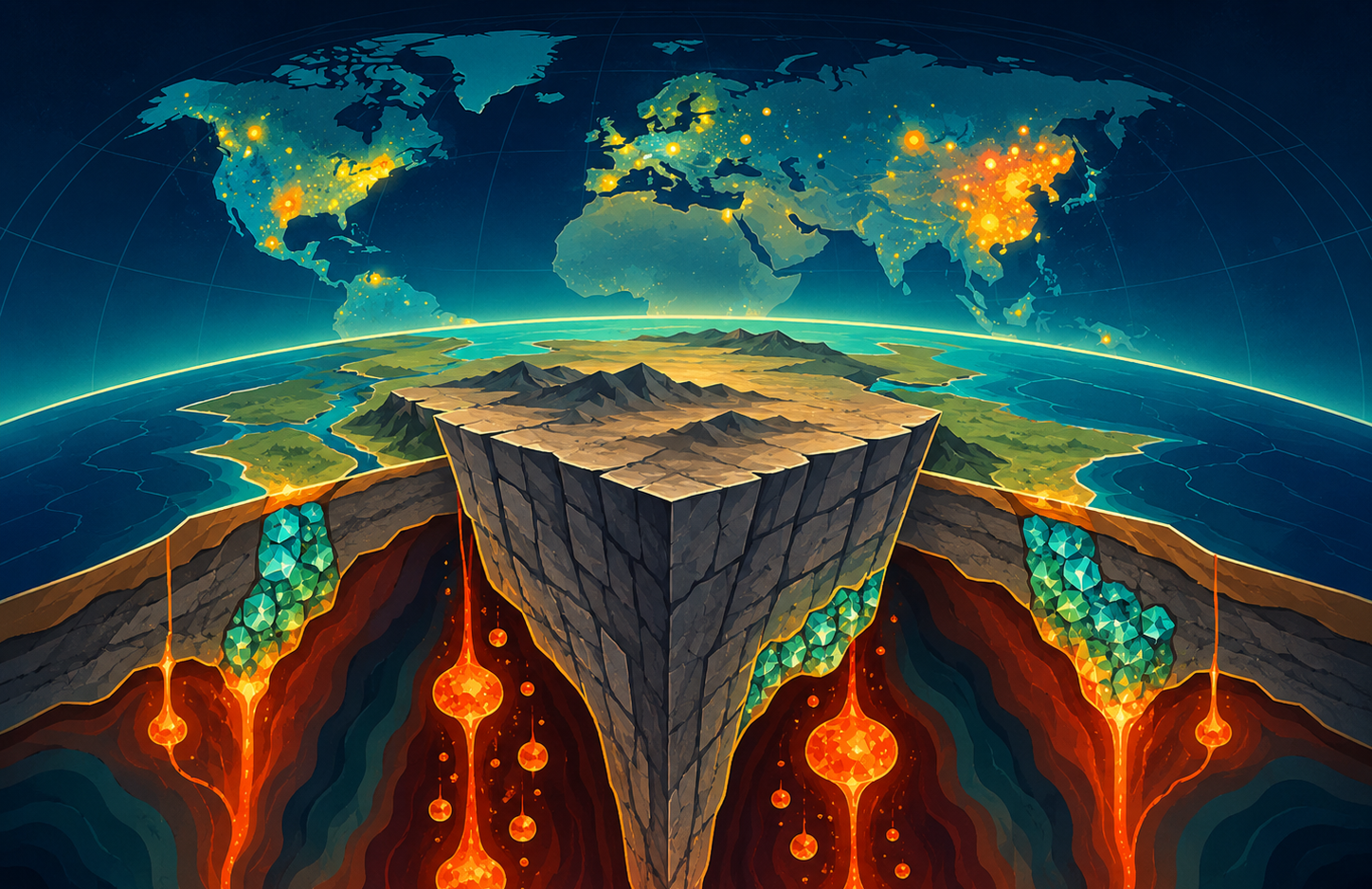
Study: The global distribution of CO2-rich magmas is determined by lithospheric thickness. Image Credit: AI-generated image / OpenAI
A recent study published in the journal Nature Geoscience investigates how variations in lithospheric thickness influence the formation and distribution of CO2-rich magmas across the globe. Using geochemical data from thousands of igneous rock samples and seismic imaging of Earth’s interior, researchers examined the controls on CO2-rich magma formation. The results show that a thicker lithosphere favors progressively more CO2-rich silicate magmas and influences the location of rare earth element (REE) deposits.
Deep Earth Controls Critical Minerals
CO2-rich magmas play a crucial role in Earth’s geological and economic systems. These unusual magmas are major sources of rare earth elements, high-field-strength elements, diamonds, and volcanic carbon emissions. Rare earth elements are essential components of modern technologies, including electric vehicles, wind turbines, smartphones, and advanced electronics. Despite their importance, the factors controlling where CO2-rich magmas form and erupt have remained poorly understood.
Previous studies identified broad associations between certain magma types and specific tectonic settings. Kimberlites, for example, are commonly found within ancient continental cratons, whereas basanites tend to occur in regions with thinner lithosphere. However, a comprehensive global analysis linking magma chemistry to lithospheric structure had not previously been undertaken.
The new study addresses this gap by examining the relationship between magma composition and lithospheric thickness on a global scale. The researchers propose that variations in the thickness of Earth’s rigid outer shell exert a fundamental control on the formation, evolution, and emplacement of CO2-rich magmas.
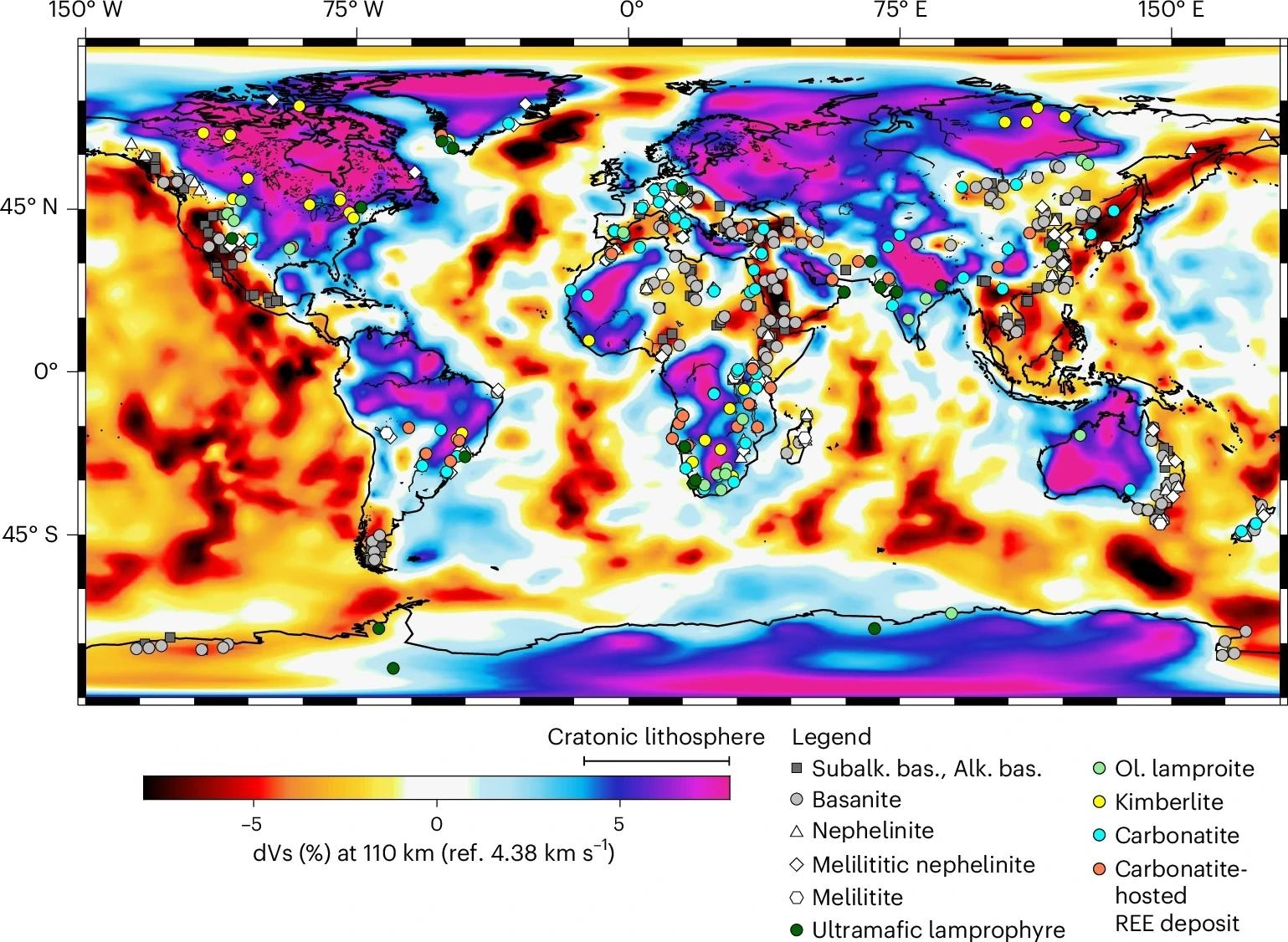
Samples have been spatially averaged into 4° × 4° bins for clarity. Cratonic lithosphere is characterized by velocity anomalies >4% above the reference value (4.38 km s−1). Shear-wave velocity anomalies are from the SL2013 tomographic model. Alk. bas., alkali basalt; Ol. lamproite, olivine lamproite; REE, rare-earth element; Subalk. bas., subalkaline basalt.
Geochemistry and Seismic Imaging Methods
The research team compiled a global database containing more than 9,000 young continental intraplate igneous rock samples. These included kimberlites, lamproites, ultramafic lamprophyres, melilitites, nephelinites, basanites, and carbonatites. Together, these rock types include a spectrum of CO2-rich silicate magmas and carbonatites formed under different mantle conditions.
The researchers combined geochemical data with global seismic tomography models to investigate the factors controlling their distribution. Seismic wave velocities were used to estimate lithospheric thickness. Thicker, colder lithosphere produces faster seismic wave speeds than thinner, warmer lithosphere.
The study also applied thermodynamic inversion techniques to calculate lithospheric thickness beneath each sample location. By comparing magma occurrences with lithospheric structure, the researchers identified systematic relationships among magma type, mantle melting conditions, and lithospheric thickness.
Magma Types Shift With Thickness
Lithospheric thickness increases progressively from regions dominated by basalts and basanites to those hosting kimberlites. Basanites and related basaltic magmas are typically associated with a thin lithosphere measuring about 60–90 km. Nephelinites and melilitites occur within intermediate lithospheric thicknesses of approximately 80–115 km. Ultramafic lamprophyres are associated with a lithosphere around 95–120 km thick. Olivine lamproites are generally found in regions where lithospheric thickness exceeds 150 km.
Kimberlites are among the most CO2-rich silicate magmas and the primary host rocks for diamonds. They occur beneath the thickest lithosphere. These magmas commonly occur beneath a lithosphere thicker than 170 km, with a median thickness of about 206 km. The geochemical characteristics of the magmas also change systematically with lithospheric thickness. A thicker lithosphere is associated with deeper mantle melting, smaller melt fractions, and higher carbon dioxide contents within the silicate magma series.
The study also provides new insights into the origin of carbonatites, which host many of the world’s economically important rare earth element (REE) deposits. These carbonate-rich rocks are a major source of REE resources. The researchers found that carbonatites are most commonly associated with lithospheric thicknesses of 95–140 km. This relationship suggests that most carbonatites are unlikely to originate directly from the convecting asthenospheric mantle. Instead, they likely evolve from CO2-rich silicate magmas through processes such as fractional crystallization and liquid immiscibility, although partial melting of the lithospheric mantle cannot be fully ruled out.
The distribution of carbonatite-hosted REE deposits closely matches that of carbonatites themselves. This pattern indicates that lithospheric structure indirectly influences the location of many economically significant REE deposits by controlling the formation and evolution of their parental magmas. However, secondary processes, including crystal fractionation and hydrothermal alteration, are likely important in concentrating rare earth elements to economic levels.
REE Exploration and Resource Implications
The results offer a new approach for predicting the occurrence of CO2-rich magmas and related REE deposits. Regions near the margins of thick cratonic lithosphere may favor carbonatite formation and associated REE mineralization. This insight could support future exploration efforts as demand for critical minerals continues to increase. Rare earth elements are essential for renewable energy technologies and the transition to low-carbon economies, making the identification of new resources increasingly important.
The study also improves understanding of Earth's deep carbon cycle. The findings show that lithospheric thickness influences magma generation and carbon enrichment, linking deep-mantle processes to surface geology and mineral-resource formation. Future research will focus on older geological systems that host many of the world's largest rare earth deposits. This may further improve predictions of critical mineral occurrences across diverse tectonic settings and geological periods.
Download your PDF copy by clicking here.
Disclaimer: The views expressed here are those of the author expressed in their private capacity and do not necessarily represent the views of AZoM.com Limited T/A AZoNetwork the owner and operator of this website. This disclaimer forms part of the Terms and conditions of use of this website.
Sources:
- Bowman, E. E., Gibson, S. A., Sui, S., and Lebedev, S. (2026). The global distribution of CO2-rich magmas is determined by lithospheric thickness. Nature Geoscience, 1–7. DOI: 10.1038/s41561-026-01990-7, https://www.nature.com/articles/s41561-026-01990-7
- Scientists map rocks with rare earth element potential, helping pinpoint new deposits https://www.cam.ac.uk/research/news/scientists-map-rocks-with-rare-earth-element-potential-helping-pinpoint-new-deposits