As demand for lithium, graphite, copper, and rare earths accelerates, researchers warn that clean energy goals will depend on financing systems that reward responsible mining and keep critical minerals in use for longer.
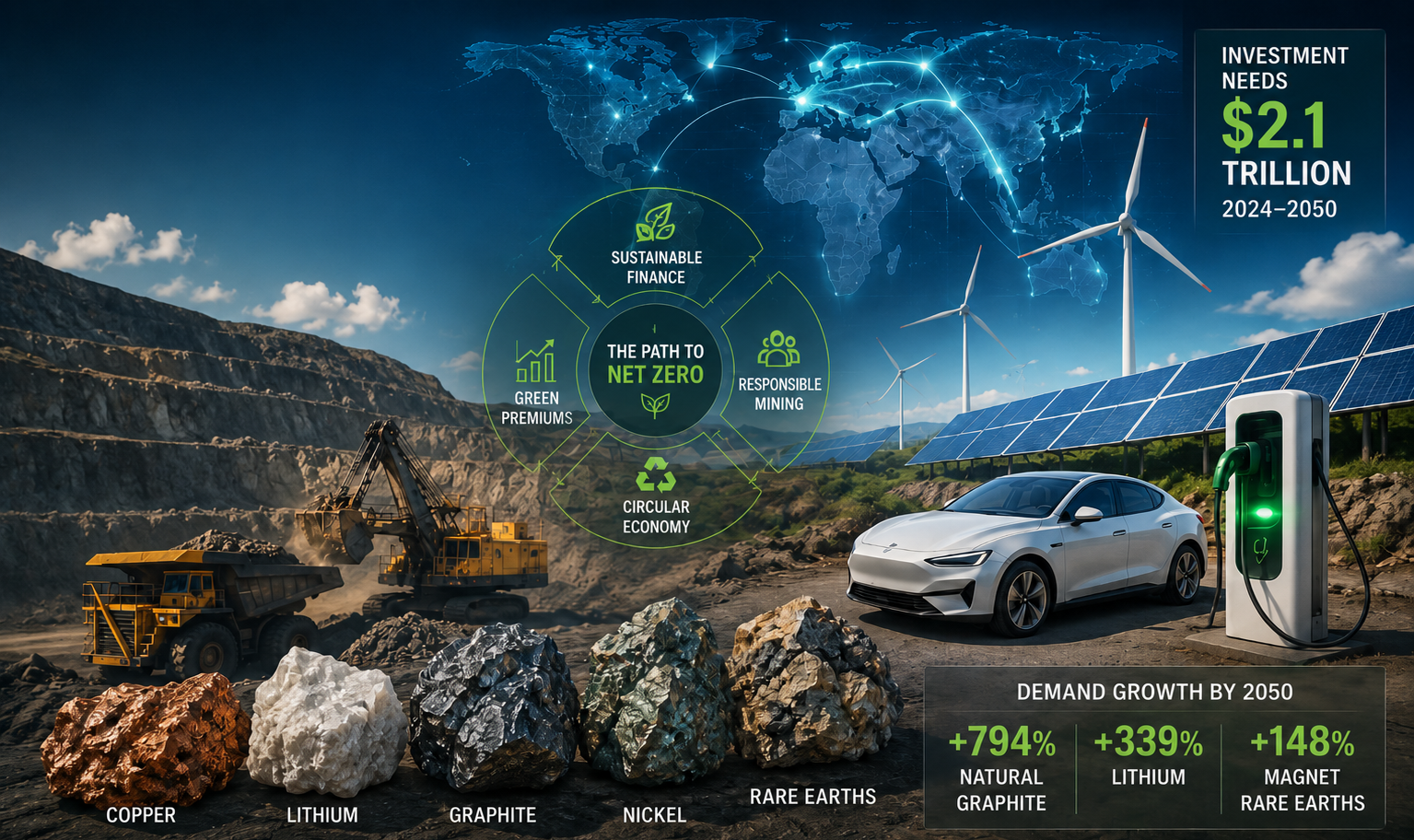
Paper: Financing the responsible supply of energy transition minerals. Image credit: AI-generated image created using ChatGPT/OpenAI
A recent paper published in the journal Mineral Economics examines the mineral needs of the global transition to low-carbon technologies. Drawing on the United Nations Environment Program International Resource Panel report and other sources, including BloombergNEF, the authors note that achieving climate goals may require approximately USD 2.1 trillion in mining investments between 2024 and 2050 under a net-zero pathway.
Citing the International Energy Agency’s Net-Zero Emissions scenario, the paper reports substantial growth in demand for key minerals, including a 794% increase in natural graphite and a 339% rise in lithium consumption. The study argues that conventional commodity markets often fail to account for the environmental and social costs associated with resource extraction. To ensure long-term supply stability, it emphasizes the need for sustainable financing mechanisms, the incorporation of green premiums into market structures, and the adoption of circular economy practices that prioritize reuse and recycling.
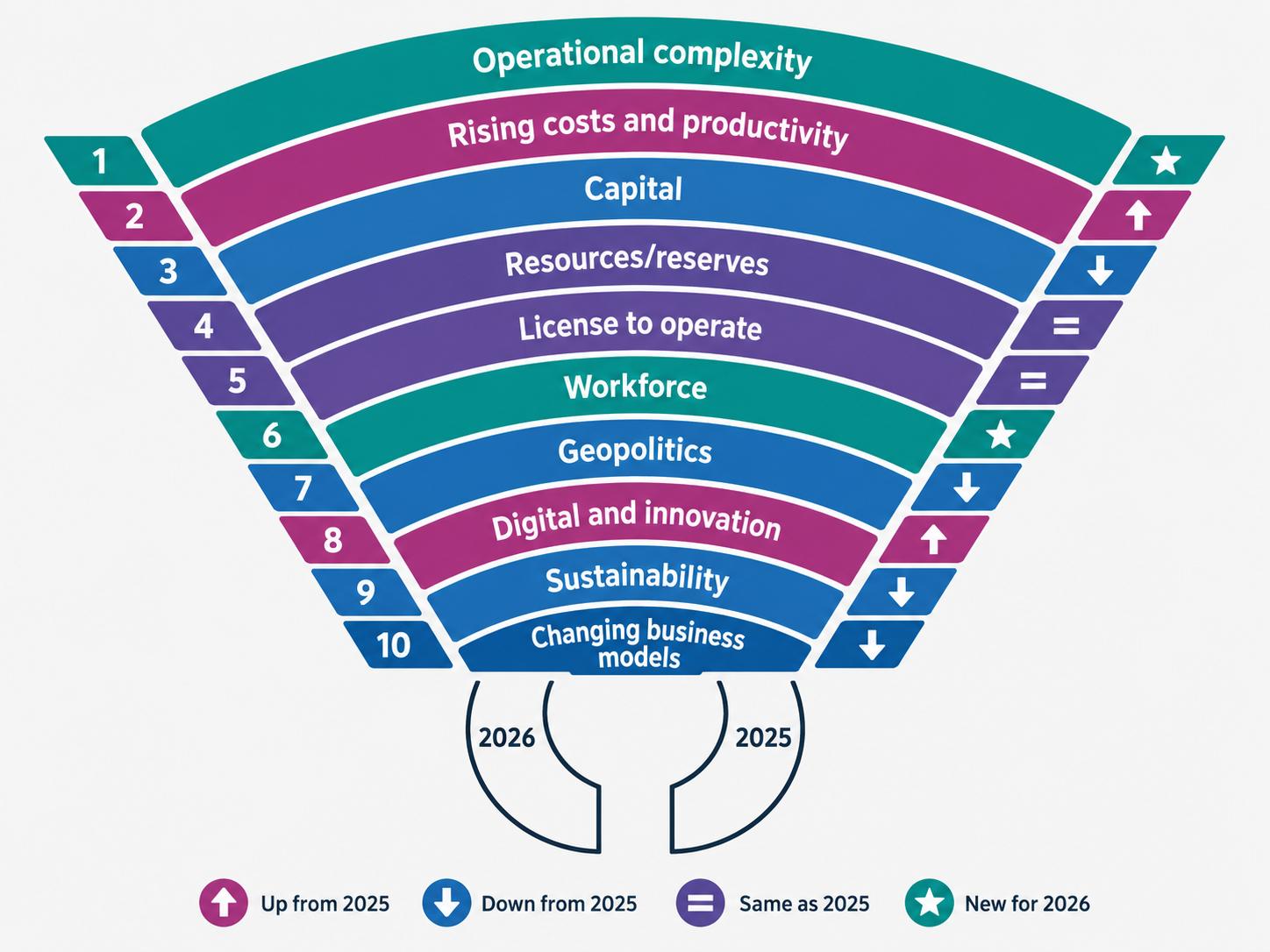
Top 10 business risks and opportunities for mining and metals in 2026.
Drivers of Increased Demand for Critical Minerals
The transition toward low-carbon energy systems depends on a reliable supply of primary minerals and metals. The deployment of electric vehicles, photovoltaic systems, and wind energy infrastructure is driving rapid growth in demand for key minerals. At the same time, demographic growth, rising living standards, technological advancements, and defense-related investments continue to place additional pressure on resource demand.
As economies reduce their reliance on fossil fuels, the focus of industrial development is shifting from hydrocarbon resources to the minerals required for energy, manufacturing, digital technologies, and national security applications. This transition necessitates a significant expansion of extraction and processing capacity to meet future material needs.
However, the supply chain for many materials remains geographically concentrated, creating economic and geopolitical vulnerabilities. Expanding production requires not only increased output but also responsible resource management across sensitive regions worldwide.
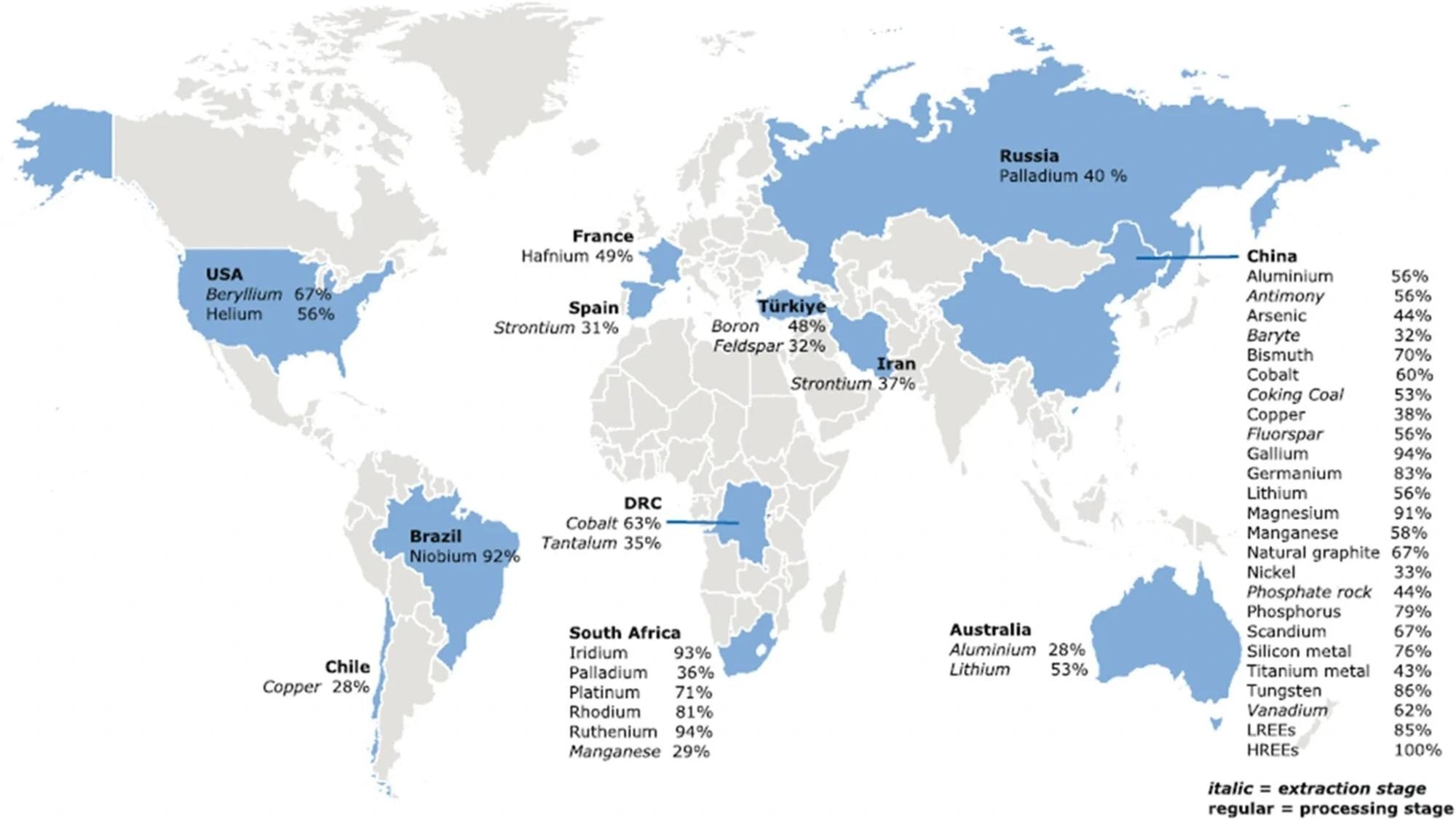
Countries with the largest share in global supply (extraction and processing) of European critical raw materials (CRMs). Source: European Commission
Methodology and Analytical Framework
To evaluate the challenges of securing supplies, researchers synthesized and updated evidence from the UNEP International Resource Panel report, the International Energy Agency, BloombergNEF, S&P Global Market Intelligence, and other industry and policy sources. The paper draws on global exploration investment data from 1997 to 2024, using constant 1998 economic metrics adjusted for inflation using the United States Consumer Price Index. It also discusses a database of over 60,000 mineral deposits to track exploration trends and investment returns.
The study characterizes mining development as a three-stage process: the creation of geoscientific data infrastructure, risk-managed mineral exploration, and large capital investments required to construct production facilities. Separate project-spending data indicate that major copper developments typically require initial investments of USD 1912 million, while lithium projects average USD 728 million.
To assess supply-chain vulnerabilities, researchers examined the geographic concentration of extraction and refining activities and considered evidence from mining-related conflict mapping, environmental justice resources, and industry risk assessments. A targeted survey of mining companies evaluated how environmental, social, and governance (ESG) reporting is integrated into decision-making.
Financial Challenges and the Green Premium
The analysis highlights a significant gap between climate ambitions and the financial conditions required to expand mineral production. Exploration investment has declined substantially from its previous peak, with historical returns averaging only USD 0.64 per dollar invested in global mineral exploration over 2011 to 2022. At the same time, higher sovereign bond yields have increased the cost of capital, delaying investment decisions for many viable mining projects.
Projected demand growth under the IEA’s net-zero scenario is substantial, including increases of 794% for natural graphite, 339% for lithium, and 148% for magnet rare earth elements between 2024 and 2050. However, shifts in battery chemistry introduced uncertainty into long-term demand, including the growing use of lithium-iron-phosphate batteries, potential graphite-free anodes, and possible sodium-ion battery technologies. The study highlights that critical raw material extraction and refining remain highly geographically concentrated, creating supply chain vulnerabilities. Additionally, environmental and social challenges pose significant barriers to project development, as numerous documented mining-related conflicts worldwide attest.
Survey data suggested that adopting stronger sustainability standards could increase operating costs. Enhanced environmental protections were associated with anticipated cost increases of 25% to 50%, while comprehensive social and human rights protections were associated with anticipated increases of 51% to 75%. Without market mechanisms that recognize these additional costs, lower-cost production methods may retain a competitive advantage despite their environmental and social impacts.
Strategies for Resource Recovery and Circular Economy
To reduce dependence on primary extraction, this research highlights several strategies for recovering value from secondary resource streams. One approach involves reprocessing legacy industrial tailings, which contain significant quantities of unrecovered metals that can be extracted using advanced hydrometallurgical and bioleaching techniques.
The research emphasizes integrating circularity into mineral processing systems by converting portions of crushed ore into low-carbon manufactured sand before disposal. This reduces tailings volumes while providing an alternative source of construction aggregate.
Additionally, the analysis identifies a growing challenge associated with end-of-life clean energy technologies, projecting 60-78 million tonnes of discarded solar modules and 43 million tonnes of wind turbine waste by 2050. Recovering materials from this waste remains difficult due to complex product structures that do not prioritize recycling. Furthermore, researchers highlight the importance of standardized digital product passports and extended producer responsibility frameworks to support recycling systems and help overcome economic barriers associated with large-scale recovery infrastructure.
The paper also stresses that circular economy strategies cannot fully replace mining. Instead, recycling, reuse, remanufacturing, and secondary recovery are presented as complementary approaches that can reduce pressure on primary extraction while improving supply-chain resilience.
Ensuring Long-Term Stability in Supply Chains
In summary, this study argues that securing the material foundations of the energy transition requires coordinated international frameworks that integrate sustainable finance, responsible mining practices, circular resource management, and market mechanisms that reward responsible producers. Supply stability depends on ensuring that environmental and social performance is reflected in financial and commodity markets. Overall, balancing responsible primary extraction with expanded recycling and secondary material recovery is key to maintaining secure mineral supplies while supporting global decarbonization objectives.
The paper further emphasizes the need for mine-site transparency, stronger local and Indigenous community engagement, responsible management across the full mining life cycle, and improved standards for artisanal and small-scale mining. These measures are presented as essential for reducing conflict, improving accountability, and ensuring that expanded mineral production supports sustainable development.
Download your PDF copy by clicking here.
Disclaimer: The views expressed here are those of the author expressed in their private capacity and do not necessarily represent the views of AZoM.com Limited T/A AZoNetwork the owner and operator of this website. This disclaimer forms part of the Terms and conditions of use of this website.
Source:
- Ekins, P., Christmann, P., Ciftci, M. M., Larosa, F., & Verrier, B. (2026). Financing the responsible supply of energy transition minerals. Mineral Economics, 39, 743-761. DOI: 10.1007/s13563-026-00637-8, https://link.springer.com/article/10.1007/s13563-026-00637-8