A global analysis reveals that the true freshwater demand for green hydrogen depends not only on electrolysis but also on cooling systems, local climate, and whether renewable energy projects are built in areas already water-scarce.
Article: Demand for cooling water reshapes global water-sustainable hydrogen production. Image credit: AI-generated image created using ChatGPT/OpenAI
The global transition to low-carbon energy has positioned green hydrogen as a key option for industrial decarbonization. However, a recent study published in the journal Communications Sustainability found that the freshwater footprint of green hydrogen is often underestimated, primarily because conventional approaches focus solely on electrolyzer water and overlook the cooling needs of industrial electrolyzers.
Researchers in Germany combined thermodynamic modeling with climate data and water-stress indices to quantify the total freshwater required for large-scale electrolysis using evaporative cooling. Their analysis demonstrated that evaporative cooling can increase overall water consumption severalfold beyond the amount needed for hydrogen generation itself. Many regions that produce solar-based hydrogen already experience severe freshwater scarcity, underscoring the importance of alternative cooling techniques and sustainable water management strategies.
Quantifying Water Needs for Electrolysis
Green hydrogen is produced by splitting water into hydrogen and oxygen using electricity from renewable sources like wind and solar power. The electrochemical reaction requires approximately 9 liters of water per kilogram of hydrogen, increasing to about 10 liters when accounting for purification losses. However, the overall water demand can be significantly higher because large-scale electrolyzers generate substantial waste heat during operation.
Maintaining performance requires continuous cooling to protect electrolyzer stacks and preserve system efficiency and durability. When conventional freshwater-based evaporative cooling towers are used, water lost through evaporation can exceed the amount consumed in hydrogen production by a factor of 2-5, making cooling configuration a key factor in the sustainability of green hydrogen.
Comprehensive Water Risk Assessment
To evaluate the hidden water demands of green hydrogen production, researchers developed a unified thermodynamic model for commercial PEM and AEL systems. This model estimates total cooling-water requirements by accounting for evaporation, drift, and blowdown losses under standard cooling-tower operating conditions. It was coupled with ten years of high-resolution ERA5 (ECMWF Fifth Generation Reanalysis) climate reanalysis data to quantify regional evaporation potential.
The study then integrated water-stress data from the World Resources Institute Aqueduct 4.0 database, identifying regions where water withdrawals exceed 40% of renewable freshwater supplies. Using seasonal principal component analysis, researchers combined cooling-water demand with regional water availability to create a composite Water Risk Index (RI) ranging from 0 to 100. Based on this index, locations were then classified into Go, Caution, and Other Solutions zones for freshwater-based evaporative cooling in green hydrogen development.
Regional Disparities in Water Demand and Supply
High-quality solar resources were primarily concentrated in hot, arid regions with high cooling-water demand, whereas many wind-rich regions benefit from cooler climates that reduce evaporative losses. The simulations indicated that cooling water demand varies significantly across global climate zones, ranging from about 19 liters per kilogram of hydrogen in cold, high-latitude regions to 39 liters per kilogram in hot, arid environments.
Ambient temperature and relative humidity emerged as key factors controlling evaporative cooling losses. The annual global median water need was about 30 liters per kilogram of hydrogen, with 50% of land areas above that value. Summer conditions increased evaporative demand by up to 25% in many mid-latitude continental regions. This seasonal effect pushed 83% of global land areas above the annual median during the June-August period, particularly across the Northern Hemisphere mid-latitude interiors, including the southwestern United States, southern Europe, Central Asia, and northern China.
Compared with planned green hydrogen developments, the study found a mismatch between renewable energy potential and freshwater availability. About 43% of planned PEM and AEL project capacity fell within the Water Risk Index’s “Other Solutions” category, while a separate capacity overlay showed that about 25% of global planned capacity (10.68 GW) is located where high cooling-water demand coincides with moderate to severe water stress. Major projects, including NEOM in Saudi Arabia, Hyphen in Namibia, and the Pilbara in Australia, are situated within regions facing water-related constraints.
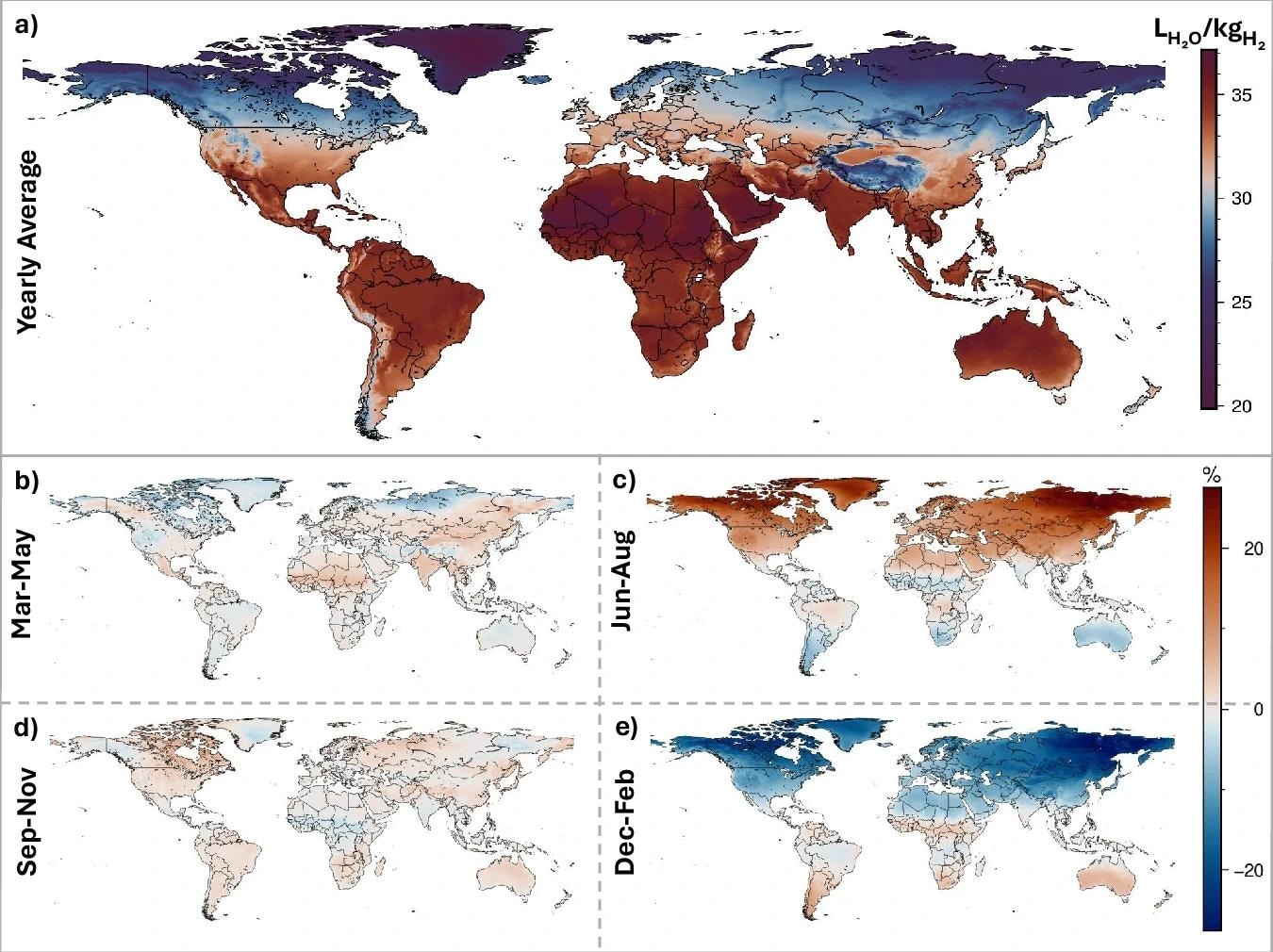
a Annual average specific water consumption of electrolysis using evaporative cooling, calculated from long-term mean ambient and dew-point temperatures from ERA5 reanalysis data. b–e Seasonal deviations from the annual average for March--May, June--August, September--November, and December--February, respectively. a shows total specific water consumption in liters of water per kilogram of hydrogen, including reaction water and cooling-water demand. b–e show percentage deviations from the annual average. Blue shading indicates lower values or negative deviations, and orange-to-red shading indicates higher values or positive deviations
Solutions for Sustainable Hydrogen Infrastructure
Addressing these water constraints requires project-specific decisions about cooling technology, water sourcing, and infrastructure design. In arid or highly water-stressed regions, conventional freshwater evaporative cooling may need to be replaced or supplemented with dry air cooling or hybrid adiabatic systems. Although dry cooling eliminates water consumption, it can increase capital costs by up to 8 times and reduce electrolyzer efficiency during extreme heat.
For coastal facilities, seawater reverse osmosis desalination offers a practical alternative by supplying water for electrolysis and cooling. Desalinating the required cooling water adds only 0.08-0.25 kWh of electricity per kilogram of hydrogen, increasing total system energy demand by just 0.15-0.50%. This translates to an additional production cost of approximately USD 0.02-0.09 per kilogram of hydrogen, representing less than 5% of projected levelized hydrogen costs. Successful implementation requires the use of corrosion-resistant materials and careful management of concentrated brine to minimize impacts on coastal ecosystems.
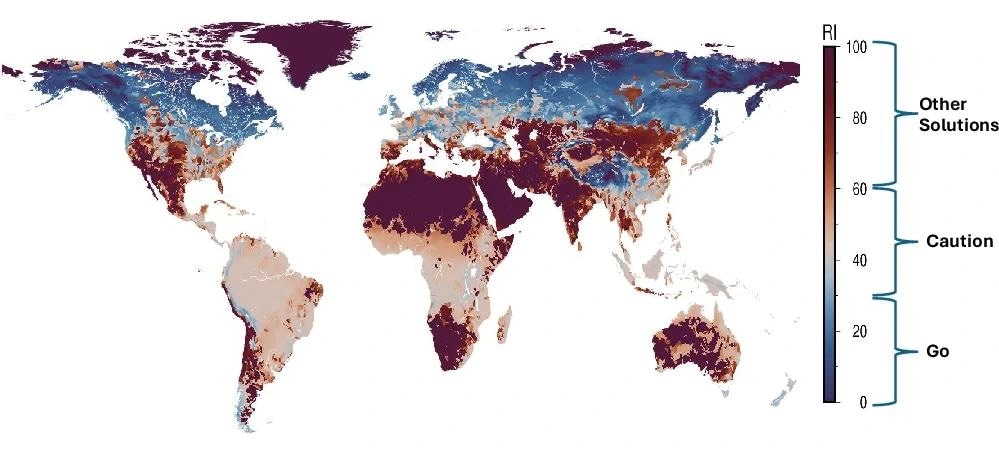
The composite Water Risk Index is scaled from 0 to 100 and combines modeled evaporative-cooling water consumption with regional water-stress levels. Colors denote risk categories for local water resources: Go, 0–30, low risk; Caution, 30–60, potential risk; and Other Solutions, 60–100, high risk.
Implications for Sustainable Hydrogen Production
In summary, this study demonstrates that green hydrogen planning must consider local freshwater constraints alongside carbon reduction goals. High-quality onshore wind resources are often located in relatively water-abundant regions. In contrast, solar-powered projects may require alternative cooling technologies or non-freshwater sources because they are often located in arid environments. Water availability and local climate conditions should be treated as fundamental engineering considerations during project design.
Researchers also highlight the need to incorporate water-related metrics into green hydrogen policies and financing frameworks. The authors note that the framework is intended as a global screening tool and does not explicitly resolve short-term heatwaves, droughts, transient operating dynamics, or site-specific adiabatic cooling performance. By integrating climate, water, and energy considerations into national hydrogen strategies, policymakers can reduce pressure on freshwater resources and support the long-term sustainability of the clean energy transition.
Want to read later? Download your PDF copy by clicking here.
Disclaimer: The views expressed here are those of the author expressed in their private capacity and do not necessarily represent the views of AZoM.com Limited T/A AZoNetwork the owner and operator of this website. This disclaimer forms part of the Terms and conditions of use of this website.
Source:
- Wortmann, B., Arenas, D., Winkler, C., Linßen, J., Stolten, D., & Heinrichs, H. (2026). Demand for cooling water reshapes global water-sustainable hydrogen production. Communications Sustainability, 1, 103. DOI: 10.1038/s44458-026-00106-x, https://www.nature.com/articles/s44458-026-00106-x