A carefully engineered crystal architecture lets tantalum nitride respond to stress in ways rarely seen in ultra-hard ceramics.
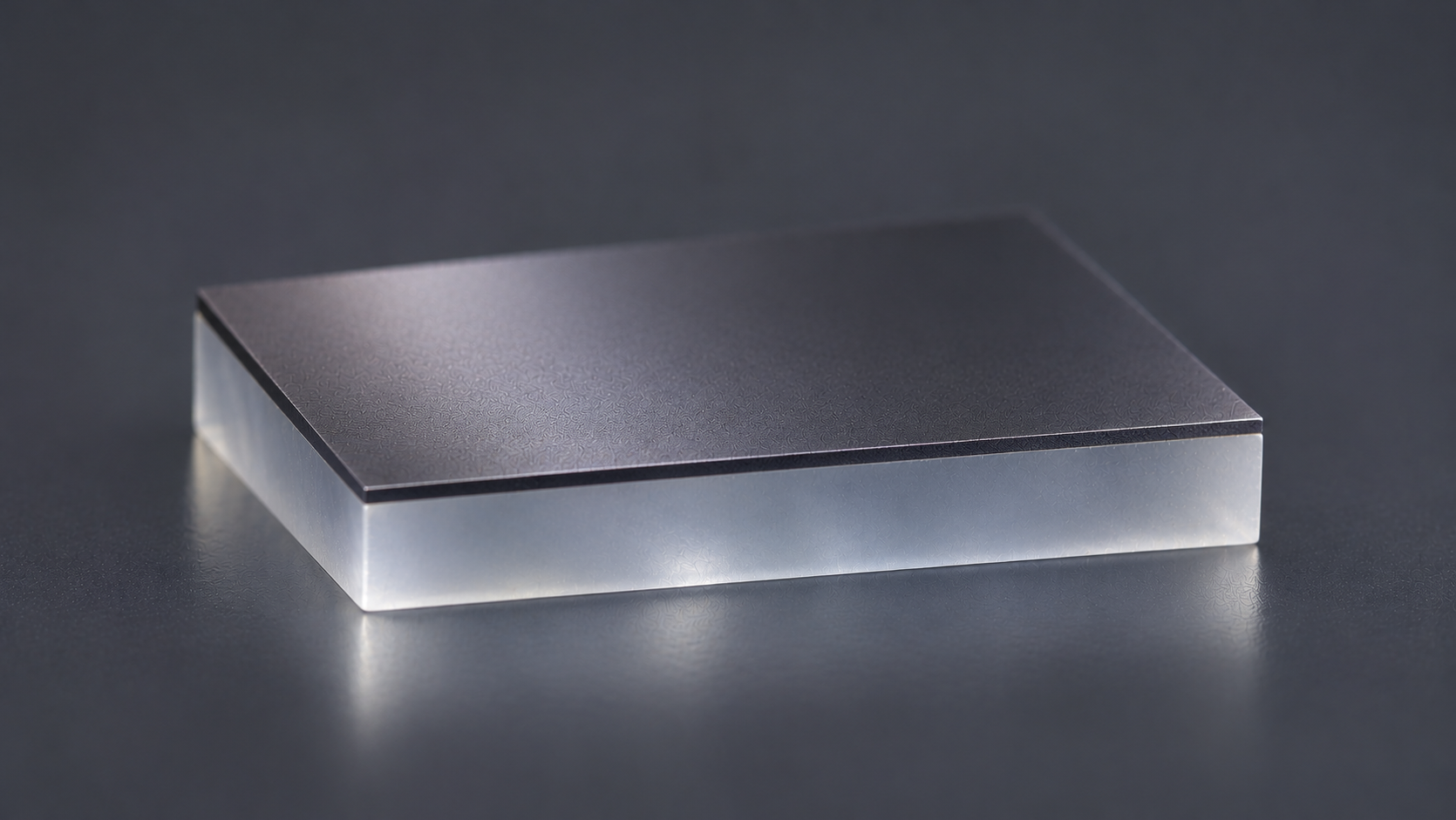
Paper: Mitigating brittleness in ceramics via transformation- and twinning-induced plasticity. AI-generated abstract conceptual image created using ChatGPT/OpenAI
*Important notice: This news reports on an unedited version of an accepted paper and is awaiting final editing. Therefore, the paper should not be regarded as conclusive or treated as established information.
Developing ductility in ceramics without compromising mechanical strength remains a major challenge in materials science. While ceramics provide high hardness and thermal stability, their susceptibility to sudden brittle fracture limits their use in demanding applications.
A recent study published in the journal Nature Communications addressed this limitation by engineering the nanoscale crystal structure of a monolithic tantalum nitride (TaN) ceramic film. Activating twinning-induced plasticity (TWIP) and transformation-induced plasticity (TRIP) allowed researchers to achieve sustained plastic deformation at room temperature in micropillar compression while retaining high yield strength and indentation hardness.
Addressing the Brittleness Challenge in Ceramics
Ceramics are known for their high hardness, thermal resistance, and environmental stability, resulting from strong covalent and ionic bonds. These rigid bonding structures restrict dislocation mobility and limit active slip systems at room temperature, causing stress to concentrate around defects and microcracks, often leading to sudden fracture.
Scientists have explored mechanisms such as TWIP and TRIP to improve ductility, which allow materials to accommodate strain through stress-induced phase changes or twin-boundary formation under mechanical loading. Triggering both mechanisms in ceramics has been difficult because their rigid structures resist phase transformations and twin formation.
Synthesis Techniques and Analytical Approaches
To activate both plasticity mechanisms, researchers selected TaN, a transition-metal nitride with refractory properties and a complex phase structure. They synthesized monolithic films of metastable cubic delta-phase tantalum nitride (δ-TaN) using direct-current reactive magnetron sputtering, a physical vapor deposition method.
By controlling substrate bias, gas pressures, and deposition conditions, the researchers stabilized the non-equilibrium phase and formed a hierarchical, three-dimensional nanotwin network in the ceramic film. The network consists of nanoscale crystal regions whose orientations are related by twin symmetry across their boundaries.
The study employed micromechanical testing, atomic-resolution imaging, and computational simulations to examine deformation mechanisms. In situ micropillar compression experiments measured yield behavior and monitored damage progression.
Following compression, cross-sections were analyzed using atomic-resolution transmission electron microscopy to identify nanoscale phase transformations and dislocation interactions. Ab initio simulations investigated atomic rearrangements under shear and tensile loading.
Mechanisms Behind Improved Damage Tolerance
The experimental results showed that hierarchical nanotwinned TaN can accommodate extensive deformation without catastrophic brittle failure. In micropillar compression tests, the ceramic maintained load-bearing capacity beyond 60% engineering compressive strain, including in specimens with localized cracks, and reached a peak indentation hardness of approximately 43.1 GPa.
Microstructural characterization and atomic-scale simulations attributed this damage tolerance to the combined action of TWIP and TRIP, with their contributions changing as strain increased.
At low to moderate strains, deformation twinning, dislocation activity, twin refinement, and twin-boundary migration accommodated strain while cubic δ-TaN remained dominant. At higher strains, δ-TaN progressively transformed toward hexagonal θ-TaN through coordinated atomic displacements and transitional lattice structures.
The nanotwin network also hindered dislocation motion and helped hinder crack propagation, while movements and structural changes at twin boundaries helped redistribute local stresses. Consistent with this damage-tolerant behavior, indentation cracks were about 18.2% shorter than in nt-TaN/TiN, suggesting greater apparent fracture resistance, though residual stresses may partly affect that comparison. The newly formed hexagonal regions and their boundaries also made the material more resistant to further deformation.
Loading geometry mattered in the simulations. Under tension perpendicular to the twin boundaries, the modeled structures fractured without the same phase transformation or boundary migration seen under shear. The large compressive strains do not demonstrate comparable tensile ductility.
Practical Implications in High-Performance Industries
The combination of high hardness and compressive damage tolerance could support future use in mechanically demanding coatings. In high-speed machining and other wear-intensive applications, such coatings may help reduce brittle micro-chipping, but the study did not test machining, abrasive wear, impact, thermal shock, or tool life.
The authors identify aerospace propulsion, advanced energy systems, and wear-resistant technologies as possible application areas. TaN coatings may prove useful on components exposed to high contact stresses or vibration, but turbine service, particle erosion, and thermal protection were not tested.
Micro-electromechanical systems and precision microelectronics are further possible uses; however, wear, adhesion, delamination, and friction performance would require separate tests.
Future Directions in Ceramic Material Design
The study links the material's mechanical response to a specific combination of hierarchical nanotwins, a strong [001] fiber texture, and a metastable cubic phase. The findings offer a design route for damage-tolerant ceramics based on controlled deposition, nanoscale interfaces, and stress-induced phase transformations.
Future work could test related transition-metal nitrides, carbides, and borides while examining production at larger scales and in more complex components. Cyclic fatigue, high-temperature oxidation, tensile behavior, wear, and long-term service testing would help determine how well microscale compression translates to demanding operating conditions.
Disclaimer: The views expressed here are those of the author expressed in their private capacity and do not necessarily represent the views of AZoM.com Limited T/A AZoNetwork the owner and operator of this website. This disclaimer forms part of the Terms and conditions of use of this website.