Researchers examine how atomic-scale defects and crystal structures influence the mechanical behavior of nanoporous high-entropy alloys in the search for stronger, lighter materials.
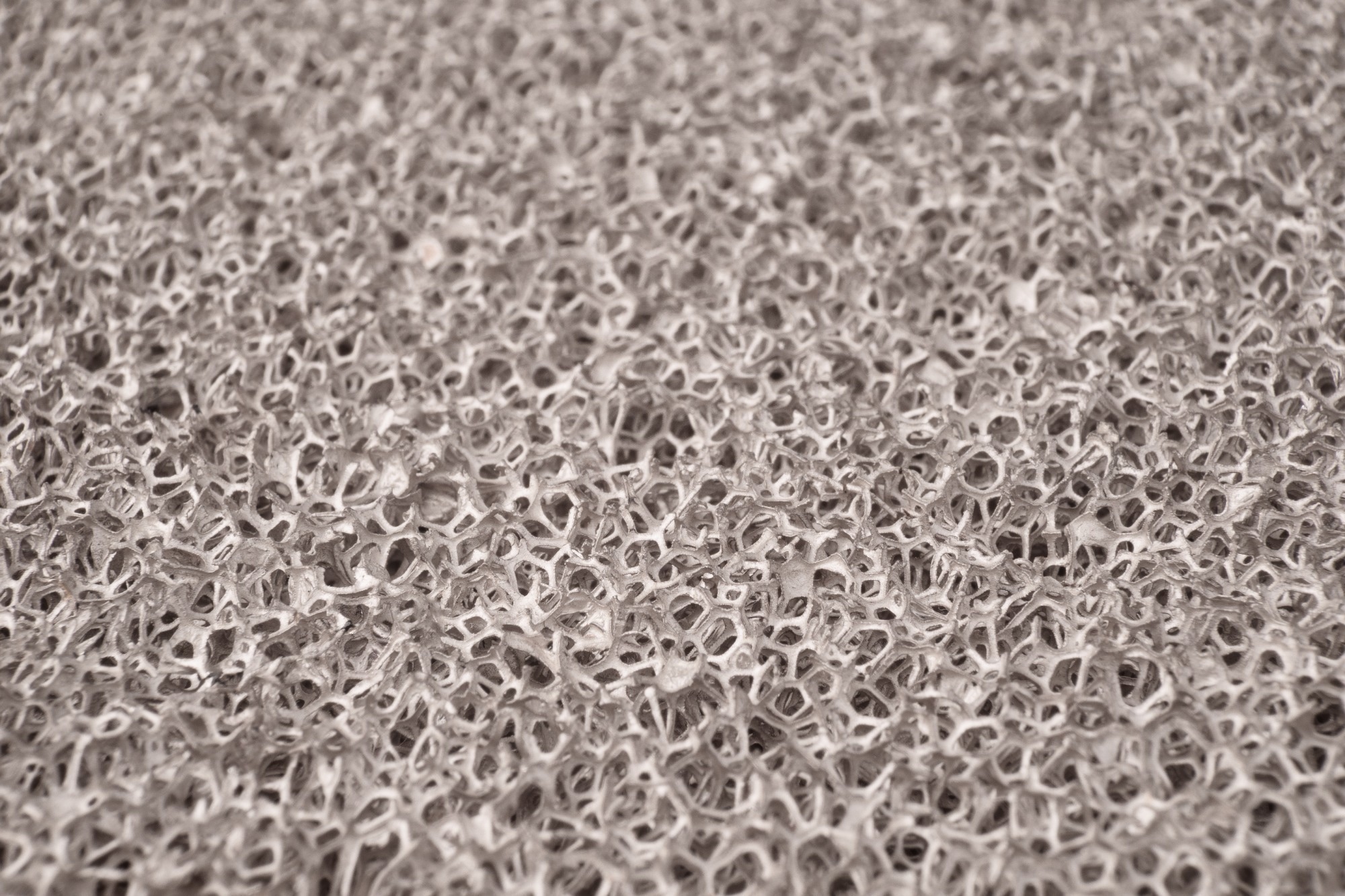
Paper: Nanoporous high entropy alloys: overcoming brittleness through strain hardening. Image Credit: Contentino / Shutterstock
*Important notice: This news reports on an unedited version of an accepted paper and is awaiting final editing. Therefore, the paper should not be regarded as conclusive or treated as established information.
A recent study published in the journal npj Computational Materials examines how high-entropy alloys (HEAs) could mitigate the inherent tensile brittleness of nanoporous metallic materials.
Using molecular dynamics simulations, the researchers modeled two nanoporous HEA systems, Al0.1CoCrFeNi and NbMoTaW, with face-centered cubic (fcc) and body-centered cubic (bcc) crystal structures, respectively. Both alloys exhibited high specific strength (strength per unit density), low specific elastic modulus (elastic modulus divided by density), and distinct strain-hardening mechanisms. These mechanisms may reduce the risk of cascading ligament failure in lightweight structural materials.
Addressing brittleness in nanoporous metallic structures
Nanoporous metals consist of interconnected solid ligaments separated by a continuous network of pores. This bicontinuous architecture gives them low density, high specific surface area, and favorable strength-to-weight ratios. These characteristics make nanoporous materials promising for lightweight structures and energy absorption.
Under tensile loading, the failure of an individual ligament creates stress concentrations that can trigger the fracture of neighboring ligaments. This cascading process can lead to macroscopic brittleness, even when individual ligaments exhibit considerable strength. Nanoporous gold provides a well-established example of this behavior.
High-entropy alloys offer a potential approach to mitigating this limitation. Their complex atomic arrangements contribute to high strength, hardness, and strain-hardening capacity. The study tested whether introducing HEAs into nanoporous architectures could strengthen individual ligaments and reduce the risk of cascading fracture.
Molecular dynamics simulations of mechanical behavior
The researchers used molecular dynamics simulations with the Large-scale Atomic/Molecular Massively Parallel Simulator (LAMMPS) to assess the mechanical behavior of the two HEA systems. They constructed three-dimensional atomic models representing single-crystalline, polycrystalline, and nanoporous structures, with randomly assigned atomic species.
The team generated the polycrystalline models using Voronoi tessellation, with grain sizes of 10, 20, and 30 nm across the two alloys.
The nanoporous models comprised interconnected ligament-pore networks. Relative densities (percentages of the corresponding bulk alloy density) were approximately 29%, 48%, and 67% for Al0.1CoCrFeNi, compared with 28%, 47%, and 69% for NbMoTaW. Mean ligament diameters ranged from 2.20 to 7.33 nm and 4.79 to 7.95 nm, respectively.
An Embedded Atom Method (EAM) potential described atomic interactions in Al0.1CoCrFeNi and a Spectral Neighbor Analysis Potential (SNAP) modeled those in NbMoTaW.
Researchers equilibrated the models at atmospheric pressure for 100 ps using a Nosé–Hoover thermostat and barostat. Uniaxial tensile and compression tests followed at 298, 600, and 1273 K using a strain rate of 109 s-¹, considerably higher than typical experimental rates.
The team calculated surface energies for Al0.1CoCrFeNi and examined potential energy profiles to understand the energy barriers governing dislocation motion. OVITO and ParaView enabled the researchers to visualize atomic configurations and analyze dislocations, stacking faults, and twin boundaries.
Strengthening mechanisms and mechanical performance
The researchers proposed that the high specific strength arose from the combined effects of two mechanisms: dislocation starvation and sluggish dislocation motion.
Dislocations are line defects in a crystal structure that facilitate plastic deformation. Dislocation starvation, a mechanism common in nanoporous metals, occurs when dislocations migrate toward nearby free surfaces and are annihilated. The high surface-to-volume ratio of nanoscale ligaments aids this process, leaving fewer mobile dislocations to accommodate plastic deformation.
Sluggish dislocation motion arises from high migration energy barriers and promotes strain hardening. Calculations for NbMoTaW showed higher barriers than for pure tungsten, with both materials exhibiting larger barriers in nanoscale ligaments than in their bulk configurations. Local atomic variations and internal stresses may account for these increases.
The contrasting crystal structures produced distinct strain-hardening mechanisms. In the Al0.1CoCrFeNi system, the low calculated single-crystal stacking fault energy of 32.8 mJ/m² favored stacking-fault formation during deformation. These planar defects disrupt the regular stacking sequence of atomic planes.
Partial dislocations generate stacking faults as they move through the crystal. When one partial dislocation is annihilated at a free surface, the stacking fault can remain trapped by the other, impeding further slip and promoting strain hardening.
In a representative tensile simulation, stacking faults remained the dominant defects during ligament failure, while twin boundaries persisted until rupture.
The NbMoTaW system followed a different mechanism. Its high stacking fault energy of approximately 1300 mJ/m² suppressed stacking fault formation. Dislocations accumulated at network junctions, where interactions between them produced forest hardening and restricted their movement into the ligaments.
During tensile failure in a representative NbMoTaW simulation, dislocations and twin boundaries formed within the ligaments, and dislocation bundles contributed to local thinning and rupture.
NbMoTaW generally exhibited higher yield strength and Young's modulus than Al0.1CoCrFeNi. Comparisons with previously reported experimental and computational data indicated that the simulated HEAs had specific yield strengths up to five times those of typical nanoporous materials. Al0.1CoCrFeNi had higher yield strength under tension than compression, whereas the reverse held for NbMoTaW.
No ligament fractures were observed under compression.
Increasing temperature generally reduced the yield strength of both nanoporous alloys. In Al0.1CoCrFeNi, this was associated with defect annihilation and lower stacking fault concentrations. The studied nanoporous NbMoTaW configurations tended to retain a greater proportion of their yield strength at elevated temperatures than Al0.1CoCrFeNi. Their dislocation density changed little with temperature under tension but increased slightly under compression.
Smaller Al0.1CoCrFeNi ligaments showed greater thermal sensitivity and higher surface energies. The researchers attributed this increase in surface energy to greater ligament curvature and a higher density of surface steps.
The structure with the smallest ligaments (2.20 nm) collapsed during relaxation at elevated temperature. Larger ligaments had higher yield strengths at similar relative densities, suggesting a possible reversal of conventional size-dependent strengthening. This interpretation remains tentative because ligament size and relative density were not varied independently.
Advancing lightweight materials through defect engineering
The study provides atomistic evidence that high-entropy alloy design could mitigate the tensile brittleness of nanoporous materials. Adjusting alloy composition may offer a way to control the energy barriers to defect motion and tailor strain-hardening behavior.
Further research should address the limitations of high simulation strain rates and simplified ligament geometries.
The authors expect sluggish dislocation motion to play a smaller role at lower strain rates. Preliminary nanopillar simulations examined surface segregation, but the full nanoporous models retained random atomic distributions. Only one realization of each nanoporous configuration was investigated.
Future studies should isolate ligament-size effects and test multiple independently generated pore networks. Experimental validation is needed to establish whether ligament strengthening improves macroscopic fracture resistance.
Disclaimer: The views expressed here are those of the author expressed in their private capacity and do not necessarily represent the views of AZoM.com Limited T/A AZoNetwork the owner and operator of this website. This disclaimer forms part of the Terms and conditions of use of this website.