Specifically created for assessing the viscosity of polymer solutions, the Rapid Differential Viscometer (RDV) combines automated sample preparation, dissolution, and viscosity assessment within one efficient, high-throughput system.
Capable of handling a diverse array of polymers and sample formats, the RDV provides numerous viscosity parameters with the necessary speed, adaptability, and dependability for both regular quality control and research and development activities.
The RDV offers several advantages over gel permeation chromatography (GPC) for determining molecular weight, including easier operation, optimized workflows, less need for extensive operator training, higher throughput, and lower costs from reduced solvent and column use.
Rapid Analysis
RapidFlow parallel processing can achieve throughput of up to 15 samples per hour in duplicate. The RDV consistently prepares the next sample while the current sample is being measured, reducing downtime and enabling swift, continuous processing to maximize laboratory productivity.
Automated Workflow
The RDV system automates sample weighing and solvent dispensing to achieve accurate sample dissolution at predetermined concentrations. This process reduces the need for manual labor and minimizes exposure to solvents typically associated with preparing polymer solutions.
Confident Results
Integrated system evaluations and accurate repeated measurements provide confidence in results for relative, intrinsic, and inherent viscosity. Stability and linearity assessments help confirm the system's functionality, while repeated measurements provide an additional metric for precision and consistent outcomes.
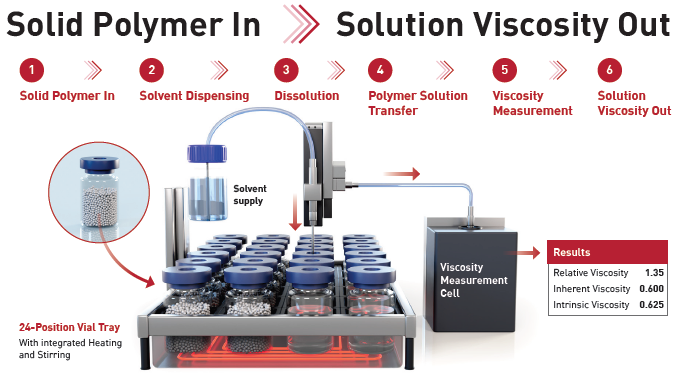
Image Credit: Cannon Instrument Company®
Wide Range of Polymers and Sample Forms
With an extensive operational temperature range, in-line sample filtration, and adjustable stirring speeds, the RDV is capable of handling a wide variety of polymers – such as PET, cellulose acetate, PVC, elastomers, biopolymers, and polystyrene – in various forms, including pellets, powders, films, fibers, flakes, and completed products. This adaptability gives laboratories greater flexibility to meet diverse testing needs.
Features and Benefits
- The Enclosed Sample Handling System automatically combines sealing ampoules, dispensing solvents, heating, and stirring. This integration minimizes operator interaction with solvents and decreases exposure to laboratory vapors.
- RapidFlow Parallel Processing (U.S. Patent 11,828,679) concurrently loads the subsequent sample into a parallel storage loop while simultaneously analyzing the current sample. This approach reduces periods of inactivity, enhances thermal stability, and facilitates quicker, continuous measurements, thereby improving laboratory efficiency.
- Integrated Solvent Bottle Stirring (optional) ensures consistent binary solvent mixtures utilized in polyester techniques, making laboratory arrangements easier and enhancing workflow efficiency.
- The Filtered Injection System facilitates programmable flushing to eliminate particles, fibers, and gels from the sample. This cohesive design removes the need for distinct filtration processes, minimizes the involvement of the operator, and streamlines sample preparation.
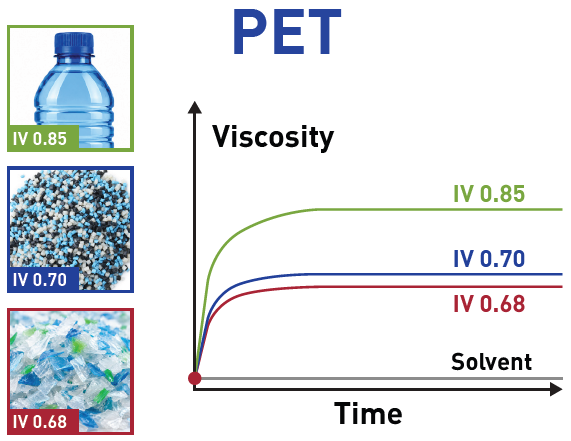
Image Credit: Cannon Instrument Company®
Source: Cannon Instrument Company®
| RDV Specifications |
| Viscosity Parameters |
Relative, Intrinsic, Inherent |
| Precision |
Better than 0.2% RSD on relative viscosity |
| AutoSampler Capacity |
24 samples |
| Analysis Time |
4–8 min/sample in duplicate* |
| Throughput |
Up to 15 samples/hour in duplicate* |
| Solvent usage (prep-analysis-wash) |
35 mL/sample |
| Solvent Compatibility |
Organic, Aqueous |
| Dissolution Temperature |
Ambient to 140 °C |
| Measurement Temperature |
15 to 50 °C |
| Data Output |
CSV export; LIMS interface available |
| Patents |
RapidFlow Parallel Processing (US Patent 11,828,679) |
| Compliance |
CE Mark; EMC directive (2014/30/EV); Low voltage directive (2014/35/EC); HIPOT (1900 VDC, 60 sec.); ROHS |
| International Standards |
ASTM D5225, ISO 1628-1:2024 |
*Configuration and/or application dependent.