Sources of Contamination in Semiconductor Processes
Electrical and Physical Indicators of Contamination
Root Cause Analysis Methodology
Analytical Characterization Techniques
Process Flow Correlation
Controlled Experiments and Collaboration
Conclusion
References and Further Reading
In semiconductor manufacturing, some of the most serious problems start at the smallest scale. A trace metal ion, a residual film, or an airborne particle can make its way into a device structure and only surface later as yield loss or a reliability issue.
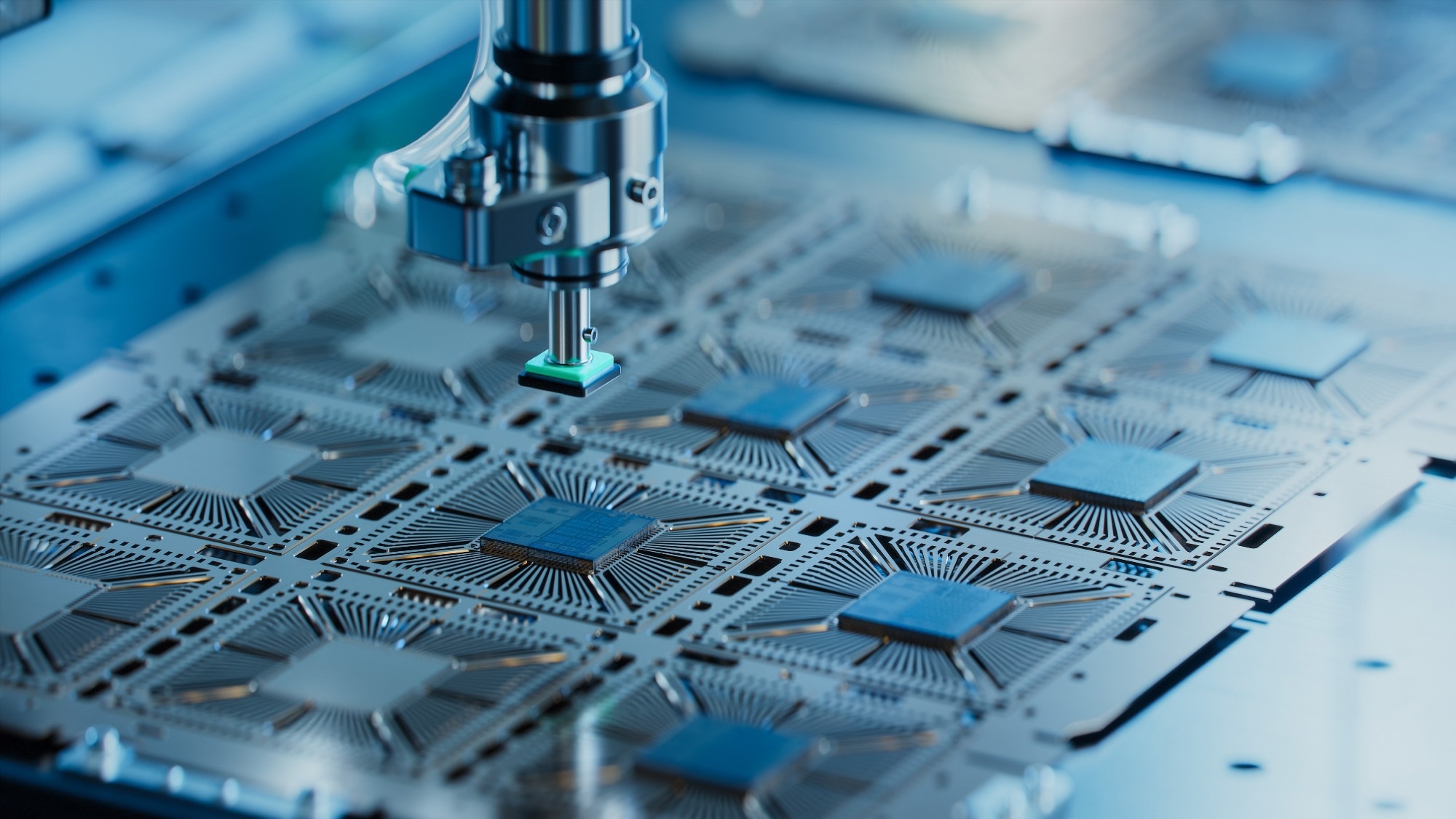
Image Credit: IM Imagery/Shutterstock.com
As device geometries continue to shrink and process integration becomes more complex, the margin for contamination grows smaller with every technology node.
Contamination can originate from process tools, materials, chemicals, or routine wafer handling, and it often moves through multiple steps before it is detected. That makes it difficult to diagnose and even harder to eliminate without a structured approach.
In the sections that follow, we’ll explore where contamination typically comes from in semiconductor production and how engineers can trace defects back to their source.
Save this PDF for later by downloading it here.
Sources of Contamination in Semiconductor Processes
Contamination in semiconductor fabrication can originate from multiple sources, broadly categorized as process-induced, material-related, environmental, and handling-related sources.
1. Process-Induced Contamination
Some contamination risks are built directly into the fabrication process itself. Steps such as plasma etching, chemical vapor deposition (CVD), and ion implantation can leave behind residues or cause redeposition inside process chambers. Over time, chamber wall wear, aging components, or incomplete cleaning cycles may introduce metallic or particulate contamination that transfers from one wafer to the next.
Research has shown that tool condition and process drift significantly influence contamination levels, which makes preventive maintenance and chamber monitoring essential.1 Chemical processes introduce additional concerns. Inadequate rinsing can leave ionic residues on wafer surfaces, and under electric fields, these ions have the tendency to migrate, contributing to leakage currents, corrosion, and long-term reliability issues.
2. Materials and Chemical Purity
Material quality is just as important as tool performance. Even trace impurities in precursor gases or photoresists can introduce unwanted elements into active device regions. Metallic contamination, in particular, is highly sensitive - parts-per-billion impurity levels are often enough to affect electrical behavior and reduce yield.2
Substrates can present a similar risk. Surface defects or residual polishing particles may pass early inspections without detection. As additional layers are deposited and device structures become more complex, those small imperfections can be amplified, ultimately impacting performance and reliability.
3. Environmental and Handling Factors
Even the most tightly controlled cleanroom cannot fully prevent environmental contamination. Airborne molecular contamination (AMC), particles generated by equipment movement, and routine human interaction during wafer handling all create potential defect pathways.
Electrostatic attraction may exacerbate particle adhesion, particularly during dry processing stages. Improper storage or transport lets moisture and organics adsorb on surfaces. That changes interface properties during later deposition or thermal steps and can lead to leakage currents, threshold shifts, increased noise, or short circuits.
Electrical and Physical Indicators of Contamination
Once contamination enters the process flow, its effects rarely appear immediately. Instead, they surface as electrical performance shifts or physical irregularities that require careful interpretation.
The specific failure mode depends on the contaminant’s composition, location, and interaction with surrounding device structures. Electrically, contamination may present as leakage currents, threshold voltage shifts, increased noise, or, in severe cases, catastrophic short circuits.
Metallic contamination is particularly disruptive because conductive particles can create unintended current paths within sensitive regions. In gate oxides, charge trapping caused by contamination may accelerate time-dependent dielectric breakdown (TDDB) and long-term reliability failures.3
Often, the earliest warning signs appear in parametric data rather than outright device failure. Subtle shifts in electrical parameters or increased variability across wafers and die populations can signal localized contamination, distinguishing it from broader process drift.
Physically, contamination can manifest as particles, residues, thin films, or embedded foreign material. High-resolution imaging may reveal voids, abnormal interfaces, or unexpected structural features. Surface-sensitive techniques such as scanning electron microscopy (SEM) and atomic force microscopy (AFM) help identify morphology changes linked to contamination. However, some contaminants remain invisible to optical inspection and require advanced analytical tools for definitive detection and characterization.
Root Cause Analysis Methodology
Identifying electrical or physical indicators of contamination is only the first step. Determining where the defect originated requires a structured Root Cause Analysis (RCA) approach.
A structured Root Cause Analysis (RCA) process typically begins with defect identification using inspection tools such as optical systems, e-beam inspection, or scanning electron microscopy (SEM). Once defects are confirmed, their distribution across wafers is mapped to uncover patterns that may point to specific tools or process steps.
These patterns provide direction. Spatial clustering can suggest localized equipment contamination, while more random distributions may indicate airborne exposure or material-related sources. Interpreting these signatures requires correlating inspection results with electrical data, tool maintenance records, and material histories.
By integrating these data sets, engineers can move from observation to causation and establish a defensible link between the defect and its source. Once confirmed, the findings should be documented and translated into corrective actions, whether through enhanced cleaning procedures, tighter material controls, or revised handling practices.
Analytical Characterization Techniques
Once defects have been localized, Failure Analysis (FA) teams use a range of analytical techniques to determine their chemical composition and structural characteristics.
Energy-dispersive X-ray spectroscopy (EDS) supports elemental identification, while time-of-flight secondary ion mass spectrometry (ToF-SIMS) enables highly sensitive detection of trace contaminants.
Transmission electron microscopy (TEM) provides nanoscale structural insight, allowing detailed examination of defect morphology and material interfaces. Together, these techniques move the investigation from surface-level observation to material-level confirmation, helping analysts verify contaminant identity and distinguish between process-induced and environmental or handling-related origins.
Process Flow Correlation
Analytical results alone, however, do not establish causation. A critical step in contamination RCA is correlating physical findings with the manufacturing process flow.
Engineers review tool histories, maintenance records, and material batches to identify links to specific process steps. Statistical process control (SPC) data can reveal subtle parameter shifts that precede contamination events. By aligning analytical evidence with process data, teams construct a coherent timeline that connects the observed defect to its likely source.4
Identifying contamination is only the first step; proving root cause requires demonstrating reproducibility and eliminating alternative explanations.
Controlled Experiments and Collaboration
To validate suspected sources, RCA teams may conduct split-lot experiments or controlled process modifications. Replacing a suspect chemical or performing targeted chamber cleaning can determine whether defect rates decline under controlled conditions.
Because contamination often results from interactions across multiple steps, effective RCA depends on collaboration among process engineers, materials scientists, and equipment specialists. Rarely does contamination stem from a single isolated factor; more often, it reflects a breakdown across interconnected elements of the manufacturing flow.
Conclusion
In advanced semiconductor manufacturing, contamination is rarely a single-point failure. It is the result of interconnected variables across tools, materials, environment, and process integration. That complexity is what makes effective root cause analysis both challenging and essential.
A disciplined approach grounded in inspection data, analytical verification, and process correlation allows engineering teams to move beyond symptom correction toward systemic control. The goal is to reinforce the stability of the entire manufacturing flow.
As scaling continues and process margins tighten, contamination control will increasingly depend on this level of integration between inspection, failure analysis, and process engineering.
For organizations evaluating their contamination control strategies, further focus on advanced defect detection, data-driven process monitoring, and cross-functional RCA frameworks can help strengthen long-term yield performance.
References and Further Reading
- Lee J, Kim K. (2024). A Study on the Development of Real-Time Chamber Contamination Diagnosis Sensors. Sensors (Basel), 25(1):20. https://www.mdpi.com/1424-8220/25/1/20
- Berger, H. (1991). Contamination due to process gases. Microelectronic Engineering, 10(3-4), 259-267. https://www.sciencedirect.com/science/article/abs/pii/016793179190026A
- Stathis, J. H., & Zafar, S. (2006). The negative bias temperature instability in MOS devices: A review. Microelectronics Reliability, 46(2–4), 270–286. https://www.sciencedirect.com/science/article/abs/pii/S0026271405003008
- Soden, J.M, Anderson, R. E. (1995). IC failure analysis: Techniques and tools for quality and reliability improvement. Microelectronics Reliability. 35(3), 429-453. https://www.sciencedirect.com/science/article/abs/pii/002627149593069M
Disclaimer: The views expressed here are those of the author expressed in their private capacity and do not necessarily represent the views of AZoM.com Limited T/A AZoNetwork the owner and operator of this website. This disclaimer forms part of the Terms and conditions of use of this website.