Sponsored by InterpowerReviewed by Olivia FrostApr 9 2026
The Underwriters Laboratories (UL) 94 Standard for Safety Tests for Flammability of Plastic Materials for Parts in Devices and Appliances specifies acceptable flammability ratings for plastic materials used in North American devices and appliances, such as cord sets.
The first edition of UL 94 appeared in September 1972. On September 16, 1988, the Department of Defense (DoD) approved UL 94.
The Horizontal Burn (HB) and Vertical Burn (V) are the two basic UL 94 burn tests, which provide testing parameters, ignition ratings, and burn times for plastics used in electronic devices and components.
Plastics in sockets where plug blades are inserted are one example, as is plastic in power strips with many outlets.
These ratings are derived from studies in which small-scale samples are exposed to a Tirrill burner flame ignition source. Unlike a Bunsen burner, the Tirrill allows for adjustments to both air and gas management.
In terms of flame retardancy, industry specialists consider UL 94 V-0 the "gold standard" for assessing the fire safety of plastic components used in electronics, such as housings and connectors.
V-1 and V-2 offer a lower standard of flame resistance, but in applications where there is little risk of ignition or overheating, they may still be appropriate for safe use. Flammability ratings and other material data are available on UL Yellow Cards through UL's Product iQ database.
A V-0 involves changing a resin by adding "glass-fill" to make it flame-retardant, such as Nylon 66.
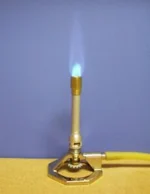
Tirrill Burner. Image Credit: Interpower
IEC 60695-2 Glow-Wire Testing
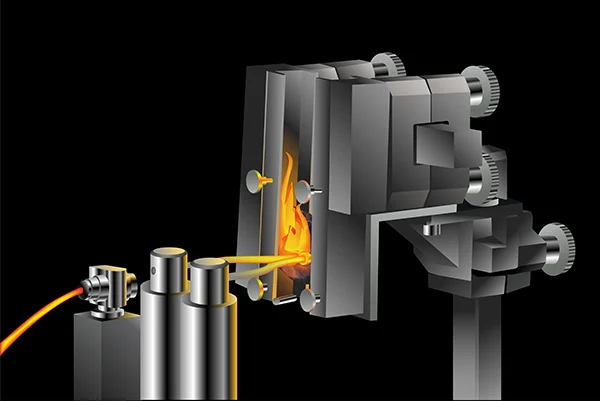
Image Credit: Interpower
Glow-Wire basics: A nickel-chromium wire loop is heated to specific temperatures, such as 850 °C (1562 °F). The glow-wire (glowing hot) is then forced against an electrical component for 30 seconds with a force of 1 Newton (1 N), which equals 0.22 lbs. After disconnecting the glow-wire, the component must meet the following requirements:
- Any flame or glowing must be extinguished within 30 seconds.
- Drops of flame material should not ignite tissue paper placed beneath the test material.
- Ensure that no portion of the finished product or its attachments catches fire.
IEC Glow-Wire Testing is covered in the numerical series of the IEC 60695 Standard, as shown below.
While UL 94 is specific to North America (though its flammability testing is recognized internationally, as many countries and islands use the NEMA plug layout), Glow-Wire testing is the most important flammability test in Europe, Australia, and Asia.
Glow-Wire simulates overheating due to defective connections and short circuits, rather than an open flame as in UL 94.
Glow-Wire testing datasheets are compiled from three distinct tests under the IEC 60695 standard:
IEC 60695-2-12 specifies the Glow-Wire Flammability Index (GWFI), IEC 60695-2-13 specifies the Glow-Wire Ignition Temperature (GWIT), and IEC 60695-2-11 specifies the Glow-Wire End-Product Test.
- GWFI: The maximum Glow-Wire temperature that fulfills three consecutive test conditions (no persistent flaming, no glowing longer than 30 seconds after removal from the glow-wire, and no ignition of tissue paper). The test temperature is set at 850 °C or 960 °C.
- GWIT: GWIT refers to the lowest temperature at which the material ignites and burns for 5 seconds when in contact with a glow wire. For many appliances, the temperature is 775 °C.
- GWEPT: A test for finished items. Temperature: as equipment varies, refer to IEC 60335-1 (home appliances) for safety standards. A reliable range is 750 °C or 850 °C, with a pass/fail outcome.
These tests are commonly referenced in product safety standards, such as IEC 60335-1, which imposes greater requirements (e.g., GWIT 775 °C and GWFI 850 °C) on unattended devices to avoid comprehensive end-product testing.
There is one significant note. While the Glow-Wire Test is the primary test in Europe, Asia, and Australia, the needle-flame test prescribed in IEC 60695-11-5 replicates the effects of a small flame that may occur during short-circuiting and arcing.
The goal is obvious: to observe how electrical problems influence electrical equipment using a small flame. It determines if materials can withstand ignition and self-extinguish, preventing flames from spreading.
Summary
UL 94 evaluates the behavior of plastic compositions when exposed to an open flame. Since its inception in the late 1800s, UL has been a strong proponent of fire prevention.
The IEC Glow-Wire evaluates how a material behaves after being squeezed by a glowing-hot (850 °C) nickel-chromium loop under a force of 1 Newton for 30 seconds, simulating overloading or short-circuiting without an open flame.
Aside from the specific Glow-Wire standard, the IEC 60695-11-5 standard defines a needle-flame test.
It is worth noting that whereas North America requires UL 94 ratings, Europe and Asia accept IEC 60695-11-10 V-0 as their standard, which is equivalent to UL 94 V-0.
Furthermore, IEC 60695 provides more comprehensive testing requirements and covers a considerably wider range of testing materials and criteria than UL 94.

This information has been sourced, reviewed, and adapted from materials provided by Interpower.
For more information on this source, please visit Interpower.