Lightweight metals are used in a variety of applications because of their low density, high strength-to-weight ratio, and corrosion resistance.
Many grades of aluminum and magnesium alloys, each with unique compositions and properties, are used in industries such as aerospace, automotive, construction, packaging, and electronics.
Recycling scrap metal is an efficient and sustainable way to obtain aluminum for such uses. It saves up to 95 % of the energy required to produce aluminum from raw materials and reduces greenhouse gas emissions compared to primary production.
Handheld XRF (HHXRF) is a valuable instrument for sorting scrap metal. While handheld XRF can detect most grades of stainless steel, titanium, nickel, cobalt, and copper alloys in as little as one to two seconds, sorting aluminum alloys takes much longer.
This is particularly true if the transition metals used in the alloys, such as manganese, copper, zinc, nickel, iron, chromium, or titanium, cannot be identified specifically.
The separation of grades within the AA 1000, AA 5000, and AA 6000 series, as well as the separation of casting alloy family grades, necessitates the measurement of light elements, including magnesium and silicon.
These elements are often tested with a lower voltage X-ray beam, resulting in measurements lasting 10 seconds or more. Around 10 years ago, handheld laser-induced breakdown spectroscopy (LIBS) emerged as a rapid method for sorting aluminum and magnesium alloy grades.
These include reduced spot sizes and fluctuations due to the transient nature of laser-induced plasma. LIBS analysis is more sensitive to surface roughness and contamination than HHXRF analysis, which uses a broader, continuous X-ray beam.
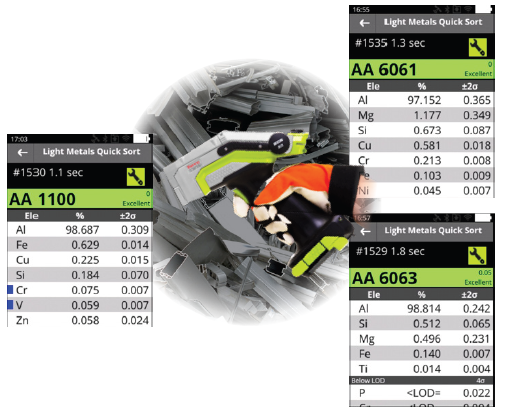
Identification of aluminum alloy grades within seconds using the Thermo Scientific Niton XL5 Plus handheld XRF analyzer. Image Credit: Thermo Fisher Scientific – Handheld Elemental & Radiation Detection
More recently, the Light Metal Quick Sort (LMQS) mode on Thermo Scientific's Niton™ XL5 handheld XRF analyzers has been developed, using different logic from traditional HHXRF equipment.
The analyzer, equipped with a 5W (up to 500 µA) tube and an advanced silicon drift detector (SDD) with a graphene window, begins measuring elements at low voltage, ranging from magnesium to zinc.
This facilitates the rapid identification of most aluminum and magnesium alloy grades in one to three seconds, as well as the identification of additional alloy families. Longer measures can be specified for the few aluminum alloy grades that contain zirconium, tin, lead, or bismuth.
As shown in the image, the LMQS mode is particularly successful for the rapid sorting of aluminum alloy classes with similar concentrations of transition elements but with varying light element contents, in cases like these:
- Casting aluminum alloys containing high silicon levels from wrought alloy grades
- Twin alloys that differ only by magnesium content, such as AA3003 and AA3004 or AA2014 and AA2024 grades
- Alloys differing by only a few tenths of a percent in silicon and magnesium content, AA1100, AA6061, and AA6063
Summary
The LMQS mode, available on Niton XL5 series analyzers, enables recyclers processing large volumes of lightweight metals – such as large scrap yards, aircraft dismantlers, or foundries – to increase productivity by efficiently and precisely determining magnesium and aluminum alloy grades in a few seconds.
Acknowledgments
Produced using materials originally written by Mathieur Bauer from Thermo Fisher.

This information has been sourced, reviewed, and adapted from materials provided by Thermo Fisher Scientific – Handheld Elemental & Radiation Detection.
For more information on this source, please visit Thermo Fisher Scientific – Handheld Elemental & Radiation Detection.