As the UK and Europe race to secure critical minerals, researchers argue that Digital Rock Physics could provide the missing measurement and modeling infrastructure needed to turn complex resources, waste streams, and recycling targets into viable low-impact supply chains.

Paper: Beyond Critical Minerals Targets: Digital Rock Physics as Infrastructure for Secure and Circular Supply Chains. Image Credit: AI-generated image / OpenAI
In a recent research article posted as an arXiv preprint, researchers presented Digital Rock Physics as an enabling infrastructure to help translate critical minerals strategies into practical, efficient, and environmentally responsible critical-minerals supply-chain solutions for the UK and Europe.
Critical Minerals Implementation Context
The growing global demand for critical minerals such as lithium, cobalt, nickel, rare earth elements, and graphite is driven by the rapid energy transition to clean technologies and the expansion of high-tech sectors. This surge in demand, alongside geopolitical market concentration, poses risks to secure, sustainable supply chains.
The EU and UK have set ambitious targets for domestic extraction, processing, recycling, and circularity to address supply security; however, many prospective local resources are geologically complex, historically mined, or economically marginal, presenting significant challenges in resource development.
Conventional methods, such as bulk assays and two-dimensional mineralogy assessments, often fail to provide the detailed structural and process-relevant insights needed to accurately assess complex ores and secondary feedstocks. There is a pressing need for pre-competitive, shared measurement and modeling infrastructure that enables robust characterization of diverse materials across the supply chain.
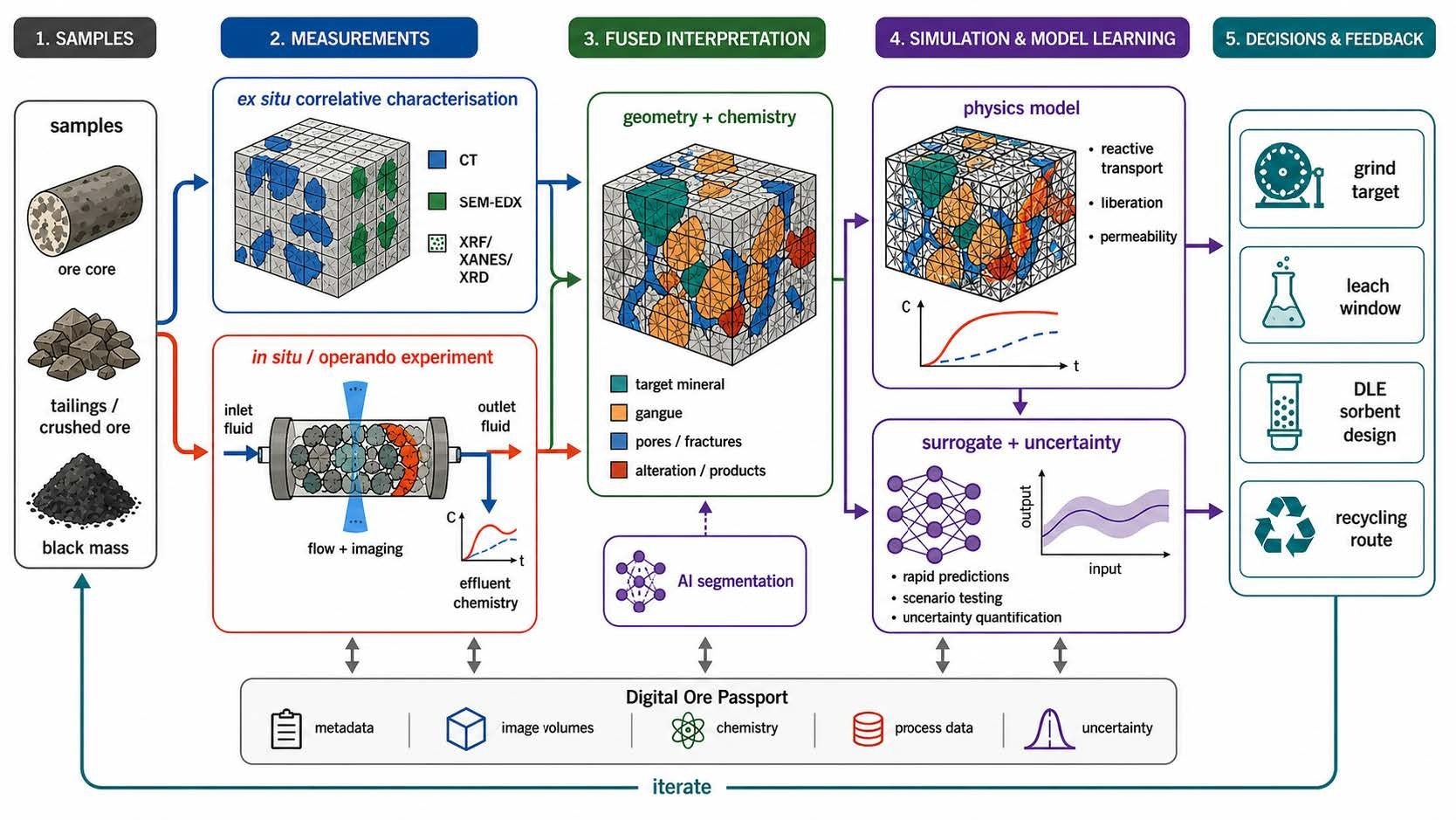
Integrated Digital Rock Physics workflow for critical-mineral systems. Static correlative imaging resolves registered geometry and mineral chemistry, while in situ experiments track reactive flow, structural change, and effluent chemistry under processrelevant conditions. AI-assisted segmentation supports image interpretation, physicsbased models translate those data into transport, liberation, and reaction predictions, and surrogate models with uncertainty estimates accelerate decision support for comminution, leaching, Direct Lithium Extraction, recycling, and tailings valorisation.
Digital Rock Physics Framework
Digital Rock Physics (DRP) entails a multi-modal and multiscale methodology centered on advanced 3D imaging techniques such as X-ray micro-computed tomography (μCT), nano-CT, focused ion beam-scanning electron microscopy (FIB-SEM), and synchrotron-based tomography.
Many X-ray CT-based approaches can capture three-dimensional pore and mineral architecture non-destructively, while destructive techniques such as FIB-SEM provide complementary high-resolution structural information. Together, these tools enable quantification of particle liberation, mineral associations, and pore-network connectivity, which are essential for predicting processing behaviors such as comminution, leaching, and battery recycling.
Complementary correlative chemical mapping techniques, including X-ray fluorescence (XRF), X-ray absorption near-edge structure (XANES), X-ray diffraction computed tomography (XRD-CT), and laser-induced breakdown spectroscopy (LIBS), are integrated to provide spatially resolved mineral chemistry.
Pore-scale numerical simulations of reactive transport and fluid flow, including tools such as GeoChemFoam, leverage these 3D datasets to model how leachants penetrate ore particles, how permeability evolves with dissolution or precipitation, and how mineral liberation develops dynamically during processing. These models support the predictive evaluation of extraction routes such as heap leaching and Direct Lithium Extraction (DLE).
The workflow extends to engineered porous materials, such as sorbents and membranes used in ion-selective mineral separations, where nano-CT and NMR characterize pore architecture, accessibility, and degradation under cycling conditions.
DRP operates in tandem with conventional SEM-based automated mineralogy platforms, such as QEMSCAN, which offer rapid 2D chemical mapping and identification but lack 3D structural context. The integration enables throughput from high-resolution texture and chemistry characterization to physical modeling of process responses.
Across the UK and Europe, DRP resources are distributed across national and transnational facilities, including synchrotron beamlines, such as the UK's Diamond Light Source, ESRF, and PSI, lab-based XCT centers, including the NXCT network and the Manchester Henry Moseley X-ray Imaging Facility, the EXCITE network, and specialized chemistry mapping infrastructures. However, coordination, data standards, and integrated translation into mineral-processing workflows remain underdeveloped.
DRP Applications and Policy Insights
DRP advances the materials understanding of critical minerals at all stages of the value chain, from exploration and characterization through processing, recycling, and tailings valorization.
In exploration, 3D imaging provides detailed ore textures prior to datasets, improving prospectivity mapping using AI and enabling more accurate drill-target ranking and resource estimation. By quantifying mineral liberation potentials in three dimensions, DRP supports advanced characterization that informs comminution strategies and flowsheet design.
In processing, pore-scale imaging and simulation enable detailed leach flow-path mapping, permeability evolution tracking, and breakage pathway modeling to optimize heap leaching and reagent targeting. Even modest improvements in orebody discrimination, liberation prediction, leach efficiency, recycling yields, or by-product identification could have strategic value, given the geological heterogeneity and limited grades of many European deposits.
For sorbents, metal-organic frameworks, and ion-selective membranes used in emerging DLE technologies, DRP elucidates pore architecture, tortuosity, accessibility, pore blockage, and deterioration under operational conditions, guiding materials design that balances selectivity, permeability, and durability.
In recycling and tailings reuse, multiscale DRP characterizes complex, heterogeneous secondary feedstocks such as battery black mass and mine waste, supporting routing decisions to optimal recovery pathways and sensor calibration for sorting technologies.
This texture-aware approach shifts recycling from bulk-chemistry assessment to process optimization sensitive to liberated mineral phases and association patterns.
Strategic Infrastructure and Roadmap
As critical minerals policy shifts from target-setting toward actionable implementation, robust materials characterization remains fundamental. Digital Rock Physics offers a potentially transformative approach by integrating multiscale 3D imaging, correlative chemistry, AI-driven analysis, and pore-scale numerical modeling.
The study advocates treating DRP as shared, pre-competitive implementation infrastructure encompassing coordinated facilities, common data standards, including a “Digital Ore Passport,” federated digital ore databases, and integrated geo-reactive endstations combining structure, chemistry, and in situ fluid analysis. The proposed roadmap links near-term demonstrators to a Digital Ore Passport by 2030, a federated Digital Ore Database by 2032, and integrated geo-reactive endstations by 2035.
However, the authors also emphasize that DRP is not yet a fully validated industrial decision platform for critical minerals. Published head-to-head benchmarks comparing DRP-informed decisions with conventional ore characterization workflows remain limited, and quantitative projections still rely partly on physical reasoning and analogy with oil and gas applications rather than independently validated industry benchmarks.
Important technical and institutional barriers also remain. Upscaling from microscopic image volumes to mine-scale predictions is unresolved, and near-term DRP is most likely to inform sample-, particle-, or core-scale decisions unless integrated with core logging, geophysics, and geostatistical frameworks. Industrial adoption will also depend on beamtime availability, facility access, IP arrangements, commercial data-sharing rules, sample transport, and cost models suitable for junior miners, recyclers, and SMEs.
Ultimately, integrating DRP into critical minerals supply chains represents a pathway to practical, environmentally responsible resource development in complex geological and operational settings, helping the UK and Europe evaluate routes toward ambitious supply and circularity targets in a rapidly evolving materials landscape.
Download your PDF copy by clicking here.
Source:
- Menke H.P., Scanziani A., Rücker M. (2026). Beyond Critical Minerals Targets: Digital Rock Physics as Infrastructure for Secure and Circular Supply Chains. arXiv. Accessed June 4, 2026. https://arxiv.org/html/2606.05798v1