As global data demand accelerates, new climate modeling shows that hotter, more humid air is eroding one of the industry’s most water-efficient cooling strategies.
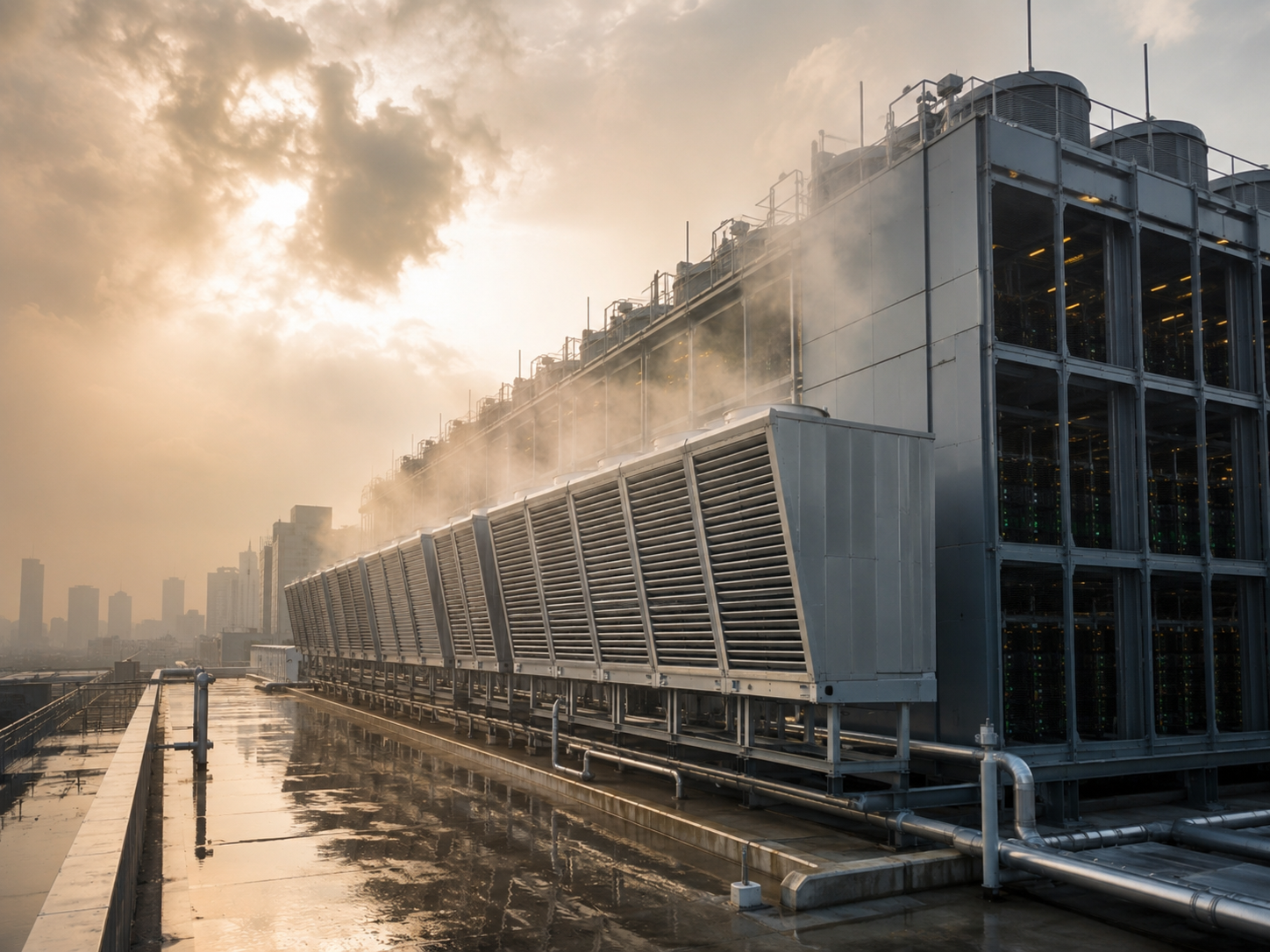
Paper: Limitations to air free cooling in data centers under rising heat and humidity. Credit: AI-generated image / OpenAI
In a recent study published in the journal Scientific Reports, researchers examined how rising global temperatures and atmospheric humidity are reducing the geographic viability of direct air-side free cooling. Using hourly multi-decadal climate reanalysis data and predictive modeling, they mapped environmental conditions that influence infrastructure reliability.
Humid heat stress has intensified over the past 45 years, significantly reducing the operational window for direct fresh air cooling across major data center regions. These changes are reshaping the environmental conditions under which data centers can rely on direct air-free cooling.
Transitioning Thermal Management Strategies
Digital infrastructure relies on continuous thermal management to maintain equipment. Traditionally, this has been achieved through energy-intensive refrigeration systems. To reduce electricity consumption and environmental impact, the industry has increasingly adopted economization strategies that leverage natural ambient conditions for cooling.
Among these technologies, direct air-side economization, or air free cooling, is efficient because outdoor air is supplied directly to the equipment space. This eliminates the need for heat exchangers and does not require direct water consumption, making it attractive in regions facing severe water scarcity. However, its effectiveness depends on local atmospheric conditions, as the incoming outdoor air must remain within acceptable limits.
Framework for Climate Viability Assessment
To evaluate the long-term viability of direct air-side free cooling, researchers combined historical observations with climate simulations. Historical conditions from 1940 to 2025 were analyzed using the ERA5 (European Centre for Medium-Range Weather Forecasts Reanalysis 5th Generation) dataset. Future conditions through 2050 were simulated using 3-hourly output from the Geophysical Fluid Dynamics Laboratory CM4-CM192 high-resolution model configuration under a high-emissions forcing scenario.
The analysis focused on annual “out-of-spec hours,” defined as periods when the inlet temperature exceeded 27°C and moisture was elevated, as indicated by a dew point above 15°C or a relative humidity above 70%. A 1.5°C increase in temperature between outdoor air and server rack inlets was incorporated into the calculations. To assess infrastructure exposure, the environmental data were mapped to 9,447 data centers worldwide. The authors assigned 2025 facility locations to four distinct exceedance tiers based on annual out-of-spec hours to evaluate seasonal stress.
Out-of-Spec Conditions and Regional Variability
The outcomes showed a substantial multi-decadal expansion of conditions that restrict air-free cooling. Over the past 45 years, the strongest increases reached up to 2 hours per day per decade in tropical regions, while the eastern United States experienced summer increases of about 1.5 hours per day per decade.
In addition to rising annual totals, extreme events became longer, with some summer episodes extending across entire 24-hour periods. Along the Black Sea coast, worst-day exceedances increased at a rate of approximately 5.85 hours per day per decade.
From 1980 to 2024, the number of Tier 0 facilities, defined as sites with minimal humid heat constraints, declined by 188 locations per decade. In contrast, Tier 3 facilities, where ambient limits are exceeded for more than half the year, increased by 9.1% per decade.
Current exceedance rates vary across major markets, reaching about 10% of the year in Northern Virginia, 20% in Dallas-Fort Worth, 40% in the Pearl River Delta, and more than 85% in Singapore. Projections indicate that out-of-spec periods will increase across most regions, with Singapore expected to exceed recommended limits throughout the entire year.
Cooling Solutions for Humid Environments
As atmospheric conditions increasingly constrain air economization, the industry is adopting liquid-based cooling technologies that reduce direct exposure of computing hardware to ambient air. Elevated humidity accelerates corrosion risk on printed circuit boards, while moisture combined with airborne pollutants can lead to premature hardware failures.
To address these challenges, alternative cooling architectures physically isolate critical equipment from the environment. Two-phase immersion systems use dielectric fluids that evaporate and condense, providing thermal management while limiting oxidation and moisture-related degradation. Direct-to-chip cooling systems circulate liquid through microchannels positioned at high-power processors, enabling efficient heat removal.
Some emerging two-phase direct-to-chip systems can operate at elevated coolant temperatures of 50°C to 70°C, reducing reliance on conventional chillers while maintaining thermal performance. By isolating hardware from external humidity fluctuations, liquid cooling technologies provide an alternative for sustaining data center operations under increasingly restrictive conditions.
Conclusion and Future Directions for the Data Center
In summary, climate-driven changes are progressively reducing the viability of direct air cooling in many regions. These trends highlight the need for multi-layered optimization strategies that combine climate-aware planning with alternative cooling technologies and hardware adaptations. The study did not model facility-level energy use, cooling costs, or hardware failure probabilities; instead, it provides climate-based indicators of operational stress and adaptive cooling needs. The findings also demonstrate that historical meteorological conditions may no longer provide a reliable basis for long-term infrastructure planning.
With the authors estimating that on the order of 20,000 additional data centers may be required by mid-century, depending on future demand and site-size assumptions, understanding climate constraints becomes increasingly important. Integrating regional climate projections, predictive modeling, and advanced engineering solutions can help maintain operational reliability and resource efficiency under changing conditions.
Download your PDF copy by clicking here.
Disclaimer: The views expressed here are those of the author expressed in their private capacity and do not necessarily represent the views of AZoM.com Limited T/A AZoNetwork the owner and operator of this website. This disclaimer forms part of the Terms and conditions of use of this website.
Source:
- Karamperidou, C., Casselman, J. W., Cleveland, S. B., et al. (2026). Limitations to air free cooling in data centers under rising heat and humidity. Scientific Reports. DOI: 10.1038/s41598-026-56926-3, https://www.nature.com/articles/s41598-026-56926-3